10 October 2026·14 min read·Filed under Income Tax·Income Tax Notice / Section 143(2) / Section 148 / Reassessment / Scrutiny
Income-tax Notices: Inquiry, Scrutiny and Reassessment under Both Acts
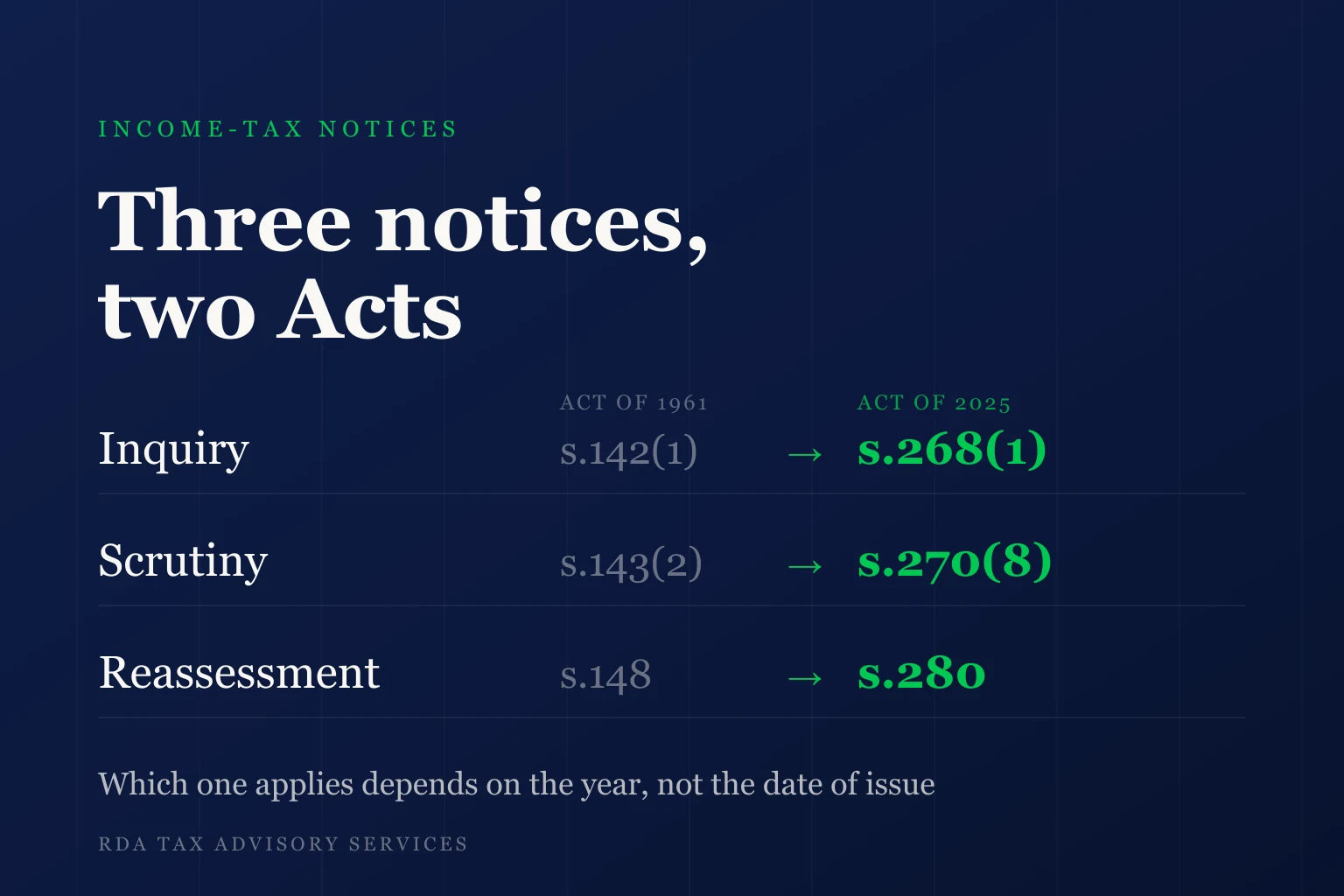
An inquiry notice, a scrutiny notice and a reassessment notice are three different things with three different risks — and from 1 April 2026 three different section numbers. Which Act applies turns on the year the notice is about, not the date it was issued. The limits, the safeguards and the reassessment case law, set out together.
CA Rahul Dang
Founder & Practice Lead
Three income-tax notices account for most of the alarm that arrives in a taxpayer’s inbox: an inquiry notice asking for accounts, a scrutiny notice saying your return is being examined, and a reassessment notice saying income may have escaped assessment. They are not the same thing, they do not carry the same risk, and from 1 April 2026 they do not even carry the same section numbers.
This guide covers all three, under both Acts, and tells you which one applies to the notice in front of you.
First: which Act governs your notice?
This is not a technicality. Section 536(2)(c) of the Income-tax Act, 2025 provides that the repealed Income-tax Act, 1961 continues to apply to proceedings initiated on or after 1 April 2026 “(including notices, assessment, reassessment, recomputation, rectification, penalty, reference, revision and appeals) in respect of any tax year beginning before the 1st April, 2026”.
Notices are named expressly. So the test is the year the notice is about, not the date it was issued:
A notice about FY 2025-26 or earlier — even one issued today — runs on the 1961 Act: sections 142(1), 143(2), 148, 148A, 149.
A notice about a tax year from 1 April 2026 runs on the 2025 Act: sections 268, 270, 279, 280, 281, 282.
Check the year on the notice before anything else. Most notices arriving now are still old-Act notices.
What it is
Income-tax Act, 1961
Income-tax Act, 2025
Inquiry before assessment
s.142(1)
s.268(1)
Processing / intimation
s.143(1)
s.270(1)–(2)
Scrutiny notice
s.143(2)
s.270(8)
Assessment order
s.143(3)
s.270(10)
Best judgment assessment
s.144
s.271
Income escaping assessment
s.147
s.279
Reassessment notice
s.148
s.280
Show-cause before that notice
s.148A
s.281
Time limits for the above
s.149
s.282
1. The inquiry notice — s.142(1) / s.268(1)
This is the Assessing Officer gathering material. Under section 268(1) of the 2025 Act (and s.142(1) before it) the officer may serve a notice requiring you to:
file a return, where you have not filed one within the time allowed and the year has run out;
produce accounts or documents the officer requires; or
furnish information in writing on specified points — expressly including “a statement of all assets and liabilities of the assessee, whether included in the accounts or not”.
Two limits worth knowing, because officers do not always volunteer them. Section 268(2) provides that the previous approval of the Joint Commissioner must be obtained before you can be required to furnish a statement of assets and liabilities not included in the accounts; and that the officer “shall not require the production of any accounts relating to a period more than three years prior to the relevant tax year”.
An inquiry notice is not an accusation. It is, however, a notice whose terms you must comply with — see the consequence below.
2. The scrutiny notice — s.143(2) / s.270(8)
This is the one people mean when they say “my return has been picked up”. Under section 270(8), where a return has been furnished, the officer may serve a notice if they consider it necessary to ensure that you:
have not understated the income;
have not computed excessive loss; or
have not under-paid the tax in any manner.
The notice requires you either to attend the officer’s office or to produce evidence in support of your return.
There is a hard outer limit, and it is short. Section 270(9): “No notice under sub-section (8) shall be served on the assessee after the expiry of three months from the end of the financial year in which the return is furnished.” The 1961 Act said the same thing in the proviso to s.143(2).
So a return filed in, say, July 2026 cannot attract a scrutiny notice served after 30 June 2027. If a scrutiny notice reaches you outside that window, the date it was served is the first thing to check — not the contents.
After hearing your evidence, section 270(10) requires the officer to make the assessment “by an order in writing” and determine the sum payable or refundable.
3. The reassessment notice — s.148 / s.280
This is the serious one, and it is the only one of the three that comes with a statutory safeguard you can hold the department to.
Under section 279 (s.147 before it), where income chargeable to tax “has escaped assessment” for a tax year, the officer may assess or reassess it. But before issuing the notice, section 281 (s.148A before it) requires a sequence:
A show-cause notice — the officer must “provide an opportunity of being heard” by serving a notice asking why a notice under section 280 should not be issued.
With the information attached. Section 281(2) requires the show-cause notice to be “accompanied by the information which suggests that income chargeable to tax has escaped assessment”. You are entitled to see what the case against you is.
Your reply. You may furnish a reply within the period specified.
A reasoned order. Section 281(3) requires the officer to pass an order, with the prior approval of the specified authority, taking your reply into account, determining whether it is a fit case to issue the notice.
Only then does the section 280 notice issue — and it must be accompanied by a copy of the section 281(3) order. Two further conditions sit on it: section 280(4), that “no notice under this section shall be issued unless there is information with the Assessing Officer which suggests that the income chargeable to tax has escaped assessment”; and section 280(5), requiring prior approval of the specified authority in the cases it lists.
How long you get to respond. Section 280(1)(c) requires the period specified in the notice to be “not less than thirty days from the date of such notice but… not exceed three months from the end of the month in which such notice is issued”. The 1961 Act carried the same floor and ceiling in s.148(1).
One trap in section 280(3): a return filed after the period specified in the notice “shall not be deemed to be a return under section 263”. Late compliance is not the same as compliance.
The time limits — and why “one year longer” is the wrong reading
Put the two sections side by side and the 2025 Act looks more generous to the department: four years and three months, where the old section said three years and three months. That reading is wrong, and the mistake is easy to make.
The two sections measure from different starting points.
Section 149 runs from the end of the assessment year — which is itself the year after the year the income belongs to.
Section 282 runs from the end of the tax year. Section 3(1) of the 2025 Act defines a tax year as “the twelve months period of the financial year commencing on the 1st April” — the year the income actually belongs to, which is a year earlier than the corresponding assessment year.
So the period was lengthened by a year because the starting line moved back by a year. Work it through on the same income:
Income of FY 2022-23
Reference point
Period
Outer date
s.149, Act of 1961
AY 2023-24 ends 31 Mar 2024
3 years 3 months
30 June 2027
s.282, Act of 2025
Tax year 2022-23 ends 31 Mar 2023
4 years 3 months
30 June 2027
The same outer date. The extended window works out the same way too — 30 June 2029 under either Act — and so does the show-cause limit, 31 March 2027 either way. The headline difference between “three years three months” and “four years three months” is an artefact of the changed reference point, not an extension of the department’s reach.
s.149 — from end of assessment year
s.282 — from end of tax year
Reassessment notice, ordinary case
3 years 3 months
4 years 3 months
Extended, escaped income ₹50 lakh or more
up to 5 years 3 months
up to 6 years 3 months
Show-cause notice, ordinary case
3 years
4 years
Show-cause, extended
up to 5 years
up to 6 years
The extended window is not available on suspicion. Section 282(1)(b) requires the officer to have “books of account or other documents or evidence related to any asset or expenditure or transaction or entry” showing escaped income of fifty lakh rupees or more — section 149(1)(b) was in the same terms.
Section 282(3) adds a floor: no notice under section 280 or 281 may be issued within one year from the end of any tax year.
And the point that actually decides your case: which Act applies to your year. Because section 536(2)(c) keeps the 1961 Act alive for tax years beginning before 1 April 2026, a notice about one of those years is governed by section 149 — three years and three months from the end of that year’s assessment year. The 2025 Act’s longer-looking period does not reach back and extend the window for an earlier year. Compute the limit under the Act that governs the year, using that Act’s own reference point.
What happens if you do not respond
Section 271 of the 2025 Act (s.144 before it) is the answer, and it names the notices expressly. Best judgment assessment follows where a person:
fails to furnish the return required under section 263(1), (4), (5) or (6);
fails to comply with all the terms of a notice under section 268(1), or a direction under section 268(5); or
having made a return, fails to comply with all the terms of a notice under section 270(8).
The officer then assesses “to the best of his judgment” on the material gathered. Note the phrase “all the terms”: partial compliance is non-compliance. Section 271(2) does require a show-cause before a best-judgment assessment — but section 271(3) removes even that where a section 268(1) notice was issued first.
We have not set out the penalty consequences here. Those sit in provisions we have not read for this guide, and we would rather say nothing than guess at them.
What the courts have said about reassessment
Two Supreme Court decisions dominate the reassessment landscape for the old-Act years, and both arose from the same transition.
Union of India v. Ashish Agarwal — Supreme Court, 4 May 2022, M.R. Shah and B.V. Nagarathna JJ, Civil Appeal Nos. 3005 to 3017 and 3019-3020 of 2022, reported at [2022] 138 taxmann.com 64 (SC). Assessing Officers had issued reassessment notices on or after 1 April 2021 under the unamended section 148, relying on notifications that purported to extend the old provisions. High Courts set those notices aside, holding that notices issued on or after 1 April 2021 are governed by the substituted sections 147 to 151 introduced by the Finance Act, 2021. The Supreme Court agreed that the High Court view was correct, but — treating the revenue’s error as bona fide and exercising its power under Article 142 — did not simply set the notices aside.
Union of India v. Rajeev Bansal — Supreme Court, 3 October 2024, Chandrachud CJI, Pardiwala and Misra JJ, Civil Appeal Nos. 8629 and 8631 of 2024 and others, reported at [2024] 167 taxmann.com 70 (SC). The follow-on question was limitation. The Court held that TOLA overrides the Income-tax Act to the extent of relaxing the time limit for a reassessment notice falling due between 20 March 2020 and 31 March 2021, until 30 June 2021; and that the entire period allowed to the assessee to respond to the show-cause notice is excluded when computing limitation.
The practical point for anyone holding an old-Act reassessment notice: limitation is a live argument, and it is fact-specific. The dates on the notice, the date information was supplied to you, and the time you were given to reply all feed into it.
A note on sourcing. We hold these judgments as publisher reproductions rather than official court copies. The citations above are accurate and the holdings are stated as the reports record them, but anyone relying on them in a proceeding should work from the court’s own text.
What to do when a notice arrives
Identify the year and the section. That decides which Act applies and which limits run.
Check the date of service against the limit — three months from the end of the financial year of filing for a scrutiny notice; the section 149 or 282 windows for reassessment.
For a reassessment notice, ask for the order and the information. Section 281(2) entitles you to the information; section 280(1)(a) requires the section 281(3) order to accompany the notice. If either is missing, that is a point.
Diarise the response window. Not less than thirty days, and not beyond three months from the end of the month of issue.
Comply with all the terms, not some of them — section 271 turns partial compliance into best-judgment exposure.
Do not file late and assume it counts. Section 280(3) says a return filed after the specified period is not deemed a return under section 263.
And one distinction worth making because the forms look similar: an income-tax notice is not a GST notice. A GST scrutiny notice in Form ASMT-10 runs on an entirely different statute and timetable — see our guide to replying to an ASMT-10.
How RDA helps
At RDA Tax Advisory Services, Baner, Pune, we handle income-tax notices end to end: establishing which Act and which limitation period governs, testing whether the notice was validly issued and served, drafting the reply to a section 281 or 148A show-cause before a reassessment notice issues, and representing through scrutiny assessment.
Received a notice and not sure how serious it is?Talk to RDA before the response window closes — Office No. 102, Snehraj Apartment, Baner, Pune 411045.
Union of India v. Ashish Agarwal, Supreme Court, 4 May 2022, [2022] 138 taxmann.com 64 (SC).
Union of India v. Rajeev Bansal, Supreme Court, 3 October 2024, [2024] 167 taxmann.com 70 (SC).
This guide explains the statutory machinery for three notices and the limits that attach to them. It is not advice on any particular notice. Whether a notice is valid, and what reply it needs, depends on its contents, the year, the dates and the material behind it. Take advice on the notice you actually hold.
Common questions
Frequently asked.
Which Act applies to my income-tax notice?
Section 536(2)(c) of the Income-tax Act, 2025 continues the repealed 1961 Act for proceedings — notices are named expressly — in respect of any tax year beginning before 1 April 2026. So the test is the year the notice is about, not the date it was issued. A notice about FY 2025-26 or earlier runs on the 1961 Act even if it arrives today.
How long does the department have to issue a scrutiny notice?
Section 270(9) of the 2025 Act provides that no scrutiny notice under section 270(8) may be served after the expiry of three months from the end of the financial year in which the return is furnished. The proviso to section 143(2) of the 1961 Act said the same. If a scrutiny notice arrives outside that window, the date of service is the first thing to check.
What is the time limit for a reassessment notice?
Under section 282 of the 2025 Act, no notice under section 280 may be issued once four years and three months have elapsed from the end of the relevant tax year, extending to six years and three months only where the Assessing Officer holds books, documents or evidence showing escaped income of fifty lakh rupees or more. Under section 149 of the 1961 Act the equivalent periods were three years three months and five years three months — so the window is one year longer under the new Act.
Can the department issue a reassessment notice without warning?
No. Section 281 of the 2025 Act, like section 148A before it, requires a show-cause notice first, accompanied by the information suggesting income has escaped assessment, an opportunity to reply, and then a reasoned order passed with the prior approval of the specified authority determining whether it is a fit case. The section 280 notice must be accompanied by a copy of that order.
How long do I get to respond to a reassessment notice?
Section 280(1)(c) requires the period specified in the notice to be not less than thirty days from the date of the notice, and not more than three months from the end of the month in which it is issued. Section 280(3) adds that a return filed after that period is not deemed to be a return under section 263.
What happens if I ignore a notice?
Section 271 of the 2025 Act (section 144 before it) allows a best judgment assessment where a person fails to comply with all the terms of a notice under section 268(1) or, having filed a return, under section 270(8). Note the words all the terms — partial compliance is non-compliance. The officer then assesses to the best of his judgment on the material gathered.
Is an income-tax notice the same as a GST ASMT-10?
No. A GST scrutiny notice in Form ASMT-10 is issued under the GST legislation and runs on an entirely different timetable and procedure. The two are frequently confused because both are described as scrutiny notices.