13 October 2026·12 min read·Filed under Income Tax·Prosecution / Compounding / Section 276C / Section 276CC / Income Tax Notice / Case Law
Income-Tax Prosecution: When It Can Be Launched, and How Compounding Works
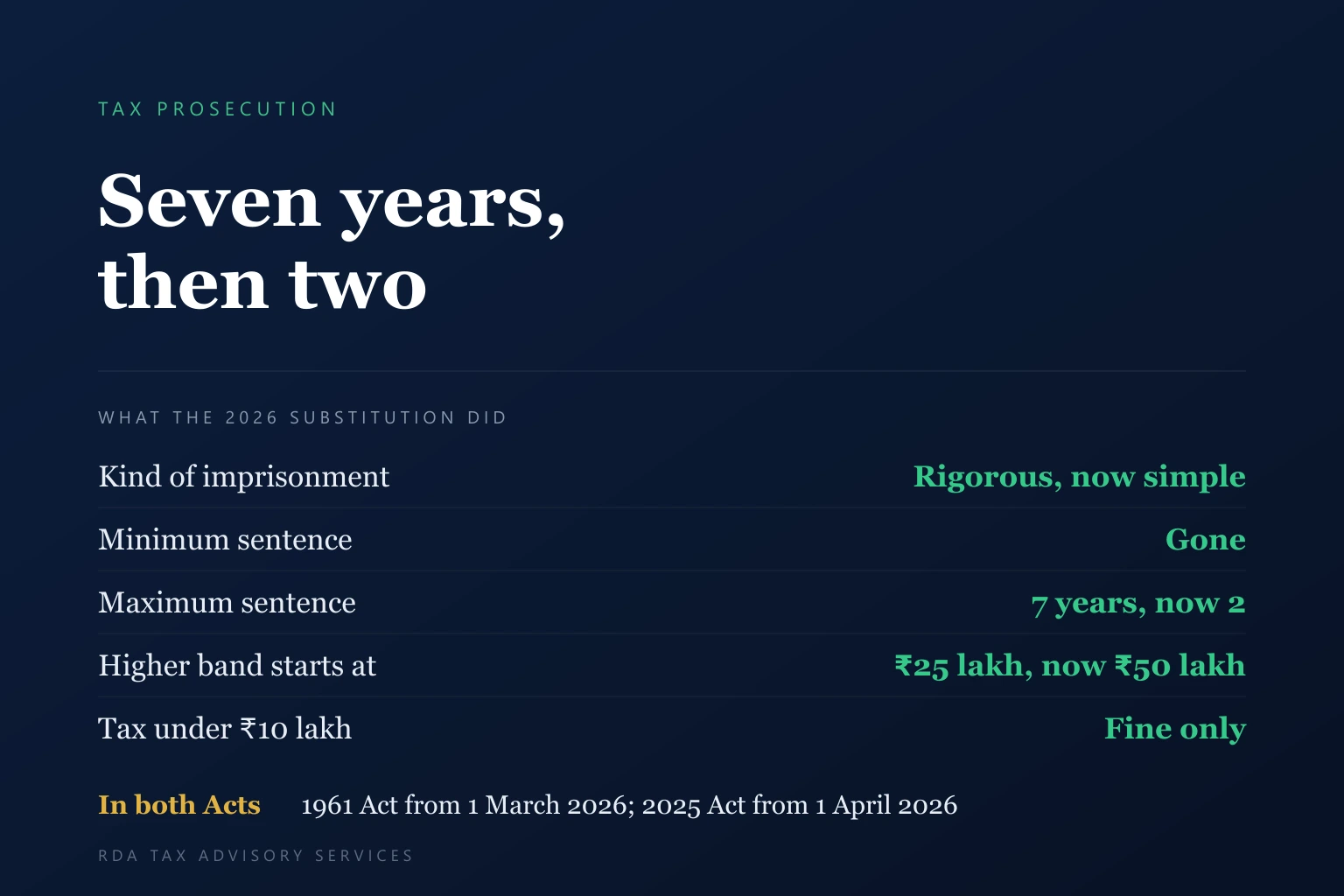
In 2026 both Acts rewrote the offence sections — rigorous imprisonment became simple, the mandatory minimum sentence went, seven years became two, and below ₹10 lakh of tax the punishment is a fine. What the Supreme Court has actually held about wilfulness, pending appeals and cancelled penalties, and how compounding works now that every offence is compoundable.
CA Rahul Dang
Founder & Practice Lead
Most tax disputes are about money. A small number are about liberty, and those are the ones nobody expects. A prosecution under the income-tax law is a criminal trial in a criminal court, with a sanction, a complaint, charges and a verdict — and it can run alongside the tax appeal rather than waiting for it.
In 2026 this part of the law changed substantially, and in the taxpayer’s favour. If your understanding of tax prosecution is that it carries rigorous imprisonment with a mandatory minimum sentence, that understanding is now out of date.
What changed in 2026, and it is the whole headline
The offence provisions were rewritten in both Acts, by two different vehicles, weeks apart:
In the 1961 Act, sections 276C, 276CC and 277 were substituted by Act No. 4 of 2026, with effect from 1 March 2026.
In the 2025 Act, the corresponding sections 478, 479, 480, 481 and 482 were substituted by the Finance Act, 2026, with effect from 1 April 2026.
The rewrite is the same in both, and it is a significant softening:
Before the 2026 substitution
Now
Kind of imprisonment
Rigorous
Simple
Minimum sentence
Mandatory — “shall not be less than” six months, or three months in the lower band
None. The term is expressed as “up to”
Maximum sentence
Seven years in the higher band
Two years
Is imprisonment compulsory?
Yes — imprisonment and fine
No — imprisonment, or fine, or both
Higher band starts at
Tax sought to be evaded over ₹25 lakh
Over ₹50 lakh
Middle band
Did not exist
Over ₹10 lakh up to ₹50 lakh — up to six months, or fine, or both
Everything below that
Still carried a minimum prison term
Fine only
Sections 276C, 276CC and 277 of the 1961 Act and sections 478 to 482 of the 2025 Act, before and after the 2026 substitutions. The pre-substitution wording is preserved in the amendment footnotes to the Department’s consolidated texts.
Two practical consequences follow. First, for a default below ₹10 lakh of tax, the statute no longer contemplates prison at all — the punishment is a fine. Second, even in the highest band the court now has a discretion it did not have before: it may impose a fine instead of imprisonment, and if it does imprison, it is not bound by any floor.
None of this makes a prosecution pleasant, and none of it is a reason to be casual. But a notice that threatens seven years of rigorous imprisonment is describing a law that no longer exists.
Which Act applies to your year
Section 536(2)(c) of the Income-tax Act, 2025 continues the repealed 1961 Act for proceedings in respect of any tax year beginning before 1 April 2026. So the question is not what today’s date is — it is which year the alleged default belongs to.
FY 2025-26 and earlier — sections 276C, 276CC, 277, 278E and 279 of the 1961 Act, in their substituted form.
Tax year 2026-27 onwards — sections 478, 479, 482, 490 and 491 of the 2025 Act.
The two offences that actually get charged
Wilful attempt to evade tax — section 276C of the 1961 Act, section 478 of the 2025 Act. The section is not confined to evading tax already assessed: sub-section (1) also reaches a person who under-reports his income, and sub-section (2) reaches a wilful attempt to evade payment. Both Acts then define “wilful attempt” to include possessing books containing a false entry, making or omitting a false entry, and causing any other circumstance to exist which has the effect of enabling evasion.
Failure to furnish the return — section 276CC of the 1961 Act, section 479 of the 2025 Act. This is the one that catches people who are not evading anything in particular; they simply never filed. The offence is committed by failing to furnish the return in due time, whether the obligation arose on the ordinary due date or under a notice.
False statement in verification — section 277 of the 1961 Act, section 482 of the 2025 Act. Every return carries a verification. A statement in it which the signatory knows or believes to be false, or does not believe to be true, is a separate offence.
The escape in the return-failure provision, and its hard edge
The return-failure provision carries its own relief, and it is narrower than it first appears.
Under the 1961 Act, the proviso to section 276CC says a person shall not be proceeded against for failing to furnish the return under section 139(1) if the return is furnished before the end of the assessment year, or is furnished under section 139(8A) — the updated return — within the time that sub-section allows; or if the tax payable on regular assessment, after advance tax, self-assessment tax and tax deducted or collected at source, does not exceed ₹10,000.
Under the 2025 Act, section 479(2) is built the same way: no proceedings for failure to furnish the return under section 263(1) where a return is furnished under section 263(4) or 263(6), or where the tax payable, similarly reduced, does not exceed ₹10,000.
Now the hard edge. In Sasi Enterprises v. ACIT [2014] 361 ITR 163, the Supreme Court held that the main part of section 276CC covered the return due under section 139(1) and returns called for by notice under section 142(1)(i) or section 148, but that the proviso took in only section 139(1) — the notice provisions being, in the Court’s word, “conspicuously absent”. The benefit was therefore available only to voluntary filing, and would not apply “after detection of the failure to file the return and after a notice under Section 142(1)(i) or 148 of the Act is issued” (paragraph 24).
The practical reading is blunt: filing late of your own accord may protect you; filing because the department came looking does not. The Court added that the proviso does not say the offence was never committed — only that such a person shall not be proceeded against (paragraph 26).
On the face of the provisions the same asymmetry appears in the 2025 Act, because section 479(1) reaches returns required under section 263(1) or by notice, while section 479(2) excuses only the section 263(1) limb. Whether Sasi Enterprises itself carries across to the new section is a question for professional advice on your facts; we do not assert here that it does.
The presumption that makes these cases difficult
This is the single most important thing to understand, and it is the opposite of what most people assume about criminal law.
Section 278E of the 1961 Act, and section 490 of the 2025 Act, provide that in any prosecution requiring a culpable mental state, the court shall presume the existence of that mental state, and it is a defence for the accused to prove that he had no such mental state. “Culpable mental state” includes intention, motive, knowledge of a fact, and belief in or reason to believe a fact. And a fact is treated as proved only when the court believes it to exist beyond reasonable doubt, not on a preponderance of probability.
In Sasi Enterprises the Supreme Court applied this directly: the court “has to presume the existence of mens rea and it is for the accused to prove the contrary and that too beyond reasonable doubt”, so the appellants had to prove the circumstances that prevented them from filing (paragraph 30).
So wilfulness is not something the department has to build from scratch. It is assumed, and the burden of displacing it — to the criminal standard — sits on you. That is why contemporaneous evidence of why a return was late matters enormously, and why it is worth preserving at the time rather than reconstructing years later.
What the department still has to prove
The presumption goes to the mental state. It does not relieve the prosecution of proving the offence.
In Prem Dass v. ITO [1999] 236 ITR 683 the assessee was convicted under sections 276C and 277, acquitted by the Sessions Judge, and convicted again by the High Court — which relied on the statutory presumption in section 132(4A) arising from a search. The Supreme Court restored the acquittal. A wilful attempt to evade under section 276C “is a positive act on the part of the accused which is required to be proved”, and for section 277 the necessary mens rea must be established; the Court said it saw “nothing in section 132(4A) which would establish the ingredients of the aforesaid two criminal offences” (paragraph 9).
The Court also held that the High Court had been wrong to reverse an acquittal without examining the Sessions Judge’s reasons or reversing his findings, merely by invoking that presumption (paragraph 4). The ordinary rules about interfering with an acquittal apply to a tax prosecution like any other.
Does a pending appeal stop a prosecution? No
This is the assumption that costs people the most, because it feels so reasonable.
In Sasi Enterprises the Supreme Court found “no basis” in the contention that the pendency of appellate proceedings was a relevant factor against initiating prosecution under section 276CC. The offence is committed on the non-filing of the return and is “totally unrelated to the pendency of assessment proceedings”; had the legislature intended prosecution to wait, it would have said so (paragraph 28).
The same case disposed of another common argument. Partners had stated in their individual returns that the firm’s accounts were not finalised and so no firm return had been filed. The Court held that the firm is independently required to file, and that this did not make the failure non-wilful (paragraph 29).
When the penalty collapses, does the prosecution collapse with it?
Sometimes — and when it does, it is decisive. But the reason matters more than the result.
In K.C. Builders v. ACIT [2004] 265 ITR 562 the Tribunal had set aside concealment penalties under section 271(1)(c), finding that the additions represented a voluntary offer in settlement rather than concealment. The Supreme Court held that once that finding stood, “there is no concealment in the eyes of law and, therefore, the prosecution cannot be proceeded with”; the Assessing Officer had no alternative but to correct his order, and further proceedings would be “illegal and without jurisdiction” (paragraph 26). Letting the trial continue would be “an idle and empty formality”. The Court closed with the principle that a matter adjudicated and settled by the Tribunal “need not be dragged into the criminal courts unless and until the act of the appellants could have been described as culpable” (paragraph 30).
Read that carefully, because it is narrower than the headline. What did the work in K.C. Builders was a finding that there was no concealment — the factual foundation of the criminal charge was removed. A penalty merely reduced, or an addition cut down in quantum, does not do the same work. In Prem Dass too, the Tribunal had found positively that there was no concealment and that the dispute was “purely on difference of opinion as to the estimates”.
There is also a statutory bar, and it is much narrower than it first looks. Section 279(1A) of the 1961 Act — section 491(3) of the 2025 Act — says a person shall not be proceeded against under the evasion or false-verification sections for an assessment year in respect of which the penalty has been reduced or waived by an order under section 273A (section 469 of the 2025 Act).
The weight sits on those last words. Section 273A is not a general description of a penalty going away. It is the Principal Commissioner’s own discretionary power, available only where the taxpayer made a full and true disclosure voluntarily and before the Assessing Officer detected anything, co-operated in the enquiry, and paid or arranged to pay the tax. An order of the Commissioner (Appeals) or the Tribunal deleting a penalty on the merits is not an order under section 273A, and meets none of those conditions.
In Prem Dass the department argued on exactly that basis that the bar could not apply, and the Supreme Court said it did not agree with that “literal interpretation”, the Commissioner (Appeals) having reduced the penalty and the Tribunal having set it aside altogether (paragraph 12). Two things are worth being clear about. That passage begins “We also find sufficient force…” — it is an additional reason why the High Court should not have disturbed an acquittal, not a holding that the prosecution was statutorily barred; the acquittal had already been justified because the ingredients of the offences were not proved. And the Court was speaking to facts in which the penalty had been both reduced on appeal and then cancelled outright.
So if your penalty was deleted on appeal, section 279(1A) is not your strongest argument.K.C. Builders is — a finding that there was no concealment removes the factual foundation of the charge altogether. Section 279(1A) is worth pleading in addition, not instead.
Compounding: paying to end it
Prosecution is not the only road. Both Acts allow an offence to be compounded — section 279(2) of the 1961 Act, section 491(4) of the 2025 Act — either before or after proceedings are instituted, by the Principal Chief Commissioner, Chief Commissioner, Principal Director General or Director General.
CBDT issued revised Compounding Guidelines on 17 October 2024 and then a set of FAQs on them, Circular No. 4/2025 dated 17 March 2025. On the circular’s own account:
Question
CBDT’s answer
What is it?
A mechanism by which the defaulter is “reprieved of major legal consequences by affording him an opportunity to pay certain sum of money to escape prosecution”
Is applying an admission of the offence?
No. Compounding “is not to be construed as an admission of such offence(s) by the applicant”
Which offences can be compounded?
All offences under the Act were made compoundable by the revised guidelines of 17 October 2024
Where is the application filed?
Before the jurisdictional Pr. CCIT / CCIT / Pr. DGIT / DGIT
Is there a time limit?
No. It can be filed at any time after the offence, “regardless of whether the same has come to the notice of the department or prosecution proceedings have been launched”
Must an appeal be withdrawn first?
No, but the applicant must undertake to withdraw appeals or writ petitions, or the related grounds where an appeal has mixed grounds
What if there is already a conviction of two years or more?
Still compoundable, but only with the approval of the Chairman, CBDT
What if prosecution has already been launched?
Still available. Where the application is made more than 12 months after the end of the month in which the complaint was filed, the compounding charge is increased by 50%
As stated in CBDT Circular No. 4/2025 dated 17 March 2025, which answers questions on the Compounding Guidelines dated 17 October 2024. The guidelines themselves are a separate document; the compounding charge rates are set out there and are not reproduced here.
Two things are worth drawing out. The absence of any time limit and the availability of compounding after a complaint has been filed mean the door is rarely shut — but the 50% uplift after twelve months means delay has a price. And because an application is expressly not an admission, applying does not concede the offence.
The guidelines and these FAQs are framed on the 1961 Act. We do not state here how they apply to the 2025 Act regime, because the sources do not say.
Nothing starts without sanction
A prosecution for these offences cannot simply be launched by an assessing officer. Section 279(1) of the 1961 Act and section 491(1) of the 2025 Act require the previous sanction of the Principal Commissioner, Commissioner, Commissioner (Appeals) or Joint Commissioner (Appeals). Higher authorities may issue instructions for instituting proceedings, but the sanction requirement is a real gate, and whether it was validly obtained is a proper question to ask.
These offences are also non-cognizable — section 492 of the 2025 Act says so expressly for the main offence sections — which means no police investigation begins of its own motion.
If a prosecution notice arrives
Check the year first. Which Act applies, and therefore which section, turns on the tax year, not on today’s date.
Check the band. The amount of tax involved now decides whether the provision contemplates imprisonment at all.
Check the sanction. No prosecution for these offences without the previous sanction of the prescribed authority.
Do not assume the appeal protects you. On Sasi Enterprises, pendency is no bar — so the criminal track needs its own answer, now.
Build the wilfulness answer with documents. The mental state is presumed against you and must be displaced beyond reasonable doubt.
Ask what the penalty proceedings found. A finding of no concealment is the most powerful thing available, on K.C. Builders. A mere reduction is not the same thing.
Consider compounding in parallel. There is no time limit, it is available after launch, and it is not an admission — but the charge rises by half after twelve months.
How RDA helps
We deal with the criminal track and the tax track as two problems, because they run on different rules and different clocks. That means establishing which Act and which section govern the year in question; testing the sanction; assembling the contemporaneous record that answers wilfulness rather than asserting it; reading what the penalty order and any appellate finding actually say about concealment; and, where it is the right answer, preparing and filing the compounding application and pressing it before the competent authority.
Sources
Income-tax Act, 1961 — sections 276C, 276CC and 277 as substituted by Act No. 4 of 2026 with effect from 1 March 2026, with the pre-substitution wording in the amendment footnotes; sections 278E and 279(1), (1A) and (2), read from the Income Tax Department’s consolidated text. Official text, section by section
Income-tax Act, 2025, as amended by the Finance Act, 2026 — sections 478, 479, 480, 481 and 482 as substituted with effect from 1 April 2026, and sections 490, 491 and 492. Official text, section by section
K.C. Builders v. Assistant Commissioner of Income-tax, [2004] 265 ITR 562 (SC), 28 January 2004 — paragraphs 25, 26 and 30.
Prem Dass v. Income-tax Officer, [1999] 236 ITR 683 (SC), 9 February 1999 — paragraphs 4, 9 and 12.
Sasi Enterprises v. Assistant Commissioner of Income-tax, [2014] 361 ITR 163 (SC), 30 January 2014 — paragraphs 24, 26, 28, 29 and 30.
CBDT Circular No. 4/2025 [F. No. 285/08/2014-IT(INV.V)/281] dated 17 March 2025 — Frequently Asked Questions on the Guidelines for Compounding of Offences under the Income-tax Act, 1961 dated 17 October 2024.
This guide explains the statutory offences, the presumption as to mental state, what the reported decisions of the Supreme Court held, and the compounding route as CBDT has described it. It is not advice on any particular case, and it is not a substitute for representation in a criminal proceeding. The judgments were read in reproduction rather than from the official reports; the Compounding Guidelines of 17 October 2024 were not read, only CBDT’s FAQs on them, and the compounding charge rates are deliberately not stated. If a prosecution or sanction notice has been issued to you, take advice on your own facts and papers without delay.
Common questions
Frequently asked.
Can I actually go to prison for a tax default?
The statute now makes that far less likely than it was. Sections 276C, 276CC and 277 of the 1961 Act were substituted by Act No. 4 of 2026 with effect from 1 March 2026, and sections 478 to 482 of the 2025 Act by the Finance Act, 2026 with effect from 1 April 2026. Imprisonment is now simple rather than rigorous, there is no minimum sentence, the maximum in the highest band is two years rather than seven, and the court may impose a fine instead of imprisonment. Where the tax involved does not exceed ten lakh rupees, the punishment is a fine only.
Which Act applies to my case?
It turns on the tax year, not on today's date. Section 536(2)(c) of the Income-tax Act, 2025 continues the 1961 Act for proceedings in respect of any tax year beginning before 1 April 2026. So FY 2025-26 and earlier run on sections 276C, 276CC, 277, 278E and 279; tax year 2026-27 onwards runs on sections 478, 479, 482, 490 and 491.
Does my pending appeal stop the prosecution?
No. In Sasi Enterprises v. ACIT the Supreme Court found no basis in the argument that pendency of appellate proceedings was a reason not to initiate prosecution under section 276CC. The offence is committed on the non-filing of the return and is, in the Court's words, totally unrelated to the pendency of assessment proceedings. Had the legislature intended prosecution to wait, it would have said so. The criminal track needs its own answer, and it needs it now.
Does the department have to prove I acted wilfully?
No, and this is the hardest fact about these cases. Section 278E of the 1961 Act and section 490 of the 2025 Act require the court to presume the existence of a culpable mental state; it is a defence for the accused to prove he had no such mental state, and a fact counts as proved only when the court believes it beyond reasonable doubt. In Sasi Enterprises the Supreme Court applied this directly. Contemporaneous evidence of why a return was late is therefore worth far more than an explanation reconstructed years afterwards.
If I file late, am I safe from prosecution?
Only if you filed before the department came looking. The proviso to section 276CC protects a return furnished under section 139(1) before the end of the assessment year, or an updated return under section 139(8A) within time, or where the tax payable does not exceed ten thousand rupees. In Sasi Enterprises the Supreme Court held the proviso takes in only section 139(1), the notice provisions under sections 142(1)(i) and 148 being conspicuously absent, so the benefit is confined to voluntary filing and does not apply after the failure is detected and a notice is issued.
My penalty was cancelled. Does the prosecution end?
It depends on why it was cancelled. In K.C. Builders v. ACIT the Tribunal had found there was no concealment, and the Supreme Court held that once that finding stood there is no concealment in the eyes of law, so the prosecution could not be proceeded with and further proceedings would be illegal and without jurisdiction. What did the work was the finding of no concealment, which removes the factual foundation of the charge. A penalty merely reduced, or an addition cut down in amount, does not do the same thing.
What is compounding, and is it an admission of guilt?
Compounding lets you pay a sum to escape prosecution, and it is available either before or after proceedings are instituted under section 279(2) of the 1961 Act and section 491(4) of the 2025 Act. CBDT Circular No. 4/2025 states expressly that it is not to be construed as an admission of the offence by the applicant. Under the revised guidelines of 17 October 2024 every offence under the Act was made compoundable.
Is it too late to apply for compounding?
Almost certainly not. CBDT Circular No. 4/2025 states there is no time limit: an application can be filed at any time after the offence, regardless of whether it has come to the department's notice or prosecution has already been launched. Even a conviction carrying imprisonment of two years or more can be compounded, with the approval of the Chairman, CBDT. Delay does cost money, though: where the application is made more than twelve months after the end of the month in which the complaint was filed, the compounding charge is increased by fifty per cent.