2 September 2026·14 min read·Filed under NRI & Foreign Income·FAST-DS / Foreign Assets / NRI / Black Money Act / Compliance
FAST-DS 2026: Foreign Asset Disclosure — Eligibility, Form 1, Valuation and the ₹1 Crore / ₹5 Crore Limits
A one-time window runs to 31 December 2026. Row 1 costs 60% and caps at ₹1 crore; Row 2 is a flat ₹1 lakh fee and caps at ₹5 crore. Here is who qualifies, why your foreign bank account's closing balance is the wrong number, and how Form 1 actually works.
CA Rahul Dang
Founder & Practice Lead
A one-time window is open. Between 16 August 2026 and 31 December 2026, an eligible taxpayer can declare a foreign asset or foreign income that never made it into an Indian return — and settle it under the Foreign Assets of Small Taxpayers Disclosure Scheme, 2026 (FAST-DS). The scheme sits in Chapter IV, sections 130 to 144 of the Finance Act, 2026, read with the FAST-DS Rules, 2026 notified by G.S.R. 732(E) on 14 August 2026.
Form 1 is live on the e-filing portal. The last date does not move.
The short version
Two categories, not one. Row 1 of the section 133 table costs 60% and caps at ₹1 crore. Row 2 costs a flat fee of ₹1 lakh and caps at ₹5 crore.
Row 2 is for a reporting failure, not concealed income. It covers an asset bought from money that was already taxed, or bought while you were a non-resident, which you then failed to list in the relevant Schedule of your return.
Valuation date is 31 March 2026. A foreign bank account is valued at the sum of every deposit since the account opened — not its closing balance.
Breaching the cap disqualifies you entirely. There is no partial declaration.
The immunity is granted under the Black Money Act. That is a narrower promise than it first sounds, and the difference matters.
The official material calls this a one-time voluntary disclosure scheme, and we use the same words. It does not clear every tax consequence generally. What it does give is defined by the scheme itself, and set out below.
Who is eligible to declare?
Section 131(1)(a) defines the eligible assessee more precisely than most summaries suggest. You qualify if you are:
resident in India under section 6 of the Income-tax Act, 1961 in the relevant previous year; or
a non-resident or RNOR now, provided you were resident in India either in the previous year to which the foreign income relates, or in the previous year in which the foreign asset was acquired.
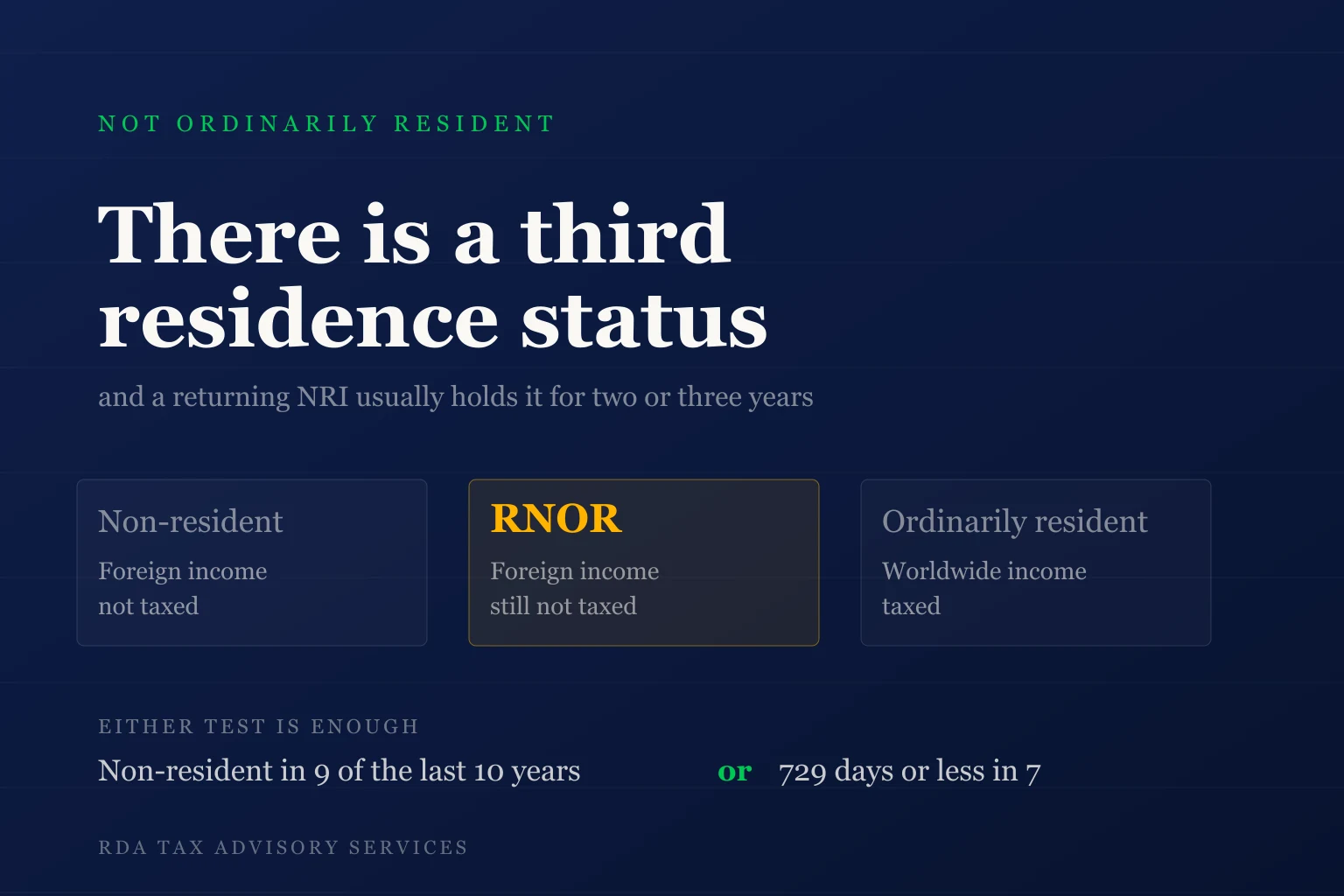
So a present non-resident can still declare. What matters is your status in the year the income arose or the asset was bought, not your status today. If you claim non-resident status for any declared year, Form 1 asks for your passport details. Our note on residential status for NRIs sets out how that test actually runs.
You also need one of three grounds
Section 132 allows a declaration where the assessee:
failed to furnish a return under section 139; or
failed to disclose the asset or income in a return filed before the scheme commenced; or
the asset or income has escaped assessment within the meaning of section 147.
That third ground is worth pausing on. An escaped-assessment situation is expressly within the scheme, not outside it.
Row 1 versus Row 2 — the distinction that decides everything
Section 133 sets out one table with two rows. Getting your facts into the right row changes the cost by orders of magnitude.
Section 133 — the two rows compared
Row 1 — undisclosed
Row 2 — undeclared
What it covers
An undisclosed asset located outside India, or undisclosed foreign income, that was never offered to tax
An asset outside India acquired while you were a non-resident from foreign income, or acquired from income already offered to tax in India — in each case not declared in the relevant Schedule of the return
Amount payable
30% tax on the asset value at 31.3.2026, plus 30% on the undisclosed income, plus an amount equal to 100% of that tax — 60% effective
A fee of ₹1,00,000
Ceiling
Aggregate of the asset value and the income must not exceed ₹1 crore
Value of the assets must not exceed ₹5 crore
Underlying failure
Tax was not paid
Tax was paid or not due. Reporting failed.
Getting your facts into the right row is the whole exercise. The underlying failure differs: Row 1 is unpaid tax, Row 2 is unreported holdings.
Row 2 is the provision that will matter to most people who come to us on this. It is a fee for a disclosure failure. It is not a penalty on concealed income, because in a Row 2 case there is no concealed income — the money was taxed, or it was earned abroad while you were outside the Indian tax net.
The people most likely to sit in Row 2: returning NRIs with an old overseas salary account; professionals holding ESPP, RSU or ESOP stock in a foreign brokerage; holders of foreign retirement accounts; and anyone who kept investing abroad after moving back and assumed that tax paid meant nothing further to report. Reporting is a separate obligation — see our note on Schedule FA.
Exceed the cap and you are out
The Rules are blunt here. Rule 4, Illustration 3 takes a foreign mutual fund worth ₹2.5 crore and quoted shares worth ₹4 crore. Aggregate ₹6.5 crore, above the ₹5 crore ceiling, so the assessee is not eligible to declare under the scheme at all. You cannot carve out ₹4.9 crore and declare that. The threshold is tested on the aggregate of everything in that row, across all years.
Valuation: why your closing balance is probably the wrong number
Rule 3 fixes the valuation date at 31 March 2026. The general rule for most assets is the higher of the cost of acquisition and the open-market price on the valuation date, supported by a report from a valuer recognised by the government of the country where the asset sits. Where no such valuation is carried out, the indexed cost of acquisition is deemed to be the fair market value.
Bank accounts follow a completely different rule.
Two adjustments soften that:
Redeposits are excluded. Where a deposit is made from the proceeds of a withdrawal from the same account, it is not counted again.
Earlier Black Money Act declarations are respected. If the account was declared under Chapter VI of the Black Money Act, 2015 and charged to tax and penalty, you count only the deposits made since that declaration.
The department’s own worked example
This is Illustration 1 to Rule 3, reproduced from the notification. An account opened in 2010, with withdrawals later redeposited.
Illustration 1 to Rule 3 — an account opened in 2010
Date
Deposits
Withdrawals
Counted
01.04.2010
$1,000
—
$1,000
01.06.2011
$500
—
$500
01.08.2011
—
$700
—
01.04.2012
$500
—
—
01.08.2013
$500
—
$300
01.04.2019
$2,500
—
$2,500
01.06.2020
—
$400
—
01.09.2021
$1,000
—
$600
01.05.2024
—
$500
—
Total
$4,900
Reproduced from the notification. Withdrawals later redeposited are excluded, so only $4,900 of the credits count.
The value is $4,900, converted to rupees at the RBI reference rate on 31 March 2026. The closing balance on that date is nowhere in the computation. A modest-looking account that has been cycling salary for fifteen years can carry a valuation many times its balance — and that is the number tested against the ₹1 crore or ₹5 crore ceiling.
Reinvestment relief stops double counting
Rule 3(3) prevents the same money being taxed twice across two assets. The department’s example: a house bought abroad for ₹20 lakh, sold for ₹25 lakh, proceeds banked; ₹30 lakh later withdrawn from that account to buy a second house now worth ₹50 lakh. If the bank account computes to ₹70 lakh, the values become:
First house: ₹25 lakh less ₹25 lakh reinvested = nil
Bank account: ₹70 lakh less ₹30 lakh reinvested = ₹40 lakh
Second house: higher of ₹30 lakh and ₹50 lakh = ₹50 lakh
Other assets, in brief
Quoted shares and securities: higher of cost and the average of the lowest and highest price on an established securities market on 31.3.2026. No trading that day, use the nearest preceding trading day.
Unquoted equity shares: higher of cost and a prescribed book-value formula. No valuation, indexed cost applies.
Immovable property, jewellery, artistic work: higher of cost and open-market price per a recognised foreign valuer, else indexed cost.
Currency: RBI reference rate on the valuation date for RBI-designated currencies. Otherwise convert to US dollars at the local central bank rate first, then to rupees.
One practical comfort in Rule 5(2): for assets other than a bank account, a variance of up to 20% between your declared value and the value later determined by an income-tax authority does not, by itself, make the declaration invalid or void.
Form 1 is live — and here is the path
As at 2 September 2026, the e-filing portal home page carries the notice: “Form 1 under the Foreign Assets of Small Taxpayers Disclosure Scheme is now available for filing.” The portal gives the navigation path as:
e-File → Income Tax Forms → File Income Tax Forms → Under Other Acts → Foreign Assets of Small Taxpayers Disclosure Scheme, 2026 (Form 1)
A note on names: the portal announcement uses the acronym FADS 2026, while the Finance Act, the Rules and the CBDT FAQs all use FAST-DS. Same scheme. Worth knowing when you search the portal.
Filing is online only. Under Rule 9, verification is by digital signature where your return requires a DSC, and by electronic verification code otherwise. We have not tested the behaviour behind login, so we do not make claims about draft saving or on-screen prompts.
What happens after you file: Forms 2, 3 and 4
Form 1By 31 Dec 2026
You file the declaration electronically, with proof of acquisition and valuation reports uploaded.
Form 2Within 1 month
The income-tax authority verifies and passes an order stating the amount payable — one month from the end of the month in which you declared.
PaymentWithin 2 months
You pay the determined amount, counted from the end of the month you received Form 2. Part payments are allowed.
Extension2 more months
A further period with simple interest at 1% per month or part month. The outer limit is 4 months from the end of the Form 2 month.
Form 3Within the payment period
You intimate payment electronically, with proof and any interest.
Form 4Within 1 month
Order certifying the declaration is valid and payment complete. Conclusive. Issued one month from the end of the month of your Form 3 intimation.
Miss the outer payment limit and the consequence is severe. Form 2 states that on non-payment within time, the declaration is treated as void and deemed never to have been made. Section 138 adds that nothing paid under the scheme is refundable. The deadline discipline here is not administrative.
Where the scheme does not apply
Section 140 contains two exclusions, and only two:
income or an asset which directly or indirectly represents proceeds of crime where proceedings have been initiated or are pending under the Prevention of Money-laundering Act, 2002; and
income or an asset relating to an assessment year for which assessment proceedings are already completed under the Black Money Act, 2015.
Form 1 requires you to certify that section 140 is not attracted, so this is a positive representation, not a passive condition.
Commentary elsewhere lists further disqualifications — a search or survey, the department already holding CRS or FATCA data, an information-based notice. We checked the statute, the Rules and all fifty CBDT FAQs. None of those appears as an exclusion in the official material. We do not repeat them.
Two related points that are in the statute. A pending assessment is not an exclusion: under section 141, where proceedings under the Income-tax Act or the Black Money Act are pending on the declared income or asset, the Assessing Officer must take the declaration into account while finalising the assessment. And a declaration is invalid under section 134(3) if any material particular is false, or if you breach a condition of the scheme.
What the immunity actually covers
This is where careful reading earns its keep. Two provisions do two different jobs.
Section 136 keeps the declared income, or the amount invested in the declared asset, out of your total income under both the Income-tax Act, 1961 and the Black Money Act, 2015 — provided you pay within the extended period.
Section 139 grants immunity from further tax, penalty and prosecution under the Black Money Act, 2015, for the previous year ending 31 March 2026 or earlier.
Read them together and the shape is clear. The prosecution-and-penalty immunity is expressed as Black Money Act immunity. It is a real and substantial protection, and it is narrower than a blanket clearance of every tax consequence. Section 137 adds that you cannot then reopen a completed assessment to claim rectification, revision, set-off or relief.
How this compares with the Black Money Act exposure
The Black Money Act, 2015 attaches two separate consequences to an unreported foreign asset. Sections 42 and 43 impose a penalty of ₹10 lakh. Sections 49 and 50 provide for prosecution.
Both now carry the same threshold. Neither applies where the aggregate value of the assets, other than immovable property, does not exceed ₹20 lakh. For the penalty sections that threshold has applied since October 2024. For the prosecution sections it was inserted by the Finance Act, 2026, with retrospective effect from 1 October 2024 — before that, prosecution applied irrespective of value.
Note what those two figures are doing. ₹10 lakh is the penalty amount. ₹20 lakh is the value threshold below which the provisions do not bite. They are not alternatives to each other.
Foreign immovable property gets no relief. Penalty and prosecution both remain available whatever it is worth.
The exposure also repeats year by year, which is why a long-forgotten holding can matter more than its size suggests. Set against that, a Row 2 declaration settles the reporting failure for a flat ₹1 lakh. Whether either section would in fact apply to a given taxpayer depends on the years, the asset type, the value and the ₹20 lakh test. It is a reason to get your position assessed, not a result you can assume.
Nine situations we expect to see
CBDT’s own Budget 2026 FAQs name the groups the scheme is aimed at: employees of multinational technology companies holding unreported ESOPs or RSUs from foreign employers, former students with dormant or low-balance foreign bank accounts left over from studying abroad, returning non-residents with foreign savings or insurance policies, and personnel on deputation abroad.
The situations below are illustrative. They are not advice, and every one turns on documents.
Returning NRI, old foreign bank account. Worked in Dubai twelve years, moved back to Pune in 2019, account still open. Likely Row 2 if the funds were foreign-earned while non-resident. The risk is valuation: lifetime deposits, not the small balance left.
Foreign salary account accumulated while non-resident. Salary credited abroad, never taxable in India at the time. Row 2 territory. Key evidence is proof of non-resident status for those years.
Former student with a dormant account abroad. Opened during a master’s programme, small balance, forgotten after coming home. Named by CBDT as a target group. The balance is not the point — the account is valued on lifetime deposits, and living costs paid in over two or three years add up.
ESPP shares bought from already-taxed salary. Perquisite taxed in India, shares held in a US brokerage, never entered in the Schedule. Squarely the Row 2(b) fact pattern.
Foreign brokerage account. Several holdings across years. Values aggregate for the ceiling test, so the whole portfolio must be valued before you can even confirm eligibility.
Foreign retirement account. Often overlooked because it feels illiquid and untouchable. Still a foreign asset. The valuation method depends on what the account actually holds.
Foreign property. Higher of cost and open-market value per a recognised valuer in that country, else indexed cost. Property is also where a valuation report is most clearly expected.
Genuinely undisclosed foreign income. Income that was chargeable in India and never offered. Row 1, 60%, and only if the aggregate stays within ₹1 crore.
Aggregate over the ceiling. Two assets totalling ₹6.5 crore. Not eligible, on the department’s own illustration. The answer here is a different strategy, not a smaller declaration.
What to collect before filing
Only what your case needs. For most declarations that means:
Prior ITRs and the Schedule FA pages, if filed
Full foreign bank statements from account opening — not just recent years, because valuation runs on lifetime deposits
Brokerage and custodial statements; ESPP, RSU or ESOP grant and vesting records
Employment records and proof of residential status for the relevant years, plus passport
Acquisition documents for each asset; property papers and a recognised valuer’s report where valuation is carried out
Currency conversion workings tied to the RBI reference rate on 31.3.2026
Any prior assessment orders, notices, or Black Money Act correspondence
Two questions the scheme does not answer
We would rather flag these than paper over them.
FEMA. Chapter IV, the Rules and the FAQs are silent on the exchange-control position. Regularising a foreign asset for income-tax purposes does not by itself resolve any question under FEMA. That is a separate assessment.
What to do now
The sequence is the same in almost every case. Identify the asset or income. Establish your residential status for the year it arose or was acquired. Work out whether disclosure was required and whether tax was already paid — that determines Row 1 or Row 2. Value everything to 31 March 2026, correctly. Test the aggregate against the ceiling. Only then decide whether to file.
01
Were you resident in India in the year the income arose, or the year the asset was acquired?
Yes
You are within the section 131 definition, even if you are non-resident or RNOR today.
No
The scheme does not reach you for that item.
02
Was the asset acquired from income already taxed in India, or earned abroad while you were a non-resident?
Yes — reporting failed
Row 2. A fee of ₹1,00,000, provided the aggregate stays within ₹5 crore.
No — never offered to tax
Row 1. 60% effective, provided the aggregate stays within ₹1 crore.
03
Valued to 31 March 2026, does the aggregate for that row stay within its ceiling?
Within the ceiling
The scheme is potentially available. Bank accounts value on lifetime deposits, not the balance.
Over the ceiling
Not eligible at all. There is no partial declaration.
04
Is section 140 attracted — PMLA proceedings on proceeds of crime, or a completed Black Money Act assessment for that year?
Neither applies
Proceed. Form 1 requires you to certify exactly this.
Either applies
Excluded for that income or asset.
Clear all four and the remaining work is evidential rather than analytical: assemble the documents, complete the valuation, and file Form 1.
The window closes on 31 December 2026, and the payment cycle runs for months after the declaration. Filing in December leaves no room if a valuation is queried.
Primary sources and references
Finance Act, 2026 (4 of 2026), Chapter IV, sections 130 to 144 — The Foreign Assets of Small Taxpayers Disclosure Scheme, 2026
Notification No. 114/2026 [F.No. 370142/18/2026-TPL], G.S.R. 732(E), dated 14 August 2026 — Foreign Assets of Small Taxpayers – Disclosure Scheme Rules, 2026, including Forms 1 to 4
CBDT, FAQs on The Foreign Assets of Small Taxpayers Disclosure Scheme, 2026 — Questions 1 to 50
Income Tax Department e-filing portal, home page notice and scheme rollout announcement, verified 2 September 2026
Black Money (Undisclosed Foreign Income and Assets) and Imposition of Tax Act, 2015 — sections 42 and 43 (penalty) and sections 49 and 50 (prosecution)
Finance Act, 2026, section 160 — amendment of the Black Money Act, 2015, inserting the ₹20 lakh threshold into sections 49 and 50 with effect from 1 October 2024
CBDT, FAQs on Budget, 2026 — Part XII (FAST-DS) and Part XX (rationalisation of prosecution under the Black Money Act)
This article states the law as at 2 September 2026 and is general information, not advice. Eligibility, valuation and the amount payable turn on facts and documents specific to each taxpayer. No declaration should be filed on the strength of a general article.
Common questions
Frequently asked.
What is FAST-DS 2026?
The Foreign Assets of Small Taxpayers Disclosure Scheme, 2026 is a one-time voluntary disclosure scheme in Chapter IV, sections 130 to 144 of the Finance Act, 2026, read with the FAST-DS Rules, 2026 notified by G.S.R. 732(E) on 14 August 2026. It lets an eligible taxpayer declare certain undisclosed foreign assets, undisclosed foreign income, or undeclared foreign assets on payment of a specified tax or fee. The relief it gives is defined by the scheme itself and does not clear every tax consequence generally.
Is FAST-DS Form 1 live on the income-tax portal?
Yes. As at 2 September 2026 the e-filing portal home page states that Form 1 under the Foreign Assets of Small Taxpayers Disclosure Scheme is available for filing. The navigation path given by the portal is e-File → Income Tax Forms → File Income Tax Forms → Under Other Acts → Foreign Assets of Small Taxpayers Disclosure Scheme, 2026. The portal announcement uses the acronym FADS 2026, while the statute and CBDT FAQs use FAST-DS.
What is the deadline for a FAST-DS declaration?
The scheme commenced on 16 August 2026 and the last date to file a declaration is 31 December 2026. No declaration can be filed after that date. Payment then runs on its own timetable after the Form 2 order, so filing late in December leaves no room if a valuation is queried.
What is the difference between Row 1 and Row 2 of section 133?
Row 1 covers an undisclosed foreign asset or undisclosed foreign income that was never offered to tax. It costs 30% tax plus an amount equal to that tax, so 60% effective, and the aggregate must not exceed ₹1 crore. Row 2 covers an asset acquired while you were a non-resident, or acquired from income already offered to tax, which was not declared in the relevant Schedule of your return. Row 2 costs a flat fee of ₹1,00,000 and the value must not exceed ₹5 crore.
How is a foreign bank account valued under FAST-DS?
Under Rule 3(1)(e), the value is the sum of all deposits made into the account from the date it was opened up to 31 March 2026 — not the closing balance. Deposits made from the proceeds of a withdrawal from the same account are excluded to avoid double counting. If the account was earlier declared under Chapter VI of the Black Money Act, 2015 and charged to tax and penalty, only deposits made since that declaration are counted.
Can a non-resident file a FAST-DS declaration?
Yes. Section 131(1)(a) covers a person who is resident in the relevant previous year, and also a person who is now a non-resident or RNOR but who was resident in India either in the previous year to which the foreign income relates, or in the previous year in which the foreign asset was acquired. Form 1 asks for passport details where non-resident status is claimed for any declared year.
What happens if my foreign assets exceed the ₹5 crore limit?
You are not eligible to declare under the scheme at all. The Rules illustrate this with a foreign mutual fund of ₹2.5 crore and quoted shares of ₹4 crore: the aggregate of ₹6.5 crore exceeds ₹5 crore, so the assessee cannot use the scheme. There is no option to declare a part of the holding within the limit.
What immunity does a valid FAST-DS declaration give?
Section 139 grants immunity from further tax, penalty and prosecution under the Black Money Act, 2015 for the previous year ending 31 March 2026 or earlier. Section 136 separately keeps the declared income or investment out of your total income under both the Income-tax Act, 1961 and the Black Money Act. The prosecution and penalty immunity is expressed as immunity under the Black Money Act specifically, which is narrower than blanket immunity from every tax consequence.
When does FAST-DS not apply?
Section 140 sets out two exclusions only: income or an asset representing proceeds of crime where proceedings have been initiated or are pending under the Prevention of Money-laundering Act, 2002; and income or an asset relating to an assessment year for which Black Money Act assessment proceedings are already completed. A search, survey, CRS or FATCA information, or an information-based notice are not listed as exclusions in the statute, Rules or CBDT FAQs.
What happens after I file Form 1?
The income-tax authority verifies the declaration and passes an order in Form 2 stating the amount payable, within one month from the end of the month of declaration. You pay within two months from the end of the month you receive Form 2, with a further two months available at 1% simple interest per month or part month. You then intimate payment in Form 3, and the authority issues Form 4 certifying validity and payment. If payment is not made within the outer limit, the declaration is treated as void and deemed never to have been made, and nothing paid is refundable.