10 October 2026·11 min read·Filed under NRI & Foreign Income·Form 44 / Rule 76 / Foreign Tax Credit / Income-tax Rules 2026 / DTAA
Foreign Tax Credit under Rule 76: Form No. 44, the New Deadline and the CA Verification
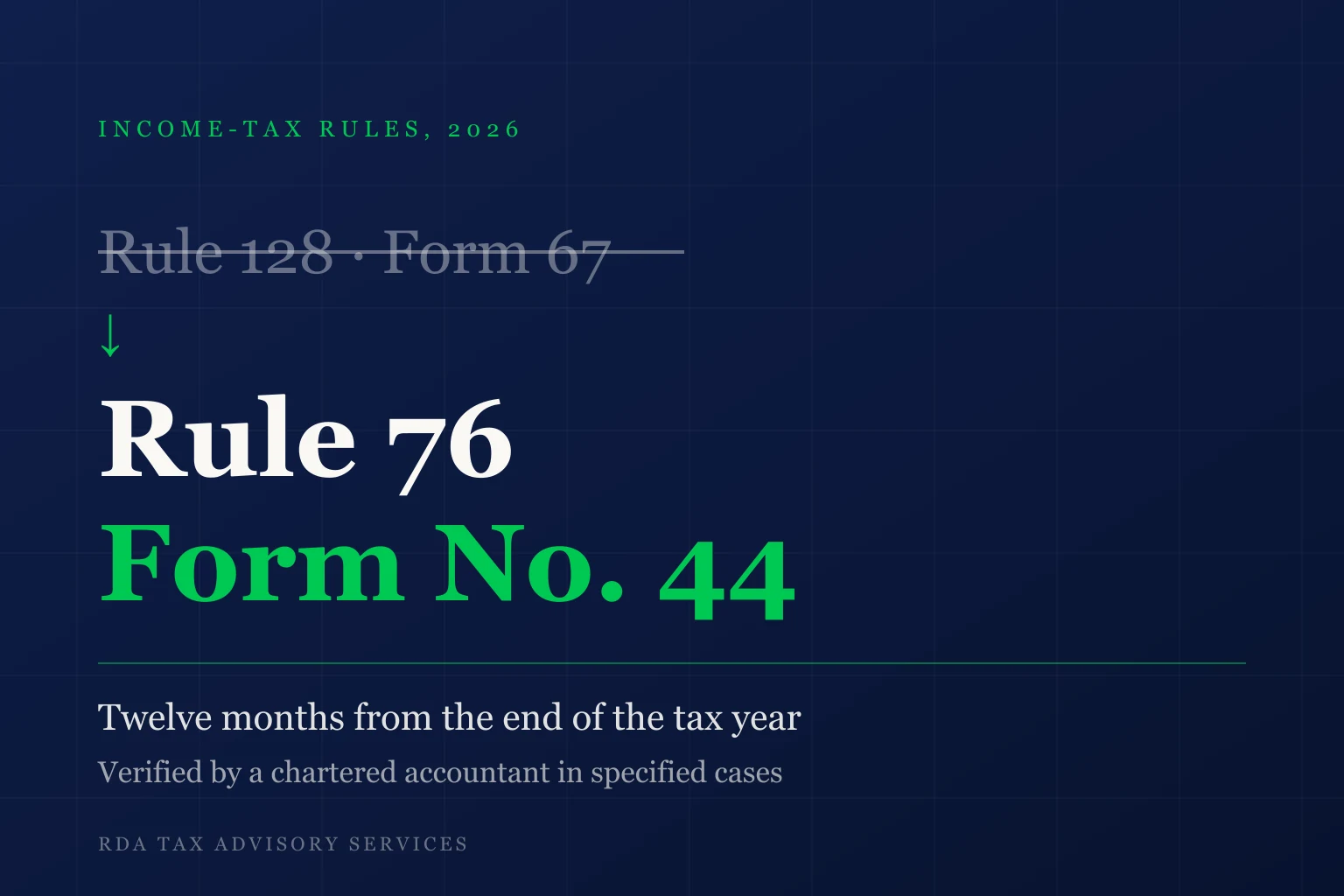
From the Income-tax Rules, 2026 the foreign tax credit sits in rule 76 and the statement is Form No. 44 — not Form 67. The deadline becomes twelve months from the end of the tax year, and a chartered accountant must verify the form where the assessee is a company or the foreign tax reaches ₹1,00,000.
CA Rahul Dang
Founder & Practice Lead
If you pay tax abroad on income you also declare in India, the foreign tax credit is what stops the same income being taxed twice. Under the Income-tax Act, 2025 and the Income-tax Rules, 2026, the credit lives in rule 76 and the statement you file is Form No. 44 — not Form 67, and not Rule 128. The deadline is different, and for some taxpayers there is now a requirement that did not exist before: a chartered accountant must verify the form.
What changed, and from when
Rule 128 and Form 67 belong to the Income-tax Act, 1961. That Act is repealed by section 536(1) of the Income-tax Act, 2025, but section 536(2)(c) preserves it “in respect of any tax year beginning before the 1st day of April, 2026”.
So two frameworks are live at the same time, for different years:
FY 2025-26 and earlier
Tax years from 1 April 2026
Rule
Rule 128, Income-tax Rules, 1962
Rule 76, Income-tax Rules, 2026
Statement
Form No. 67
Form No. 44
Deadline
End of the assessment year
Twelve months from the end of the tax year
Updated return
s.139(8A)
s.263(6)(a)
CA verification
—
Required in specified cases
If you are filing for FY 2025-26 or earlier, you are still on the old rule — our guide to Form 67 and Rule 128 covers that position and its deadline.
The deadline, and the condition attached to it
Rule 76(12) requires the statement in Form No. 44, together with the supporting certificate, to be furnished within twelve months from the end of the relevant tax year in which the income was offered to tax or assessed to tax in India.
That period is not unconditional. The same sub-rule attaches a requirement: the return for that tax year must have been furnished within the time specified under section 263(1) or (4). Those are:
Section 263(1) — the return filed on or before the due date.
Section 263(4) — a return filed late, which may be furnished “at any time within nine months from the end of the relevant tax year, or before the completion of the assessment, whichever is earlier”.
Read that list carefully. It names sub-sections (1) and (4). A revised return under section 263(5) is not in it. Whether a revised return preserves the credit where the original was filed outside the (1) and (4) windows is not answered by rule 76(12), and we do not read an answer into it — it is a question to take on your facts.
For an updated return the position is separate. Rule 76(13) provides that where the return has been furnished under section 263(6)(a), the Form No. 44 and the certificate, to the extent they relate to income included in the updated return, must be furnished on or before the date on which that return is furnished. Section 263(6)(a) itself allows an updated return “at any time within forty-eight months from the end of the financial year succeeding the relevant tax year”.
The new requirement: a CA must verify Form 44
This has no counterpart in the old rule, and it is the change most likely to catch people out. Rule 76(16) requires Form No. 44 to be verified by an accountant where:
the assessee is a company; or
in all other cases, the foreign tax paid outside India for the tax year equals or exceeds ₹1,00,000.
So an individual with a modest foreign tax deduction files Form 44 themselves; an individual whose foreign tax for the year reaches a lakh does not. Rule 76(17) carries the same requirement across to Form No. 45 (below) wherever Form 44 needed verification.
“Accountant” is not a loose term here. Section 515(3)(b) defines it as a chartered accountant under the Chartered Accountants Act, 1949 “who holds a valid certificate of practice”, and then excludes certain people — for a company, anyone ineligible to be its auditor under section 141(3) of the Companies Act, 2013; otherwise the assessee themselves, or a partner where the assessee is a firm, and others in that class. Your own accountant may or may not qualify for your particular entity. Check before the deadline, not after.
What the credit is, and what it is not
Rule 76 settles several things that are worth knowing precisely:
Who gets it. Rule 76(1) — “an assessee, being a resident”, for foreign tax paid “in the tax year in which the income corresponding to such tax has been offered to tax or assessed to tax in India”.
What it can be set against. Rule 76(4) — against “tax, surcharge and cess payable under the Act”, but not against “any sum payable by way of interest, fee or penalty”.
How much. Rule 76(7)(a) — “the lower of the tax payable under the Act on such income and the foreign tax paid on such income”, and where the foreign tax exceeds what the treaty allows, the excess is ignored.
At what exchange rate. Rule 76(7)(b) — the telegraphic transfer buying rate on the last day of the month immediately preceding the month in which the foreign tax was paid or deducted.
Income spread over years. Rule 76(2) — where the income is offered to tax across more than one tax year, the credit is allowed across those years in the same proportion.
The credit is therefore capped by the Indian tax on that income. It is not a refund of foreign tax, and a higher foreign rate does not produce a credit beyond the Indian liability on the same income.
Disputed foreign tax, and Form No. 45
Rule 76(5) denies credit for foreign tax that is “disputed in any manner by the assessee”. Rule 76(6) then provides the way back: if, within six months from the end of the month in which the dispute is finally settled, you furnish evidence of the settlement, evidence that the liability has been discharged, and an undertaking that no refund has been or will be claimed, the credit is allowed for the year in which the income was offered to tax.
The intimation for this is Form No. 45 (rule 76(15)), and per rule 76(17) it needs an accountant’s verification wherever Form 44 did.
What you have to produce
Rule 76(10) makes the credit conditional on furnishing:
Form No. 44 — a statement of the foreign income offered to tax for the tax year and the foreign tax deducted or paid on it; and
a certificate or statement specifying the nature of the income and the tax deducted or paid, from the foreign tax authority, or from the person responsible for deducting it, orsigned by the assessee.
That third option matters. Where a foreign payroll will not issue anything in a form the Indian system recognises, a statement signed by you is contemplated by the rule itself — but rule 76(11) then requires it to be accompanied by an acknowledgement of online payment, a bank counterfoil or challan where you paid the tax, or proof of deduction where it was withheld.
One further case: rule 76(14) requires Form No. 44 to be furnished again where a carry-backward of loss, a revision of return or a similar event results in a refund of foreign tax for which credit was already claimed.
Where the treaty fits
Rule 76(3) defines the foreign tax that qualifies. For a country with which India has an agreement for relief or avoidance of double taxation “in terms of section 159”, it is the tax covered by that agreement. For any other country, it is tax “in the nature of income-tax referred to in section 160(3)(a)”.
We have not set out what sections 159 and 160 provide, and this article does not tell you whether a particular treaty gives you relief or at what rate. Treaty entitlement turns on residence, the article of the treaty engaged and the facts of the income. That is a determination to make on your transaction, not from a guide.
A practical sequence
Identify the tax year the income belongs to. That decides whether you are on rule 76 and Form 44, or still on Rule 128 and Form 67.
Check your return was filed within the section 263(1) or (4) window, because rule 76(12) conditions the credit on it.
Total the foreign tax for the year and see whether it reaches ₹1,00,000, or whether the assessee is a company — either triggers the accountant’s verification.
Collect the certificate or statement under rule 76(10)(b), with the rule 76(11) proof attached.
File Form No. 44 within twelve months from the end of the tax year — or, for an updated return, on or before the date that return is furnished.
If any foreign tax is under dispute, diarise the six months from settlement and the Form No. 45 intimation.
How RDA helps
At RDA Tax Advisory Services, Baner, Pune, we handle foreign tax credit claims for residents with overseas salary, RSUs, consulting income and investment income — establishing the tax year and which framework applies, computing the credit under rule 76(7), preparing and verifying Form No. 44 where the rule requires a chartered accountant, and dealing with disputed foreign tax under rule 76(6).
Paying tax in two countries on the same income?Talk to RDA before the twelve-month window closes — Office No. 102, Snehraj Apartment, Baner, Pune 411045.
Sources
Income-tax Rules, 2026 — rule 76 (foreign tax credit), in particular sub-rules (1)–(7), (10)–(17). Official text, rule by rule
This article explains the rule and the documents it requires. It is not transaction-specific advice. The amount of Indian tax on your foreign income, and any entitlement under a double taxation avoidance agreement, depend on your facts and are not determined by rule 76. Verify the position for your tax year before you file.
Common questions
Frequently asked.
Is Form 67 still the right form for a foreign tax credit?
It depends on the tax year. Form 67 and Rule 128 belong to the Income-tax Act, 1961, which section 536(2)(c) of the Income-tax Act, 2025 preserves for any tax year beginning before 1 April 2026 — so FY 2025-26 and earlier. For tax years from 1 April 2026 the credit is governed by rule 76 of the Income-tax Rules, 2026 and the statement is Form No. 44.
What is the deadline for Form No. 44?
Rule 76(12) requires the statement and the supporting certificate to be furnished within twelve months from the end of the relevant tax year in which the income was offered to tax or assessed to tax in India, where the return for that tax year was furnished within the time specified under section 263(1) or (4). Where the return is an updated return under section 263(6)(a), rule 76(13) requires the form on or before the date that return is furnished.
When does a chartered accountant have to verify Form No. 44?
Rule 76(16) requires verification by an accountant where the assessee is a company, or in all other cases where the foreign tax paid outside India for the tax year equals or exceeds ₹1,00,000. Rule 76(17) applies the same requirement to Form No. 45 wherever Form No. 44 needed it. Accountant is defined in section 515(3)(b) as a chartered accountant holding a valid certificate of practice, with exclusions.
How much credit can I actually claim?
Rule 76(7)(a) sets the credit at the lower of the tax payable under the Act on that income and the foreign tax paid on it, and where the foreign tax exceeds the amount payable under the applicable double taxation agreement, the excess is ignored. Rule 76(4) allows the credit against tax, surcharge and cess, but not against any sum payable by way of interest, fee or penalty.
What if the foreign tax is under dispute?
Rule 76(5) denies credit for foreign tax disputed in any manner by the assessee. Rule 76(6) restores it if, within six months from the end of the month in which the dispute is finally settled, you furnish evidence of settlement, evidence that the liability has been discharged, and an undertaking that no refund has been or will be claimed. The intimation is Form No. 45 under rule 76(15).
What exchange rate applies to the foreign tax?
Rule 76(7)(b) requires conversion at the telegraphic transfer buying rate on the last day of the month immediately preceding the month in which the foreign tax was paid or deducted.
What documents support the claim?
Rule 76(10) requires Form No. 44 plus a certificate or statement specifying the nature of the income and the tax deducted or paid — from the foreign tax authority, from the person responsible for deducting it, or signed by the assessee. Where it is signed by the assessee, rule 76(11) requires an acknowledgement of online payment, a bank counterfoil or challan, or proof of deduction.