13 May 2026·6 min read·Updated 2 September 2026·Filed under NRI & Foreign Income·Foreign Assets / Compliance / NRI
What Is Schedule FA? Foreign Asset Disclosure, Filing and Penalty
If you're an ordinarily resident holding foreign shares, RSUs or bank accounts, you must disclose them in Schedule FA — even with zero income. Miss it and the Black Money Act penalty is ₹10 lakh a year.
CA Rahul Dang
Founder & Practice Lead
This is the disclosure that quietly catches honest, well-paid professionals — and the penalty for missing it is brutal. If you hold foreign assets and qualify as a Resident and Ordinarily Resident, you must report them in Schedule FA of your tax return, even if you earned nothing from them and even if you already paid tax abroad.
Who must file Schedule FA
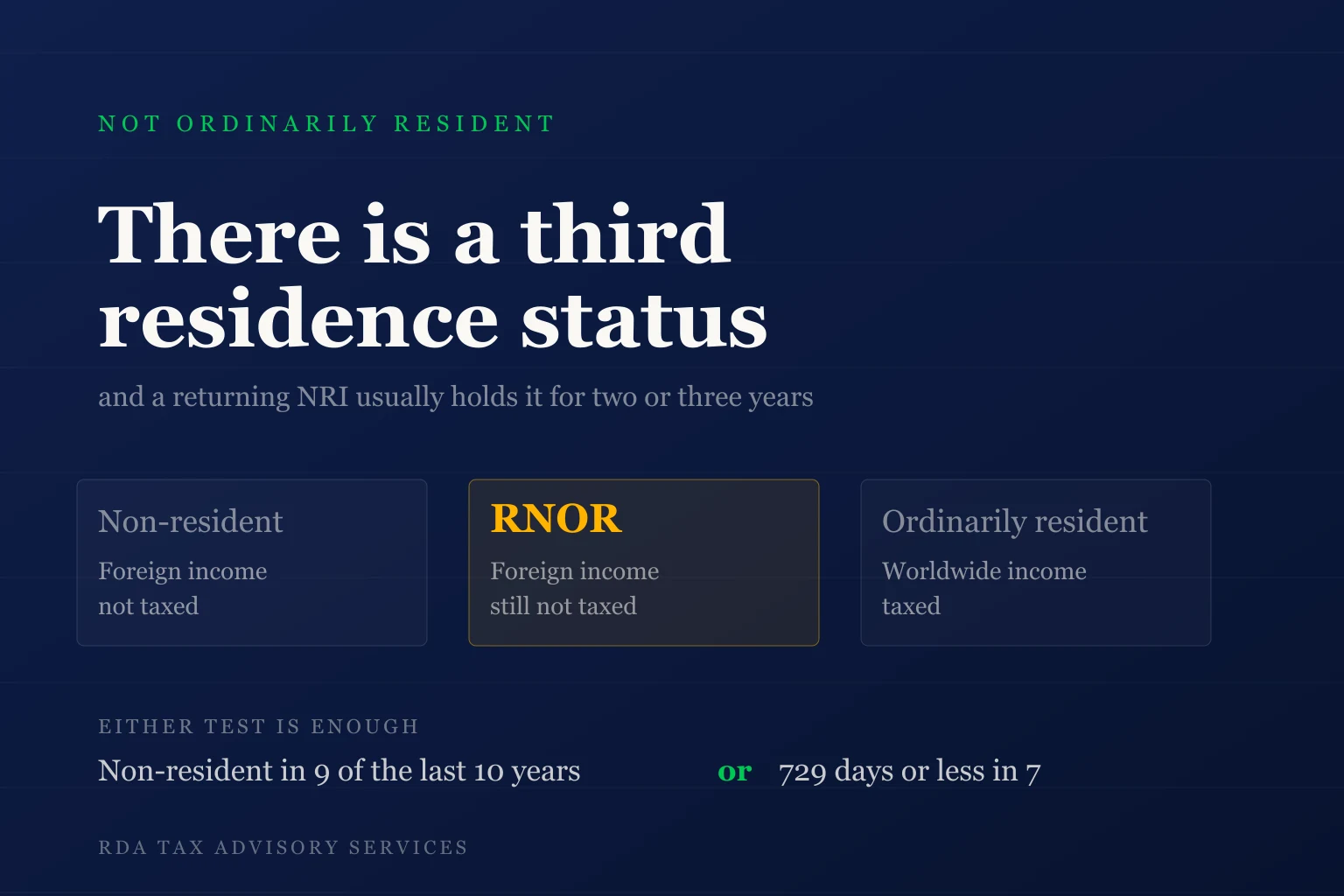
Only a Resident and Ordinarily Resident (ROR) has to disclose foreign assets. NRIs and RNORs do not. The moment a returning NRI becomes ROR, every foreign asset comes into the net.
What counts as a foreign asset
Foreign bank accounts (and any signing authority you hold).
Foreign shares, RSUs and ESOPs — including unsold ones.
Custodial and brokerage accounts, mutual funds, bonds.
Foreign immovable property and any beneficial interest.
Crucially, disclosure is required regardless of income— holding the asset is enough. Reporting follows the relevant calendar year, not the Indian financial year.
The penalty: Black Money Act, ₹10 lakh a year
Non-disclosure of a foreign asset can attract a penalty of ₹10 lakh for every yearit goes unreported, under sections 42 and 43 of the Black Money Act — entirely separate from the tax itself. Prosecution under sections 49 and 50 is a separate consequence again.
One relief applies to both. Neither the penalty nor the prosecution sections apply where the aggregate value of the assets, other than immovable property, does not exceed ₹20 lakh. That threshold has applied to the penalty sections since October 2024, and was extended to the prosecution sections by the Finance Act, 2026 with retrospective effect from the same date. Immovable property gets no relief at all.
Keep the two figures distinct: ₹10 lakh is the penalty amount, ₹20 lakh is the value threshold below which it does not bite.
If a foreign asset has already gone unreported for past years, there is now a one-time route to settle it — see our guide to the FAST-DS 2026 disclosure scheme, which closes on 31 December 2026.
A real example
Operative R, a Baner-based tech lead, has US RSUs worth ₹30 lakhsitting in a foreign brokerage — unsold, generating no Indian income. He assumes “no income, nothing to report.” Wrong: as an ROR he must list them in Schedule FA. Three years of silence could mean ₹30 lakh of penalties on assets that were fully legitimate. A single correct schedule each year avoids all of it.
Common questions
Frequently asked.
Who has to fill Schedule FA?
A Resident and Ordinarily Resident (ROR) individual who, at any time during the relevant period, held any foreign asset — foreign bank or custodial accounts, foreign shares and securities, foreign cash-value insurance or pension, immovable property abroad — or was a beneficial owner or beneficiary, must report it in Schedule FA of the ITR, regardless of income level. Non-residents and RNORs are outside its scope.
What counts as a foreign asset for Schedule FA?
Foreign depository (bank) accounts, custodial accounts, equity and debt interests in foreign entities, foreign cash-value insurance or annuity contracts, other financial interests, immovable property, and any other capital asset held outside India — plus any account where you are a signing authority or the beneficial owner. It is a disclosure of holdings, not only of income.
I already pay tax abroad — do I still disclose?
Yes. Schedule FA is a disclosure requirement, not a tax charge. Even if the foreign income is taxed abroad and you claim a foreign tax credit in India, the underlying foreign asset and account still have to be reported. Reporting and taxability are separate questions.
What is the penalty for not disclosing foreign assets?
Non-disclosure is dealt with under the Black Money (Undisclosed Foreign Income and Assets) and Imposition of Tax Act, 2015, which can impose a penalty of ₹10 lakh for failure to disclose a foreign asset in the return, in addition to tax and possible prosecution — so the reporting is taken seriously even for small balances.
Which period do I report for in Schedule FA?
Schedule FA is reported for the relevant accounting period of the foreign country — typically the calendar year — ending during the Indian financial year, so the reporting window can differ from the Indian April-to-March year. Match the foreign account's own statement period when you fill it in.