The complete NRI tax guide for AY 2026-27
For Indians living and working abroad, Indian taxation hinges on one question that decides everything else: what is your residential status? Get that right and the rest — what India can tax, what you must disclose, how to avoid double taxation — falls into place. This guide walks NRIs, returning Indians and those with foreign income through the full picture for AY 2026-27, and links to detailed articles on each topic.
Residential status decides what India can tax
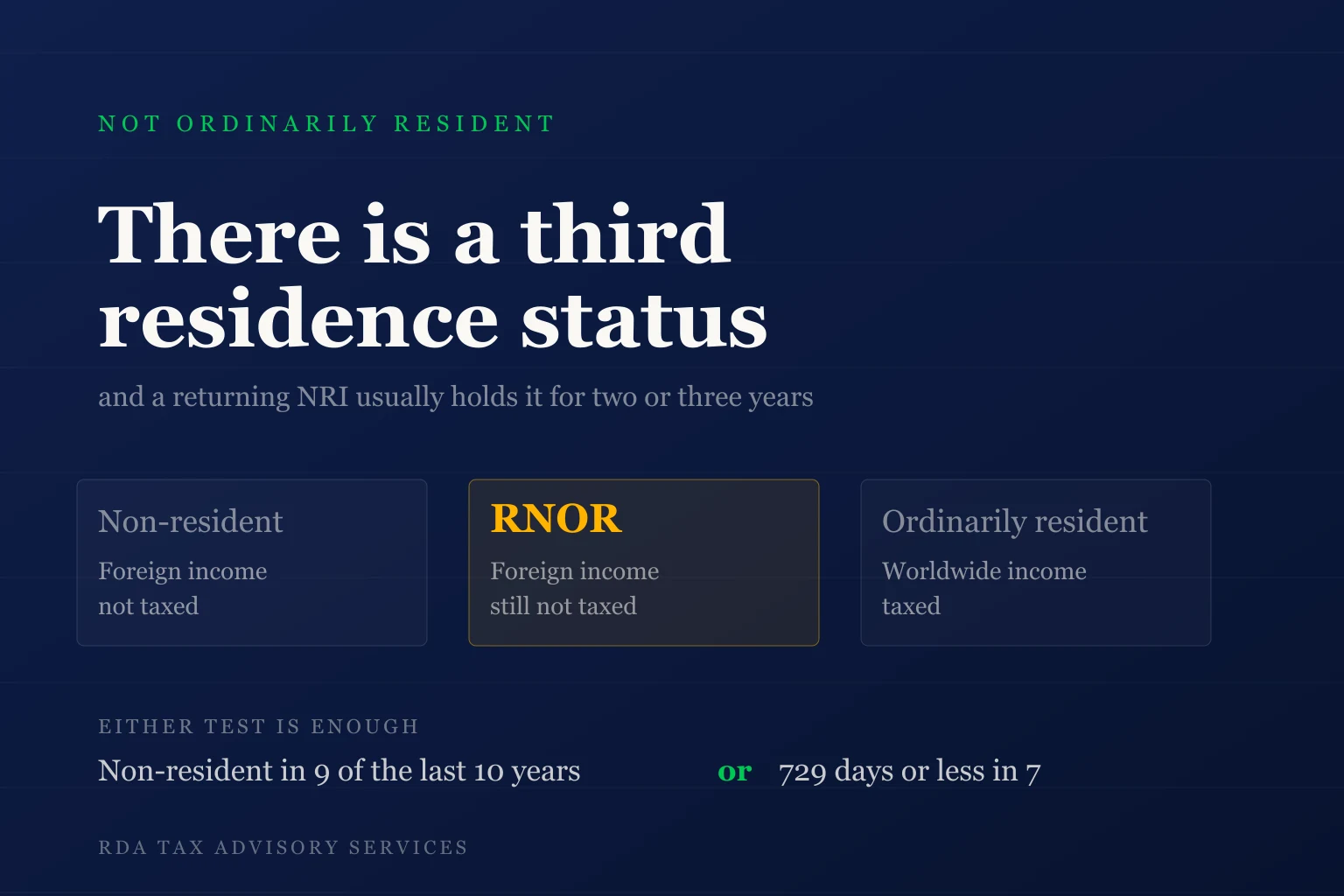
Indian tax law recognises three statuses: Resident and Ordinarily Resident (ROR), Resident but Not Ordinarily Resident (RNOR), and Non-Resident (NRI). The distinction is decisive:
- A Non-Resident is taxed in India only on income that arises or is received in India — Indian salary, rent from Indian property, capital gains on Indian assets, and Indian interest.
- An ROR is taxed on worldwide income.
- An RNOR sits in between — broadly taxed like a non-resident on most foreign income for a transitional period, which makes the RNOR window valuable for returning Indians.
Status is decided by day-count rules — how many days you were physically in India during the year and in preceding years — with special thresholds for Indian citizens and persons of Indian origin, and a "deemed resident" rule for high-income individuals not taxed elsewhere. Because a few days can change your status and your entire tax exposure, this is the first thing to compute. Our detailed guide explains how residential status decides what India can tax.
Income an NRI is taxed on in India
As a non-resident, your Indian tax net typically covers: salary for services rendered in India, rent from Indian property, capital gains on Indian shares, mutual funds and property, and interest on certain Indian deposits (NRO interest is taxable; NRE and FCNR interest is generally exempt while you are a non-resident). Foreign salary and foreign investment income are outside the Indian net for a non-resident — a key relief, and a key reason status must be established correctly.
Selling Indian property as an NRI
This is where NRIs most often get caught out. When an NRI sells Indian property, the buyer must deduct TDS under Section 195 — not the 1% that applies to resident sellers, but much higher rates on the sale value, often leading to far more tax being withheld than is actually due. NRIs can apply for a lower/nil TDS certificate (Section 197) to avoid locking up cash, and claim the correct capital-gains treatment (including indexation options and Sections 54/54EC exemptions). The mechanics mirror the resident rules in our guide to capital gains on the sale of property, but the TDS layer makes professional handling essential.
Foreign assets and Schedule FA
If you become Resident and Ordinarily Resident — for example, after returning to India — you must disclose all foreign assets in Schedule FA: foreign bank accounts, shares, RSUs, ESPP, pension accounts and property, held at any time during the relevant period, even if they produced no income. Non-disclosure carries a penalty of ten lakh rupees (₹10 lakh) under the Black Money Act, though since 1 October 2024 it does not apply where your foreign assets other than immovable property total twenty lakh rupees or less. This is the single biggest compliance risk for returning Indians and for resident employees of foreign MNCs. See our guide to Schedule FA foreign-asset disclosure. The same foreign RSUs are also covered in our RSU and ESOP taxation guide. For assets that went unreported in earlier years, the FAST-DS 2026 disclosure scheme closes on 31 December 2026.
Avoiding double taxation: DTAA and Form 67
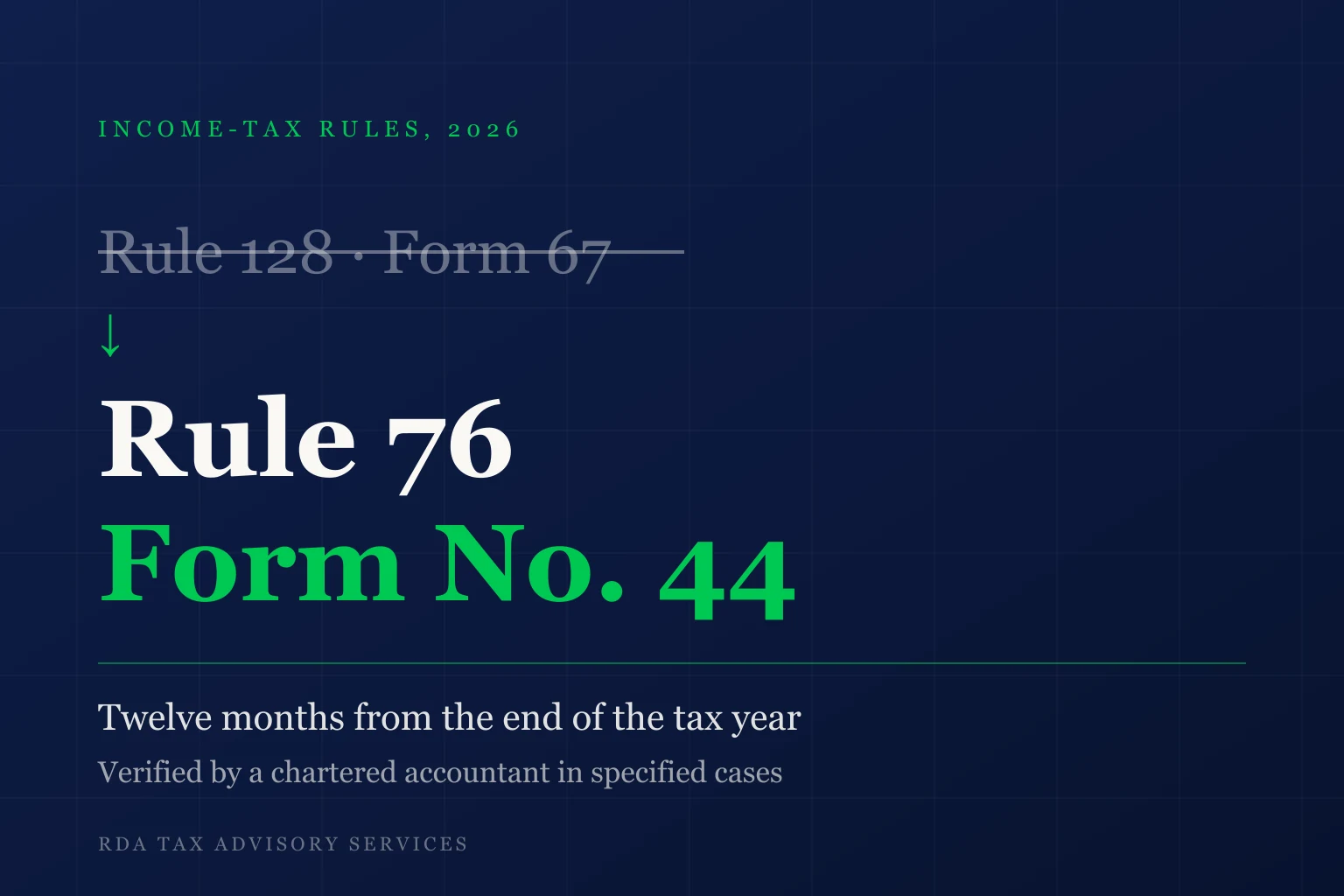
If the same income is taxed both abroad and in India — common for returning Indians with global salary or foreign dividends — India's Double Taxation Avoidance Agreements (DTAAs) let you claim relief. The mechanism is the Foreign Tax Credit, claimed by filing Form 67, which must be furnished on or before the end of the assessment year, provided your return for that year was furnished within the time specified under section 139(1) or 139(4). Miss Form 67 and the credit can be denied, meaning you pay tax twice. The credit, the documentation and the treaty rates are explained in our guide to the foreign tax credit and Form 67.
Which ITR form and how NRIs file
NRIs generally file ITR-2 (or ITR-3 if they have Indian business income) — never ITR-1. Filing requires an Indian PAN, the correct residential-status declaration, and reporting of Indian-source income and TDS. Our ITR form selector confirms the right form, and as with every taxpayer, reconciling against the AIS before filing prevents notices — see AIS, TIS and 26AS reconciliation.
Refunds — why most NRIs need to file
Because TDS on NRI income (especially property sales and NRO interest) is deducted at high rates, NRIs frequently have tax refunds due. The only way to recover the excess is to file a return and claim it — often the single biggest financial reason for an NRI to file in India. A lower-TDS certificate obtained in advance, plus a properly filed return, can together free up substantial cash.
Returning to India: the RNOR planning window
Indians returning home should pay particular attention to the RNOR status, which can shield foreign income for a transitional period before full ROR taxation begins. Timing the return, managing foreign account closures, and planning the first Schedule FA disclosure are where good advice saves the most. This is genuinely a planning exercise, not just a filing one.
NRE, NRO and FCNR accounts — the interest rules
Account type matters for taxation. Interest on an NRE (Non-Resident External) account and an FCNR (Foreign Currency Non-Resident) deposit is generally exempt while you remain a non-resident. Interest on an NRO (Non-Resident Ordinary) account is taxable in India and subject to TDS, often at a higher rate that a return can recover. When you return to India and your status changes, the exemption on NRE/FCNR interest ceases prospectively. Structuring deposits across these accounts is a core part of NRI tax planning.
TDS on NRI income and the Section 197 lower-deduction certificate
Because TDS on NRI income — especially property sales under Section 195 and NRO interest — is deducted at high rates, NRIs frequently have far more tax withheld than they owe. Two tools fix this: applying in advance for a Section 197 lower or nil TDS certificate so the buyer or bank deducts the correct amount, and filing a return to recover any excess. Obtaining a 197 certificate before a property sale is one of the most valuable services for an NRI seller, because it avoids locking up lakhs of rupees for a year.
Repatriation and Form 15CA/15CB
Moving money out of India — sale proceeds, rent, or investment income — generally requires a Form 15CA declaration and, for many remittances, a Form 15CB certificate from a chartered accountant confirming that the correct tax has been paid. Getting the repatriation paperwork right is essential to move funds abroad without delay or bank queries, and it is an area where NRIs particularly value a CA who can issue the certification.
Returning to India: using the RNOR window
Indians moving back should plan around the RNOR status, which can shield most foreign income for a transitional period before full worldwide taxation begins. Timing the return date, closing or restructuring foreign accounts, planning the first Schedule FA disclosure, and sequencing the sale of foreign assets are where good advice saves the most. This is a planning exercise that ideally starts before you board the flight home, not at filing time.
The most common NRI tax mistakes we fix
Recurring errors include: misjudging residential status by miscounting days; NRIs filing ITR-1 (not permitted); ignoring the high Section 195 TDS on a property sale instead of obtaining a 197 certificate; missing Form 67 and losing the foreign tax credit; omitting Schedule FA after becoming resident; and not filing at all, thereby forfeiting a large refund of over-deducted TDS. Each is straightforward to avoid with timely advice.
NRI tax FAQs
Is my foreign salary taxable in India as an NRI? No. As a non-resident, India taxes only income arising or received in India; foreign salary is outside the net.
How can I avoid the high TDS when selling my Indian property? Apply for a Section 197 lower-deduction certificate before the sale, and file a return to claim any excess TDS as a refund.
Do I need to disclose foreign assets if I return to India? Once you become Resident and Ordinarily Resident, yes — all foreign assets must be disclosed in Schedule FA, even with no income, or you risk a penalty under the Black Money Act.
Documents an NRI needs to file in India
To file cleanly from abroad, keep ready: your Indian PAN; passport pages evidencing your travel dates (to establish residential status); Form 16/16A and TDS certificates; NRO/NRE bank statements; capital-gains statements for Indian shares, funds or property; the sale deed and TDS challan for any property sold; foreign tax payment proof (for Form 67); and your foreign bank details for repatriation. Because residential status turns on day-count, accurate travel records are the foundation of an NRI return.
DTAA — how treaty relief actually works
A Double Taxation Avoidance Agreement between India and your country of residence prevents the same income being fully taxed twice. Relief comes in two main forms: the exemption method (income taxed in only one country) or, more commonly, the credit method (you pay in both but credit the foreign tax against your Indian liability). To claim the credit you must furnish Form 67 on or before the end of the assessment year, supported by proof of the foreign tax paid, provided your return for that year was furnished within the time specified under section 139(1) or 139(4); if you file an updated return under section 139(8A), Form 67 must be furnished on or before the date that return is filed. Treaty rates often reduce withholding on dividends, interest and royalties below domestic rates — but you must claim them correctly, typically with a Tax Residency Certificate (TRC) from your country of residence.
Buying or holding property in India as an NRI
NRIs can freely buy residential and commercial property in India (but not agricultural land, plantations or farmhouses). Rental income from such property is taxable in India, with the standard 30% standard deduction and home-loan interest available, and tenants must deduct TDS on rent above the threshold. On a future sale, the capital-gains rules and the high Section 195 TDS apply — which is why advance planning, including a Section 197 certificate, matters. Many of our NRI clients hold Pune property as an investment or for eventual return, making this a central part of their tax picture.
Pune-specific considerations for NRIs
Pune is one of the most popular Indian cities for NRI property investment, thanks to its IT economy, education hub and rental demand in Baner, Hinjewadi, Kharadi and Wakad. NRIs from the Gulf, US and UK frequently own apartments here that generate rent and, eventually, capital gains. Managing the local TDS on rent, the Section 195 deduction on sale, repatriation paperwork and the annual Indian return — all remotely — is exactly the service an NRI-focused Pune CA provides.
NRI tax FAQs (continued)
Do I need to file in India if I am an NRI with only NRE interest? NRE interest is exempt while you are a non-resident, but if you have other Indian income or want to claim a TDS refund, you should file.
What is a Tax Residency Certificate and do I need one? A TRC from your country of residence is generally required to claim DTAA benefits; it evidences where you are tax-resident.
Can I repatriate the proceeds of a property sale abroad? Yes, subject to limits and the Form 15CA/15CB process certifying that the applicable tax has been paid.
TDS on rent paid to an NRI
If you rent out Indian property as an NRI, your tenant must deduct TDS on the rent at the applicable rate (higher than the resident rate) and deposit it against your PAN, filing Form 15CA where required. Many tenants are unaware of this obligation, creating compliance gaps that surface later. An NRI landlord should set this up correctly from the start and then file a return to claim credit for the TDS and recover any excess.
Inheritance and gifts for NRIs
An NRI can inherit Indian assets, and the inheritance itself is not taxed in India. Income from inherited assets (rent, interest, gains on later sale) is, however, taxable per the normal rules, and a future sale attracts the Section 195 TDS. Gifts of Indian assets between relatives are exempt; gifts from non-relatives above ₹50,000 can be taxable. NRIs planning to receive or pass on Indian assets benefit from mapping the tax and repatriation consequences in advance.
A simple filing checklist for NRIs
Establish your residential status from travel records; gather Indian-income statements and TDS certificates; obtain a Section 197 certificate before any property sale; file Form 67 for foreign tax credit if relevant; complete Schedule FA if you are ROR; reconcile against your AIS; file ITR-2 (or ITR-3); and arrange Form 15CA/15CB for any repatriation. Following this sequence turns a daunting remote filing into a predictable routine.
NRI tax FAQs (final)
Is agricultural land in India a problem for NRIs? NRIs cannot purchase agricultural land, plantations or farmhouses, though they may inherit such land — sale of inherited agricultural land has its own rules.
Does the deemed-resident rule affect me? An Indian citizen with Indian income above a threshold who is not liable to tax in any other country can be deemed resident; high-income NRIs should check this carefully.
The bottom line for NRIs
For an NRI, Indian tax begins and ends with getting the residential status right, then layering on the specific rules for property, foreign assets, treaty relief and repatriation. The recurring theme is that NRIs are over-deducted at source and under-claimed at filing — high Section 195 TDS on property, taxable NRO interest, withheld foreign dividends — so the return is frequently a route to a refund, not just a compliance chore. Plan the status, obtain the lower-TDS certificate, file Form 67 and Schedule FA where needed, and recover what is yours. Done remotely with a Pune CA who knows the local property and banking landscape, the entire process is straightforward.
Can RDA file my Indian return while I'm abroad? Yes — we handle NRI filings end to end remotely, including lower-TDS certificates, Schedule FA, Form 67 and repatriation paperwork, without you needing to travel.
Which countries' NRIs does RDA commonly assist? We regularly file for NRIs based in the UAE, Saudi Arabia, Qatar, the United States, the United Kingdom, Singapore and Australia who retain salary, investments or property in Pune and across Maharashtra, coordinating Indian filing with their overseas tax position.
File your NRI return with RDA, Pune
We act for NRIs across the Gulf, the US, the UK and beyond who retain income, investments or property in Pune and Maharashtra. We establish your residential status, obtain lower-TDS certificates on property sales, complete Schedule FA correctly, claim your foreign tax credit via Form 67, and recover refunds — all without you needing to be in India. Book an NRI tax consultation at rdatax.in or call +91 77570 45059 — RDA Tax Advisory Services, Office No. 102, Snehraj Apartment, Baner, Pune 411045.