11 May 2026·7 min read·Updated 12 October 2026·Filed under NRI & Foreign Income·NRI / Residential Status / DTAA
NRI Taxation: How Your Residential Status Decides What India Can Tax
Resident, RNOR or Non-Resident — this one status decides whether India taxes only your Indian income or your entire global income. A plain-English guide to the day-count test, the deemed-resident trap and DTAA relief.
CA Rahul Dang
Founder & Practice Lead
For NRIs and returning Indians, almost every tax question has the same first answer: it depends on your residential status. Get your status right and you may owe tax only on your Indian income. Get it wrong and your entire global income can suddenly become taxable in India. Here is how the status is decided, in plain language.
The day-count test
You are a Resident in a financial year if either:
You were in India for 182 days or more that year; or
You were here 60 days or more that year and365 days or more across the previous four years.
For Indian citizens who leave for employment abroad, and for NRIs visiting India, the 60-day limit is relaxed to 182 days — so a short India visit does not accidentally make you a resident.
The three buckets — and why RNOR is the sweet spot
Non-Resident (NR): only your Indian income is taxed in India.
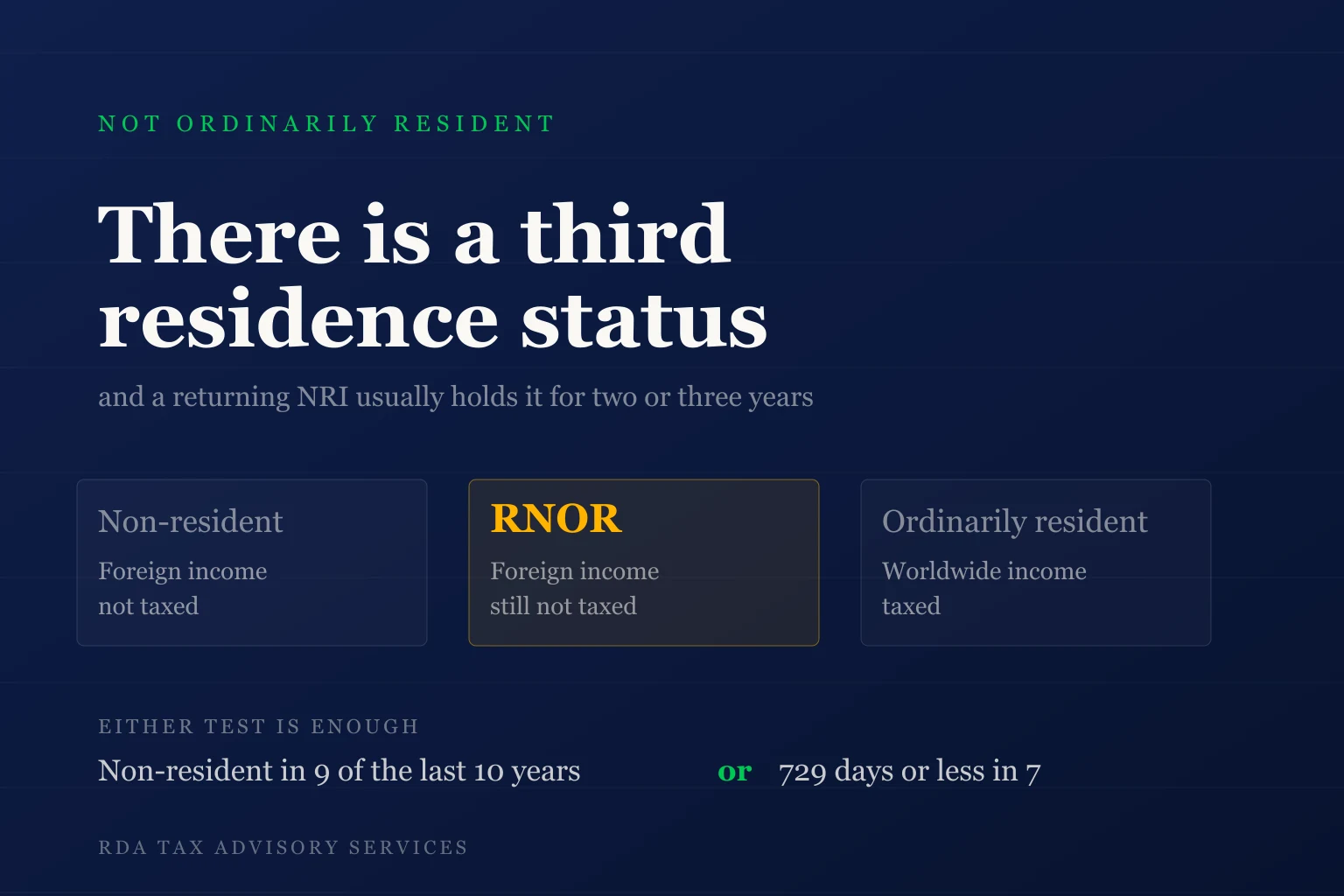
Resident but Not Ordinarily Resident (RNOR): still only your Indian incomeis taxed — your foreign income stays outside India’s net. Returning NRIs usually get RNOR for two to three years, a valuable window.
Resident and Ordinarily Resident (ROR): your entire global income is taxable in India, and you must disclose foreign assets in Schedule FA.
The deemed-resident trap
A newer rule catches high-earning NRIs of certain countries: if you are an Indian citizen with more than ₹15 lakh of Indian income and you are not liable to tax in any other country, you can be treated as a deemed resident (taxed as RNOR). It targets “stateless” tax residency, not genuine NRIs paying tax abroad.
DTAA: your shield against double tax
India has Double Taxation Avoidance Agreements with most countries. If the same income is taxable both here and abroad, the DTAA lets you claim relief — usually a credit for the foreign tax paid (via Form 67). A Tax Residency Certificate from your country of residence is the key document.
A real example
Operative R moves back to Pune mid-year after eight years in Dubai. He qualifies as RNOR for the first couple of years, so his Dubai-earned savings and overseas rental income stay outsideIndian tax — only his Indian salary and interest are taxed. Planning the exact return date can extend this RNOR window and save lakhs.
Note: the new Income Tax Act, 2025 carries these residency rules forward from FY 2026-27 with the same thresholds.
Read next
RNOR: the third residence status — if you are moving back to India, this is the status that usually applies for the first two or three years, and it keeps foreign income outside the Indian net.
The NRI tax guide — what is actually taxable once the status is settled.
Section 197 lower-TDS certificate — if you are selling Indian property, this is the provision that stops the buyer withholding on the whole sale price.
Common questions
Frequently asked.
How is residential status decided?
Under Section 6 of the Income-tax Act you are a resident for a year if you are in India for 182 days or more that year, or 60 days or more that year and 365 days or more across the four preceding years; otherwise you are a non-resident. It is decided year by year on physical days in India, not on your passport or visa.
What is the 60-day relaxation for NRIs?
For an Indian citizen or person of Indian origin living abroad who visits India, and for a citizen leaving India for employment or as a crew member, the 60-day threshold is replaced by 182 days — so a short trip home does not accidentally make you a resident. A 120-day exception applies to visiting NRIs whose Indian income exceeds ₹15 lakh.
What is a deemed resident under Section 6(1A)?
An Indian citizen with total Indian income above ₹15 lakh in a year who is not liable to tax in any other country by reason of domicile or residence is deemed to be a resident of India (as RNOR). It targets high-income individuals with no tax home anywhere; a genuine tax resident of another country is not caught.
What is RNOR and why does it matter?
Resident but Not Ordinarily Resident is a middle status for someone who has recently become a resident — a non-resident in 9 of the 10 preceding years, or in India for 729 days or fewer in the preceding 7 years. An RNOR is broadly taxed only on Indian-source income and foreign income from an Indian-controlled business, so most foreign income stays outside the Indian net for those years.
Does an NRI pay Indian tax on foreign salary?
No. A non-resident is taxed in India only on income that is received, accrues or arises in India. Salary for work done abroad and paid into a foreign or NRE account is not taxable in India for an NRI. Indian-source income — rent, capital gains on Indian assets, Indian interest — remains taxable here.