Repatriation isn't automatic — it is certified
Moving money from India to a foreign bank account is not a simple bank transfer. The Income-tax Act and FEMA together require the remitter to certify that the correct Indian tax has been paid on the amount being sent abroad. Without that certification, the bank either refuses the wire or holds it, and the entire chain of an NRI property sale or rent collection breaks at the last step.
The certification is built on two forms: Form 15CA, filed by the remitter (you, or your bank), and Form 15CB, signed by a Chartered Accountant confirming the tax position. This guide explains which form applies when and how the CA-deliverable workflow actually runs.
What each form does
Form 15CA is filed by the remitter on the income-tax portal before a foreign remittance is made. It declares the amount, the recipient country, the nature of payment, the applicable section, and the tax deducted (if any).
Form 15CB is a certificate issued by a Chartered Accountant confirming the chargeability of the payment to Indian tax, the amount of tax payable, the rate after considering DTAA relief if any, and that the tax has been paid (or that no tax is payable). It is the professional sign-off that tax compliance has been honoured.
The forms travel together for most cases but Form 15CA itself has four "parts" — A, B, C and D — each with different applicability based on the amount and the nature of payment.
The four parts of Form 15CA
Part A — small remittances, no CB required.
Applicable where the aggregate of remittances during the financial year does not exceed ₹5 lakh and the amount is chargeable to Indian tax. No 15CB needed. Simplest path, used for low-value remittances.
Part B — payment chargeable to tax but covered by an AO order or 197 certificate.
Used where the remittance is chargeable but a lower-deduction certificate under Section 195(2)/195(3)/197 is already in place. No 15CB needed, but the certificate number is referenced.
Part C — substantive remittances above ₹5 lakh, requires 15CB.
Used for chargeable remittances above the ₹5 lakh annual threshold that are not covered by an AO certificate. A Form 15CB from a CA must be in hand before Part C is filed; the 15CB acknowledgement number is referenced in the 15CA. This is the path most NRI property-sale and rent repatriations follow.
Part D — remittance not chargeable to tax.
Used where the amount is not chargeable to Indian tax at all (for example, capital exported from your own NRE account, or a permitted gift). No 15CB needed.
When Form 15CB is required, and when it isn't
You need 15CB when Part C applies — i.e. the remittance is chargeable and exceeds ₹5 lakh in the year and is not covered by an AO certificate. You do not need 15CB when:
- The remittance is in the specified list of nature-of-payment codes the RBI has exempted from 15CB requirements.
- Part A, B or D applies as above.
- The remittance is from your own NRE/FCNR account where the principal is your own already-taxed savings (capital, not income).
The actual workflow
Most repatriation processes look like this:
- Confirm the source. Is this NRE balance (no 15CB needed for principal), NRO balance from property sale (15CB needed), rent collected in NRO (15CB needed), or dividends/interest from Indian shares (15CB needed)?
- Compute the tax position. Has the correct TDS already been deducted? Is any further tax payable? Is there a DTAA relief available?
- Obtain 15CB from your CA. The CA reviews the supporting documents (sale deed, TDS certificates, 197 certificate if any, computation), and issues a digitally signed 15CB on the income-tax portal. An acknowledgement number is generated.
- File 15CA Part C referencing the 15CB acknowledgement number.
- Share both forms with your bank (your NRO branch or treasury team).
- The bank processes the remittance to your foreign account on the basis of the certification, typically within 2–7 days.
Common errors that delay remittance
A few avoidable mistakes account for almost all repatriation delays we see:
- Wrong part filed. Filing Part D claiming non-chargeability when the source is actually chargeable (e.g. NRO rent treated as non-chargeable). The bank's compliance team catches this and bounces it back.
- 15CB issued without TDS being paid. The 15CB certifies the tax has been paid; if the TDS challan isn't on record yet, the bank flags it.
- DTAA relief claimed without a TRC. Treaty rate reductions need a Tax Residency Certificate from the country of residence. Missing TRC = treaty rate denied = full domestic withholding.
- Repatriating more than the USMI — most NRO repatriations are capped at USD 1 million per financial year. Higher amounts need RBI permission and a longer certification chain.
The USD 1 million annual cap
Repatriation from an NRO account is generally capped at USD 1 million per financial year, covering principal and current income. Within this cap, 15CA/15CB compliance is the gating step. For property sale proceeds exceeding the cap, a structured plan over multiple years is the standard approach.
DTAA and Form 67 — adjacent but distinct
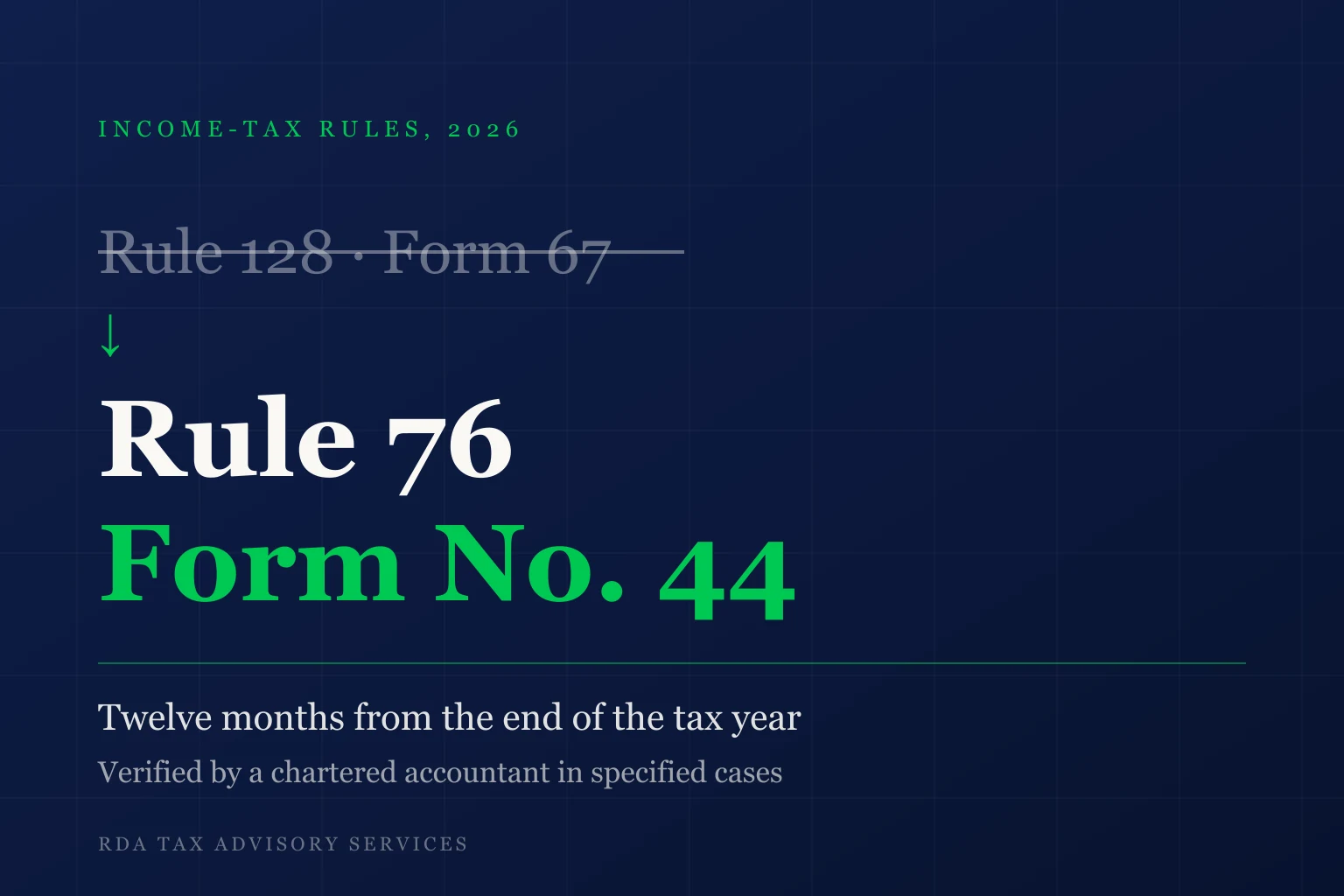
A common source of confusion: Form 15CA/15CB certifies that the Indian tax has been paid before money leaves India. Form 67 is what you use to claim foreign tax credit for tax paid abroad against your Indian liability — see Form 67 and foreign tax credit. They sit at opposite ends of the same cross-border transaction.
Pune note: 15CA/15CB is a CA-deliverable, and we ship it the same day
At RDA Tax Advisory Services, Baner, Form 15CB is one of the most frequent NRI deliverables we issue. For an NRI selling a Pune flat, we typically obtain the Section 197 certificate, coordinate the buyer's Form 27Q TDS, prepare the capital-gains computation, issue Form 15CB with a digital signature, and walk the bank through the 15CA Part C — usually within 48 hours of the buyer's TDS challan being generated. NRIs from the Gulf, US, UK and Singapore filing through us do not deal with the bank or the portal themselves; we run the full repatriation chain. Office No. 102, Snehraj Apartment, Baner, Pune 411045 · call +91 77570 45059.
Move your money out of India cleanly
Repatriating sale proceeds, rent or investment income? RDA prepares the Form 15CB, files 15CA Part C, and walks your bank through it. Book an NRI consultation at rdatax.in or call +91 77570 45059 — RDA Tax Advisory Services, Baner, Pune.