12 May 2026·6 min read·Filed under NRI & Foreign Income·Foreign Income / DTAA / NRI
Foreign Tax Credit and Form 67: Don't Pay Tax Twice on Overseas Income
Earned income abroad and had tax withheld there? You can credit it against your Indian tax — but only if you file Form 67 on time. Here's how the Foreign Tax Credit and DTAA relief actually work.
CA Rahul Dang
Founder & Practice Lead
If you earned income abroad — salary, RSUs, freelance fees, dividends — and tax was deducted there, you should not have to pay full tax on it again in India. The mechanism that prevents this is the Foreign Tax Credit (FTC), and claiming it correctly hinges on one small form most people miss: Form 67.
What the Foreign Tax Credit does
When the same income is taxed in two countries, India lets you reduce your Indian tax by the tax you already paid abroad. The relief comes through Section 90 (where India has a DTAA with that country) or Section 91 (where it does not). In effect, you pay the higherof the two countries’ rates — not both rates stacked.
The credit is the lower of the foreign tax paid and the Indian tax payable on that same income.
Form 67 — the step that gets forgotten
To claim FTC you must file Form 67 online, under Rule 128. It asks for the foreign income, the country, and the tax paid, with proof. Skip it and the assessing officer can deny your credit — turning relief into double tax.
The deadline is not your return due date. Rule 128(9) requires the statement in Form 67 and the supporting certificate to be furnished on or before the end of the assessment year relevant to the previous year in which the income was offered to tax in India — provided the return for that assessment year was furnished within the time specified under section 139(1) or 139(4). Where the return is an updated return under section 139(8A), Form 67 is due on or before the date that return is furnished.
That is a materially later date than the return due date, and it is the position after Rule 128(9) was substituted in 2022. Filing late is not automatically fatal, but filing outside the rule removes your strongest ground if the credit is questioned.
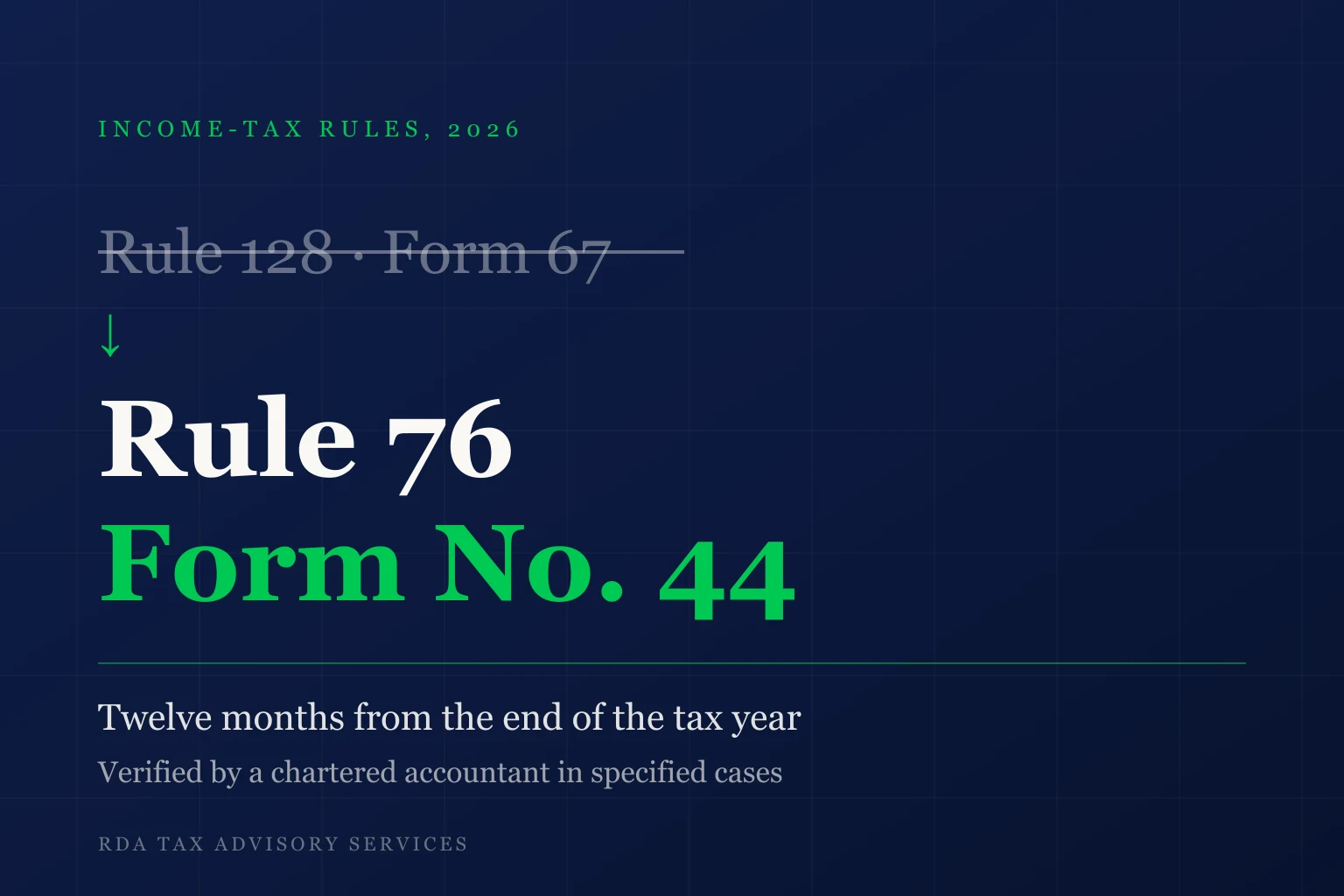
Which years this covers.Form 67 and Rule 128 belong to the Income-tax Act, 1961, which section 536 of the Income-tax Act, 2025 preserves for tax years beginning before 1 April 2026 — so this is the framework for FY 2025-26 and earlier. For tax years from 1 April 2026 the foreign tax credit sits in rule 76of the Income-tax Rules, 2026 and the statement is Form No. 44, on a different deadline and with an accountant’s verification in some cases — see our guide to the foreign tax credit under rule 76 and Form No. 44.
A real example
Agent Mehra, a Pune software consultant, earns ₹20 lakh from a US client who withholds ₹3 lakhin US tax. In India the tax on that same ₹20 lakh works out to ₹4 lakh. He claims FTC of ₹3 lakh (the lower figure) and pays only the ₹1 lakhbalance in India — provided he files Form 67 in time. Forget the form, and he risks paying the full ₹4 lakh on top of the US ₹3 lakh.
What to keep ready
A Tax Residency Certificate where the DTAA requires one.
Proof of foreign tax paid — withholding statements, foreign returns, or Form 1042-S / equivalents.
The income converted to rupees at the prescribed reference rate.
Common questions
Frequently asked.
What is Form 67 and why file it?
Form 67 is the statement you must furnish to claim a Foreign Tax Credit (FTC) in India for tax paid abroad on income that is also taxable here, under Section 90/90A (where a DTAA applies) or Section 91, read with Rule 128. Without a valid Form 67 the credit can be denied.
When must Form 67 be filed?
Under Rule 128(9), Form 67 must be furnished on or before the end of the relevant assessment year — for AY 2026-27 that is 31 December 2026 — and before you file the return, whether the original return under Section 139(1) or a belated return under Section 139(4). Filing it after the end of the assessment year risks losing the credit.
What documents support a Foreign Tax Credit claim?
You need proof of the foreign tax paid — a certificate or statement from the foreign tax authority or the foreign deductor, or the taxpayer's own signed statement with the acknowledgement of the foreign tax payment — together with the nature and amount of the income and the tax deducted or paid on it.
How much foreign tax credit do I get?
FTC is the lower of the Indian tax attributable to the doubly-taxed income and the foreign tax paid on it, computed source by source and applying the DTAA rate where a treaty exists. It cannot exceed the Indian tax on that income, and surcharge and cess are factored into the Indian-tax side.
Can I still claim FTC if I filed Form 67 late?
Several courts have treated the Form 67 timing as directory rather than mandatory and allowed a late-filed form, but that is litigation, not a right. The safe course is to file Form 67 within the Rule 128 timeline so the credit is allowed without a dispute.