11 October 2026·7 min read·Filed under Company Law·Company Law / Statutory Audit / Section 141 / Section 144 / Auditor Independence / Private Limited
What Your Statutory Auditor Cannot Also Do for You: Sections 141 and 144
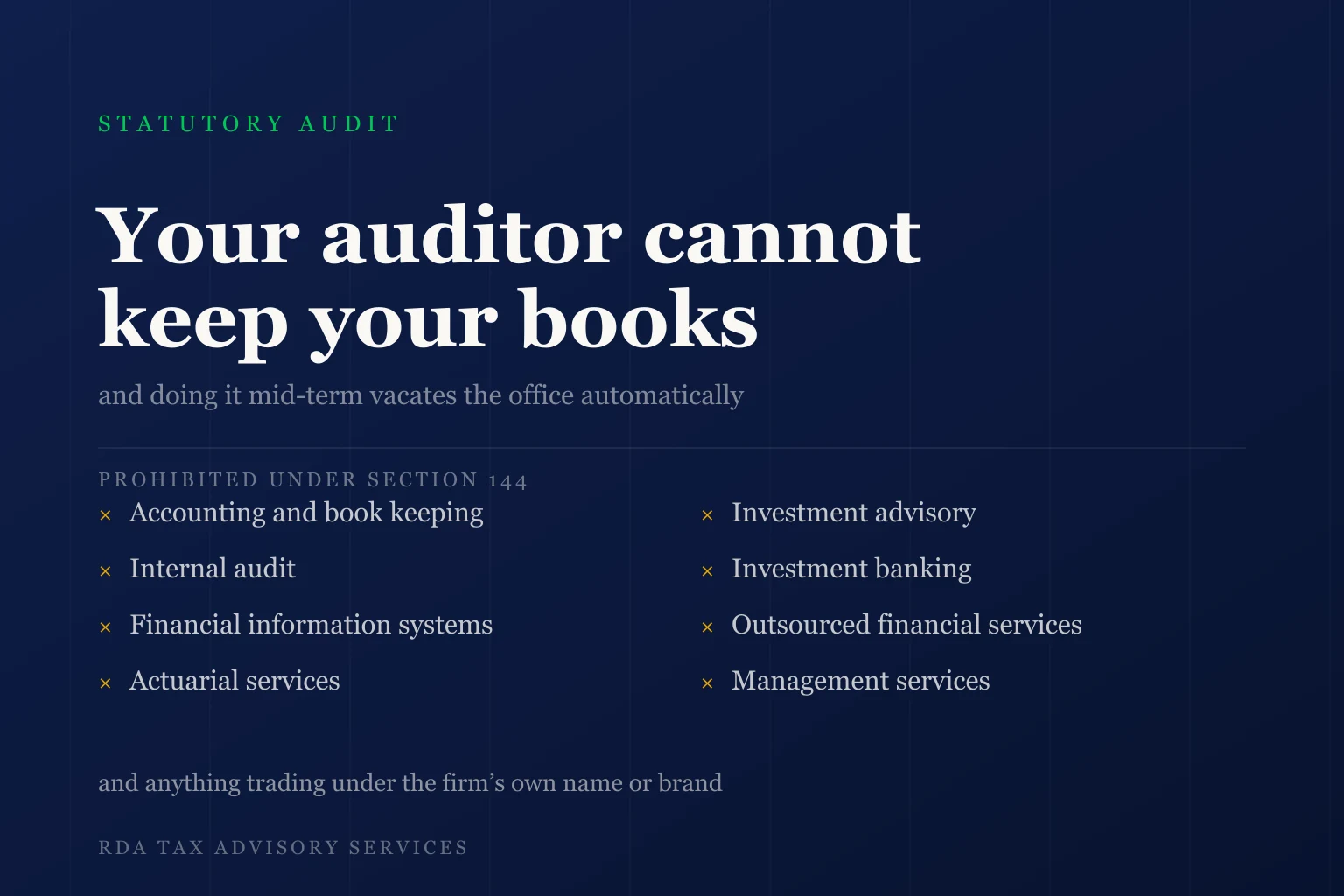
Your statutory auditor cannot keep your books and cannot be your internal auditor — both are named in section 144. The prohibition reaches partners, relatives, associate entities and anything trading under the firm’s brand, and incurring it mid-term vacates the office automatically.
CA Rahul Dang
Founder & Practice Lead
It is one of the most common questions a growing company asks its accountant, and it is usually asked too late: “You already do our books. Can you also be our auditor?”
The answer is no, and the Companies Act, 2013 says so twice over — once by disqualifying the person, and once by prohibiting the service. Understanding where that line falls matters, because crossing it does not merely invalidate the appointment. It can vacate the auditor’s office mid-term.
Two provisions, pointing at each other
Section 141 says who cannot be appointed as auditor. Section 144 says what an auditor cannot also do. Since 2018 they are explicitly linked: section 141(3)(i) disqualifies a person who “directly or indirectly, renders any service referred to in section 144”.
So the two questions collapse into one. If a firm is doing any of the section 144 services, it is not eligible to audit — and if it audits, it cannot take on those services.
The nine services an auditor cannot provide
Section 144 allows an auditor to provide other services only where approved by the Board or the audit committee, and even then the following are excluded outright:
Prohibited service
(a)
Accounting and book keeping services
(b)
Internal audit
(c)
Design and implementation of any financial information system
(d)
Actuarial services
(e)
Investment advisory services
(f)
Investment banking services
(g)
Rendering of outsourced financial services
(h)
Management services
(i)
Any other kind of services as may be prescribed
Clauses (a) and (b) are the ones that catch most firms. Your statutory auditor cannot keep your books, and cannot be your internal auditor. Those are not grey areas; they are named in the statute.
And the prohibition is not confined to the company being audited. It extends to services rendered to its holding company or subsidiary company as well. A firm auditing a subsidiary cannot do the parent’s bookkeeping.
“Directly or indirectly” is defined, and it is wide
This is the part firms and clients most often underestimate. The Explanation to section 144 defines the phrase, and it reaches well past the individual signing the report.
Where the auditor is an individual, it covers services rendered:
by himself;
through his relative;
through any other person connected or associated with him;
through any other entity in which he has significant influence or control; or
through any entity whose name, trade mark or brand he uses.
Where the auditor is a firm, it covers services rendered:
by the firm itself;
through any of its partners;
through its parent, subsidiary or associate entity;
through any other entity in which the firm or any partner has significant influence or control; or
through any entity whose name, trade mark or brand is used by the firm or any of its partners.
The limbs that actually do the work are influence and association. A sister concern is not a way out. If the firm or any of its partners has significant influence or control over the other entity — the usual position where the partners overlap — the services it renders are treated as rendered by the auditor. The same is true if the other entity is the firm’s parent, subsidiary or associate. A different registration, a different PAN and a different letterhead change none of that.
The brand limb is narrower than it is usually described, and it points the other way. On the words as enacted, what is caught is an entity whose name, trade mark or brand is used by the firm or its partners — not simply an entity that uses the firm’s name. Shared branding is therefore a strong practical warning sign rather than, by itself, a conclusive statutory test; and in most real arrangements the influence-or-control limb is engaged in any event.
One limit worth stating plainly. Everything here is the Companies Act position. A chartered accountant is separately bound by the Chartered Accountants Act, 1949 and the ICAI Code of Ethics, which deal with independence, network firms and the use of a common name in their own terms and may go further than the Act. Those requirements are not set out in this guide.
Who cannot be appointed at all
Section 141(3) lists the disqualifications. In practical order of how often they bite:
An officer or employee of the company — clause (b); and a partner or employee of such an officer or employee — clause (c).
A person whose relative is a director, or is employed as a director or key managerial personnel — clause (f).
A person, or his relative or partner, holding any security or interest in the company, its subsidiary, its holding or associate company, or a subsidiary of that holding company — clause (d)(i). A relative may hold security of face value not exceeding ₹1,000, or such sum as may be prescribed.
Indebtedness to the company or that group beyond the prescribed amount — clause (d)(ii) — or having given a guarantee or security for a third person’s debt to them — clause (d)(iii).
A business relationship, direct or indirect, with the company or that group, of a nature prescribed by the rules — clause (e).
A body corporate, other than an LLP — clause (a).
More than twenty company audits. A person in full-time employment elsewhere, or a person or partner of a firm, is disqualified if at the date of appointment or reappointment they hold appointment as auditor of more than twenty companies — clause (g).
Conviction for an offence involving fraud, where ten years have not elapsed from the conviction — clause (h).
Rendering any section 144 service, directly or indirectly, to the company, its holding company or its subsidiary — clause (i).
Several of these limits — the indebtedness figure, the guarantee amount, the nature of a disqualifying business relationship — are fixed by the rules rather than by the Act, and are deliberately not stated here. Check the rules applicable to your year.
It is not only a question at appointment
Section 141(4) is the provision to keep in view throughout the engagement:
“Where a person appointed as an auditor of a company incurs any of the disqualifications mentioned in sub-section (3) after his appointment, he shall vacate his office as such auditor and such vacation shall be deemed to be a casual vacancy in the office of the auditor.”
So a disqualification arising mid-term is not something to be corrected at the next annual general meeting. The office is vacated, and the vacancy has to be filled as a casual vacancy.
Read that together with section 141(3)(i): if an audit firm — or a partner, or an associate entity, or an entity using its brand — starts doing the company’s bookkeeping or internal audit during the term, the firm incurs a disqualification and vacates office. The engagement that looked like extra work has ended the audit appointment.
The term of appointment
Section 139(1) provides that every company shall, at its first annual general meeting, appoint an auditor who holds office “from the conclusion of that meeting till the conclusion of its sixth annual general meeting and thereafter till the conclusion of every sixth meeting”.
Before the appointment is made, the company must obtain from the auditor a written consent and a certificate that the appointment, if made, will be in accordance with the prescribed conditions — the second proviso to section 139(1). That certificate is the mechanism by which the section 141 disqualifications are tested before, rather than after, the appointment.
Rotation of auditors under section 139(2) applies to prescribed classes of company. Those classes are fixed by the rules rather than by the Act, and are not covered here.
Two duties worth knowing
Adverse comments are read aloud. Under section 145, qualifications, observations or comments on financial transactions or matters “which have any adverse effect on the functioning of the company” must be read before the company in general meeting and are open to inspection by any member. A qualified report is not a private document.
The auditor attends general meetings. Section 146 requires all notices of general meetings to be forwarded to the auditor, who must attend — personally or through an authorised representative who is themselves qualified to be an auditor — unless the company exempts them.
What this means in practice
Decide early which role a firm plays for you. Accounting and internal audit on one side, statutory audit on the other. A firm can do either, not both.
Apply the test across the group. The prohibition covers the holding company and subsidiaries, not just the audited entity.
Apply it across the firm, not just the signing partner — partners, relatives, associate entities, and anything trading under the same name or brand.
Test shareholdings and loans, including relatives’, before appointment rather than after.
Re-test during the term. Section 141(4) makes a later disqualification vacate the office automatically.
Keep the consent and certificate on file — they are a statutory precondition to the appointment.
We act as statutory auditors for companies in Pune and across India — and where we already do a client’s accounting, we say so and keep the roles separate, because the Act requires it. If you are appointing an auditor, or you are not sure whether an existing engagement has created a problem, the independence position is worth testing before the appointment rather than after.
Sources
The Companies Act, 2013 — sections 139(1), 141(3) and (4), 144 with its proviso and Explanation, 145 and 146, read from the consolidated text published on India Code, the Government of India’s legislative repository. The Companies Act, 2013 on India Code
This guide explains the statutory independence provisions governing a company auditor. It is not advice on any particular appointment. Several limits referred to in section 141(3) are fixed by the Companies (Audit and Auditors) Rules rather than by the Act and are deliberately not stated here, and auditor rotation is not covered. Take advice on your own facts before making or accepting an appointment.
Common questions
Frequently asked.
Can my accountant also be my statutory auditor?
No. Section 144 of the Companies Act, 2013 expressly prohibits an auditor from providing accounting and book keeping services, and section 141(3)(i) disqualifies from appointment anyone who directly or indirectly renders a section 144 service to the company, its holding company or its subsidiary. A firm can do your accounting or your audit, not both.
What services can a statutory auditor not provide?
Section 144 lists nine: accounting and book keeping services; internal audit; design and implementation of any financial information system; actuarial services; investment advisory services; investment banking services; rendering of outsourced financial services; management services; and any other kind of services as may be prescribed. Any other service requires approval of the Board or the audit committee. The prohibition extends to the company’s holding company and subsidiary company as well.
Can the audit firm’s sister concern do the bookkeeping instead?
Not if it is caught by the Explanation to section 144, which is wide. For a firm, directly or indirectly covers the firm itself, any of its partners, its parent, subsidiary or associate entity, any entity in which the firm or any partner has significant influence or control, and any entity whose name, trade mark or brand is used by the firm or any of its partners. A separately registered entity trading under the audit firm’s name is caught by the brand limb.
Who cannot be appointed as an auditor of a company?
Section 141(3) disqualifies, among others: a body corporate other than an LLP; an officer or employee of the company; a partner or employee of such an officer or employee; a person whose relative is a director or is employed as a director or KMP; a person, relative or partner holding security or interest in the company or its group, beyond a ₹1,000 face value allowance for a relative or such sum as prescribed; persons indebted to the group beyond prescribed limits; a person holding appointment as auditor of more than twenty companies; and a person convicted of an offence involving fraud where ten years have not elapsed.
What happens if the auditor becomes disqualified during the term?
Section 141(4) provides that where a person appointed as auditor incurs any section 141(3) disqualification AFTER appointment, he shall vacate his office, and that vacation is deemed to be a casual vacancy. It is not something that can wait until the next annual general meeting — so an audit firm that takes on the company’s bookkeeping or internal audit mid-term ends its own appointment.
How long does a statutory auditor hold office?
Under section 139(1), the auditor appointed at the first annual general meeting holds office from the conclusion of that meeting until the conclusion of the sixth annual general meeting, and thereafter until the conclusion of every sixth meeting. Before the appointment, the company must obtain the auditor’s written consent and a certificate that the appointment will be in accordance with the prescribed conditions.
Can a statutory auditor hold more than 20 audits?
Section 141(3)(g) disqualifies a person in full time employment elsewhere, or a person or a partner of a firm, who at the date of appointment or reappointment holds appointment as auditor of more than twenty companies. That limit is in the Act itself.
Does the auditor have to attend the AGM?
Yes, unless exempted. Section 146 requires all notices of general meetings to be forwarded to the auditor, who must attend personally or through an authorised representative who is themselves qualified to be an auditor. Separately, section 145 requires qualifications, observations or comments having an adverse effect on the functioning of the company to be read before the general meeting and kept open to inspection by any member.