11 October 2026·8 min read·Filed under Income Tax·Tax Audit / Section 44AB / Section 63 / Section 271B / Compliance Deadline
Tax Audit under Section 44AB: Thresholds, the 30 September Deadline, and the 2026 Shift from Penalty to Fee
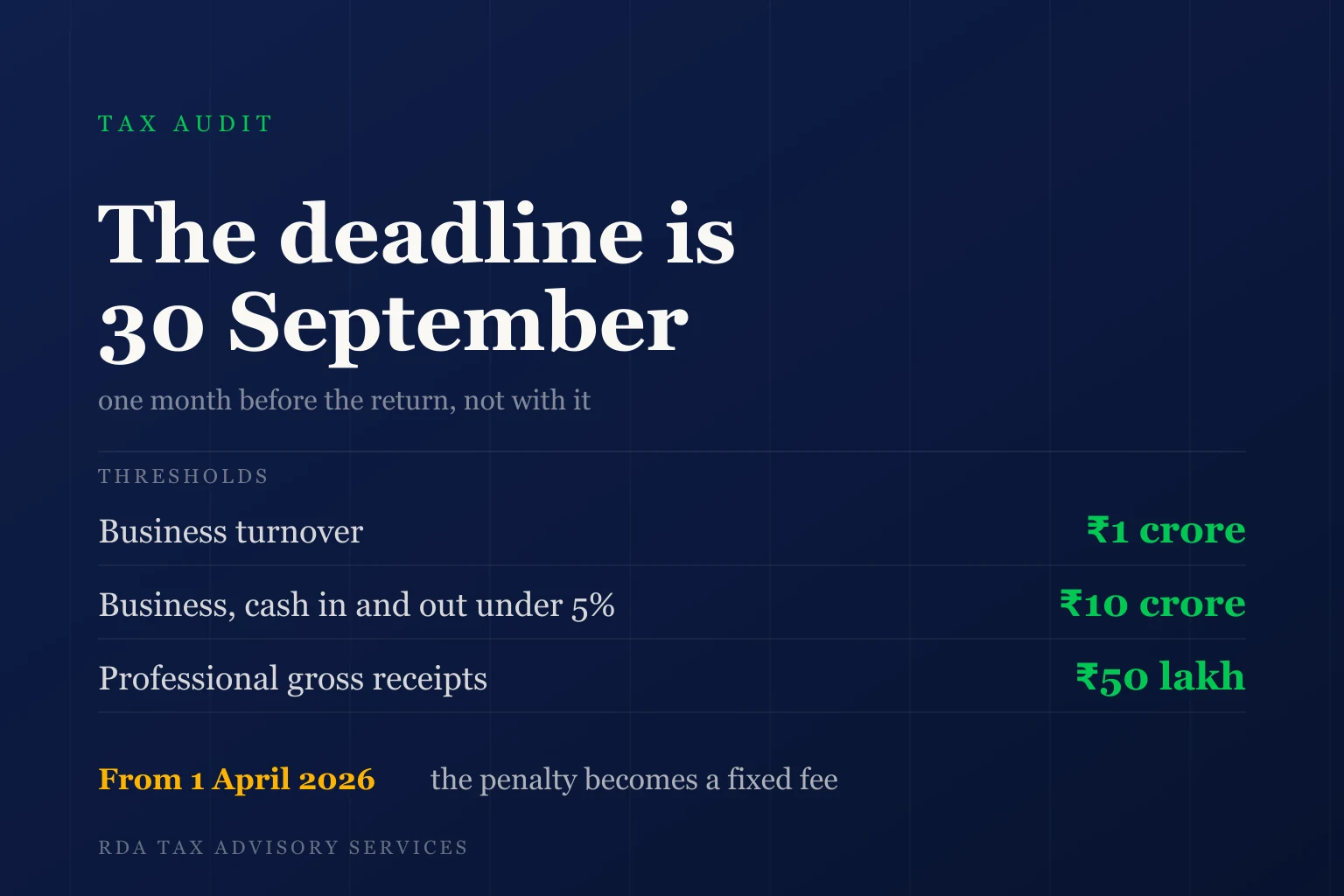
The tax audit deadline is 30 September, a month before the return — and from 1 April 2026 missing it stops being a discretionary penalty capped at 0.5% of turnover and becomes a flat fee of ₹75,000, doubling to ₹1,50,000 after one month. The thresholds, the 5% cash test both sides, and what changed.
CA Rahul Dang
Founder & Practice Lead
Tax audit is the compliance item most often discovered too late. The threshold is crossed quietly during the year, the deadline falls a month before the return deadline rather than on it, and the consequence of missing it has just changed in a way that makes lateness considerably more expensive.
This guide sets out who has to get accounts audited, by when, and what happens if they do not — under both Acts, because which one applies depends on the year.
Which Act applies to your year
Section 536(2)(c) of the Income-tax Act, 2025 continues the repealed 1961 Act for proceedings in respect of any tax year beginning before 1 April 2026.
FY 2025-26 and earlier — section 44AB, with the consequence in section 271B.
Tax year 2026-27 onwards — section 63, with the consequence in section 428(c).
The thresholds are the same under both. The consequence of default is not, and that is the part worth reading twice.
Who has to get a tax audit
You are
Audit required if
Carrying on business
Total sales, turnover or gross receipts exceed ₹1 crore in the year
Carrying on business, and both cash tests are met
The threshold becomes ₹10 crore instead
Carrying on a profession
Gross receipts exceed ₹50 lakh in the year
Declaring lower than presumptive profits
Audit required (see below)
The wording is the same in substance in both Acts: section 44AB(a) and (b) of the 1961 Act, and Sl. No. 1 of the Table in section 63(1) of the 2025 Act.
The 5% cash test — the part most people get wrong
The ₹10 crore threshold is not automatic for a business under ₹10 crore. It applies only where two separate conditions are both satisfied:
the aggregate of all amounts received, including for sales, turnover or gross receipts, in cash, does not exceed 5% of that aggregate; and
the aggregate of all payments made, including expenditure, in cash, does not exceed 5% of that aggregate.
Both. Fail either one and the threshold drops straight back to ₹1 crore. A business with 2% cash receipts but 9% cash payments does not get the higher limit.
And there is a trap written into both Acts. A payment or receipt by a cheque or bank draft that is not account payee is deemed to be in cash — second proviso to section 44AB(a), and section 63(5)(b). A bearer cheque is not a banking transaction for this test. Businesses that issue or accept them routinely can fail the 5% test while believing their cash percentage is near zero.
Presumptive taxation and the audit trigger
This is the second place the threshold catches people, and it has nothing to do with turnover.
If you have been taxed presumptively and then declare profits lower than the presumptive rate, an audit is triggered. Under the 1961 Act that appears as section 44AB(c), (d) and (e) — covering sections 44AE, 44BB and 44BBB; section 44ADA; and cases where section 44AD(4) applies. For clauses (d) and (e) there is a second condition: the audit is required only where income exceeds the maximum amount not chargeable to income-tax. Under the 2025 Act the same idea appears as Sl. No. 2 of the section 63(1) Table, by reference to sections 58(2) and 61(2).
The converse is equally important. If you simply declare profits at the presumptive rate, no audit is required — the first proviso to section 44AB, and section 63(2) of the new Act, both say so expressly. If presumptive taxation is on your mind, see our guides to section 44AD for small businesses and section 44ADA for professionals.
Already audited under another law?
A company audited under the Companies Act does not need a second audit of the same accounts. Both Acts treat an audit under any other law as sufficient compliance — the third proviso to section 44AB, and section 63(4) — on two conditions: the accounts are audited under that other law before the specified date, and the report under that law is furnished by that date together with a further report from an accountant in the prescribed form.
So the other-law audit removes the duplicate audit. It does not remove the accountant’s report, and it does not move the deadline.
The date — and why it is not the return deadline
This is the single most common scheduling error. The audit deadline is one month before the return deadline, not the same day.
Both Acts define a “specified date” as the date one month prior to the due date for furnishing the return of income — Explanation (ii) to section 44AB, and section 63(5)(a).
And for a person whose accounts are required to be audited, the return due date is 31 October: Explanation 2(a) to section 139(1) of the 1961 Act, and Sl. No. 2 of the Table in section 263(1) of the 2025 Act.
Date
Audit report — the specified date
30 September
Return of income — audited cases
31 October
Plan backwards from 30 September, not from 31 October. Books have to be closed, reconciled and available to the auditor well before that, and a tax audit is not a task that compresses usefully in the last fortnight.
The 2026 change: from a discretionary penalty to an automatic fee
This is the part that has not been widely noticed, and it materially increases the cost of being late.
The position under the 1961 Act
Section 271B provides that where a person fails to get accounts audited or to furnish the report as required under section 44AB, the Assessing Officer may direct payment, by way of penalty, of:
one-half per cent of total sales, turnover or gross receipts in business, or of gross receipts in profession; or
₹1,50,000,
whichever is less.
Three features matter. It is discretionary — “may direct”. It is capped at the lesser of the two figures, so smaller businesses pay less. And section 273B expressly lists section 271B among the provisions under which “no penalty shall be imposable … if he proves that there was reasonable cause for the said failure”.
What the Finance Act, 2026 did
The Income-tax Act, 2025 as originally enacted carried section 271B across almost unchanged, as section 446: a penalty, the lesser of 0.5% of turnover or ₹1,50,000. The Finance Act, 2026, with effect from 1 April 2026, changed that in three steps:
Section 446 was substituted. It now deals with failure to furnish information on transactions in crypto-assets — an entirely different subject. The tax-audit penalty is no longer there.
Section 447 was omitted — that was the ₹1,00,000 penalty for failing to furnish an accountant’s report under section 172.
Sections 427 and 428 were substituted. Section 428 is now headed “Fee for default in furnishing return of income, audited accounts and reports”, and the tax-audit default reappears there — as a fee.
Section 428(c) provides that where any person “fails to get his accounts audited for any tax year or years and furnish the report of such audit as required under section 63, he shall be liable to pay by way of fee”:
₹75,000 for a delay of up to one month; and
₹1,50,000thereafter.
Section 428(d) does the same for a transfer pricing report under section 172: ₹50,000 up to one month, ₹1,00,000 thereafter.
Why calling it a fee rather than a penalty matters
Three provisions of the 2025 Act give relief — and each of them is written in terms of a penalty:
Section 470, the reasonable-cause provision, says no penalty shall be imposed where reasonable cause is proved. It lists the sections it applies to — 441, 442, 446, 448 through 468. Section 428 is not among them.
Section 471(1) requires a hearing, now expressly by show-cause notice, before an order imposing a penaltyunder that Chapter. Section 428 sits elsewhere — in Part F, “Levy of fee in certain cases”.
Section 469(5), the hardship waiver, speaks of reducing or waiving “penalty or penalties”.
So on the face of the statute, the tax-audit consequence has moved out of the architecture built around penalties — discretion, reasonable cause, a hearing, a waiver — and into a fixed, automatic charge.
A caution on how far that goes. What is set out above is what the statutory text provides. Whether some route to relief against a section 428 fee nonetheless exists, and how the department will administer it in practice, is not something the text settles, and we are not going to assert that no relief is available. What we can say is that the structure the 1961 Act gave you — reasonable cause under section 273B, applied to a discretionary penalty — is not reproduced for this fee. Treat the deadline as hard.
What it costs, compared
Take a business with turnover of ₹1.2 crore that files its audit report six weeks late.
1961 Act — s.271B
2025 Act — s.428(c)
Nature
Penalty
Fee
Discretionary?
Yes — “may direct”
Not on the face of the provision
Amount
Lesser of 0.5% × ₹1.2 cr = ₹60,000, or ₹1,50,000 → ₹60,000
Over one month late → ₹1,50,000
Reasonable cause
Yes — s.273B
s.470 does not list s.428
Linked to turnover
Yes
No
The same default, two and a half times the cost — and the gap widens the smaller the business. A ₹1.1 crore turnover business faced ₹55,000 under the old rule. Under the new one it is ₹75,000 if it is a few weeks late and ₹1,50,000 if it is longer. The charge no longer scales with size at all.
Note also where the cliff falls: the step from ₹75,000 to ₹1,50,000 happens at one month. If the specified date has already been missed, the difference between filing in week three and week six is ₹75,000.
Practical checklist
Test the threshold during the year, not after it. Turnover is known monthly; the audit requirement should never be a surprise in September.
If you are relying on the ₹10 crore limit, test both halves of the 5% condition — receipts and payments separately — and check whether any non-account-payee cheques have been issued or accepted, because those count as cash.
If you declare below the presumptive rate, check the audit trigger and, for the section 44ADA and 44AD(4) routes, whether income exceeds the basic exemption limit.
Diarise 30 September, not 31 October. Work back from it.
If you are audited under another law, remember the accountant’s report is still required, by the same specified date.
If a deadline has already been missed under the new Act, treat the one-month mark as the live deadline — that is where the fee doubles.
Need help with a tax audit?
We carry out tax audits for businesses and professionals in Pune and across India, and the useful work usually starts well before September: testing the threshold, checking the cash percentages against the 5% conditions on both sides, closing the books so that the audit can actually be completed by the specified date rather than against it. If you are near a threshold or already past a deadline, the sooner it is looked at the cheaper it is.
Sources
Income-tax Act, 1961 — section 44AB with its provisos and Explanation, Explanation 2(a) to section 139(1), section 271B and section 273B, read from the Income Tax Department’s consolidated text. Official text, section by section
Income-tax Act, 2025, as amended by the Finance Act, 2026 — section 63 and its Table, the Table in section 263(1), section 428 as substituted, sections 469(5), 470 and 471, and the amendment footnotes recording the substitution of section 446 and the omission of section 447 with effect from 1 April 2026. Official text, section by section
This guide explains the statutory thresholds, dates and consequences for tax audit. It is not advice on any particular case. Whether an audit is required turns on the composition of your receipts and payments, the basis on which income is declared and the year in question. Form numbers prescribed by rule under the 2025 Act are deliberately not stated here. Take advice on your own figures.
Common questions
Frequently asked.
What is the tax audit turnover limit?
For business, audit is required where total sales, turnover or gross receipts exceed ₹1 crore in the year. That becomes ₹10 crore only where two separate conditions are both met: cash receipts do not exceed 5% of total receipts AND cash payments do not exceed 5% of total payments. For a profession, the limit is gross receipts exceeding ₹50 lakh. The thresholds are the same under section 44AB of the 1961 Act and section 63 of the 2025 Act.
Does a bearer cheque count as cash for the 5% test?
Yes. Both Acts provide that a payment or receipt by a cheque drawn on a bank, or by a bank draft, which is not account payee, is deemed to be a payment or receipt in cash — the second proviso to section 44AB(a), and section 63(5)(b) of the 2025 Act. Businesses that issue or accept bearer cheques can fail the 5% test while believing their cash percentage is close to zero.
What is the tax audit due date?
The audit report is due by the specified date, which both Acts define as one month prior to the return due date — Explanation (ii) to section 44AB and section 63(5)(a). For a person whose accounts are required to be audited the return due date is 31 October, so the audit report deadline is 30 September. Plan backwards from 30 September, not 31 October.
Is a tax audit needed if I declare income under presumptive taxation?
No — not if you declare at the presumptive rate. The first proviso to section 44AB, and section 63(2) of the 2025 Act, both say the section does not apply where profits are declared in accordance with the presumptive provisions. The audit is triggered the other way round: where you declare profits LOWER than the presumptive rate. For the section 44ADA and section 44AD(4) routes there is a second condition — income must also exceed the maximum amount not chargeable to tax.
What is the penalty for not getting a tax audit done?
Under section 271B of the 1961 Act the Assessing Officer MAY direct a penalty of 0.5% of turnover or gross receipts, or ₹1,50,000, whichever is LESS — and section 273B provides that no penalty is imposable if reasonable cause is proved. From 1 April 2026 the position changes: the default is dealt with as a FEE under section 428(c) of the 2025 Act, being ₹75,000 for a delay of up to one month and ₹1,50,000 thereafter, with no link to turnover.
Why does it matter that it is now a fee rather than a penalty?
Because the relief provisions of the 2025 Act are each written in terms of a penalty. Section 470, the reasonable-cause provision, lists the sections it applies to — 441, 442, 446 and 448 to 468 — and section 428 is not among them. Section 471(1), which requires a show-cause notice and hearing, applies to a penalty under that Chapter, and section 428 sits elsewhere, in Part F on levy of fees. Section 469(5), the hardship waiver, also speaks of penalties. Whether any relief route nonetheless exists is not settled by the text, so the safest course is to treat the deadline as hard.
I am already audited under the Companies Act. Do I need a separate tax audit?
Not a second audit of the same accounts. Both Acts treat an audit under any other law as sufficient compliance — the third proviso to section 44AB and section 63(4) — provided the accounts are audited under that other law before the specified date and the report under that law is furnished by that date together with a further report from an accountant in the prescribed form. The other-law audit removes the duplicate audit, not the accountant report, and it does not move the deadline.
Which Act applies to my tax audit?
Section 536(2)(c) of the Income-tax Act, 2025 continues the 1961 Act for proceedings in respect of any tax year beginning before 1 April 2026. So FY 2025-26 and earlier run on section 44AB with the consequence in section 271B, and tax year 2026-27 onwards runs on section 63 with the consequence in section 428(c).