12 October 2026·9 min read·Filed under Income Tax·Bogus Purchases / Section 69C / Accommodation Entries / Income Tax Notice / Case Law / Gross Profit
Bogus Purchases: Can the Department Add the Whole Amount, or Only the Profit?
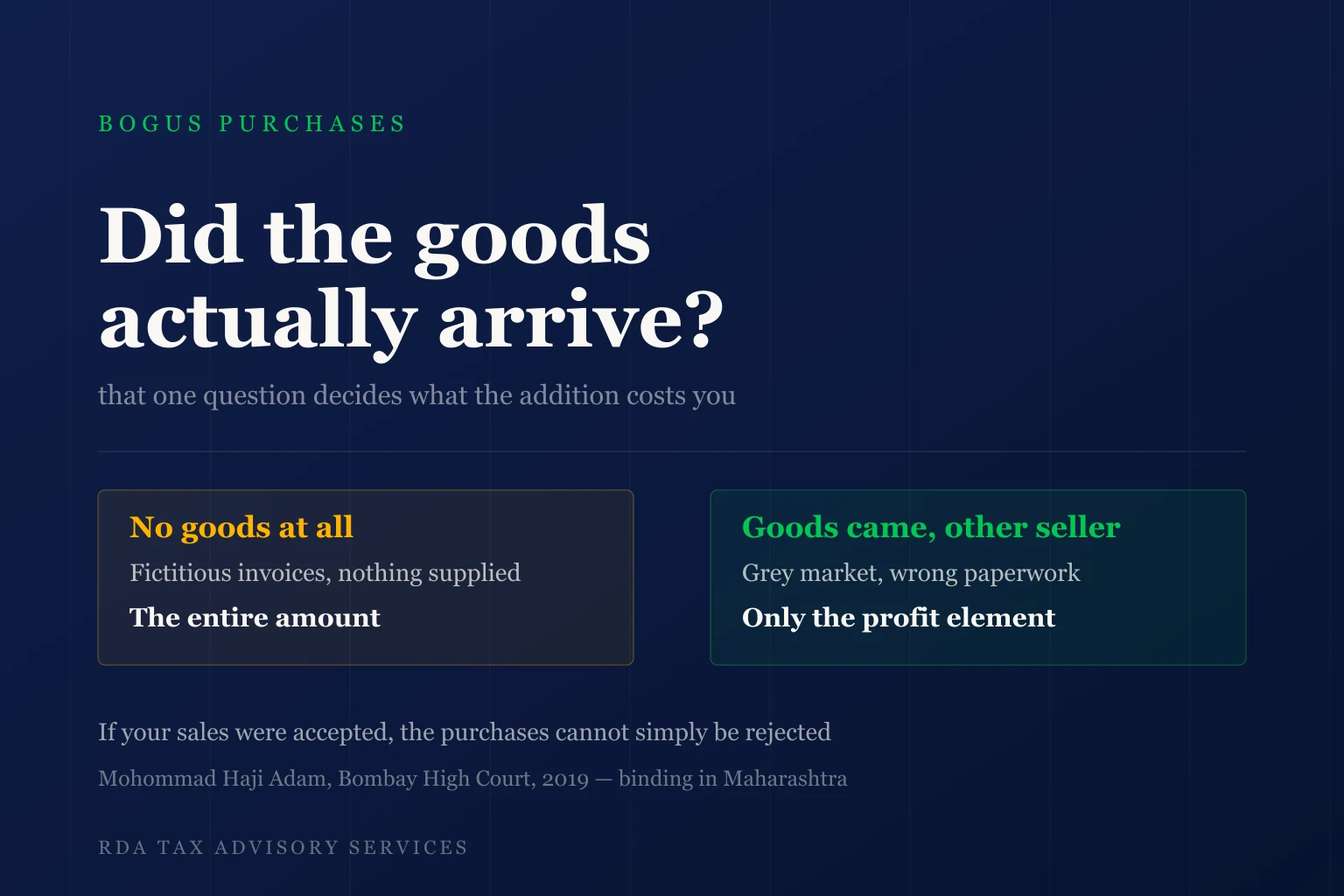
The answer turns on one question — did the goods actually arrive? If they did, but from someone other than the billed party, the Bombay High Court has held the addition is confined to the gross-profit difference. If nothing was ever supplied, the entire amount can go in. The distinction, the binding authority, and what the Supreme Court orders really say.
CA Rahul Dang
Founder & Practice Lead
A notice lands saying your purchases from a named supplier were bogus — the supplier was surveyed, someone gave a statement that they only issued bills, and the Assessing Officer proposes to add the entire purchase value to your income.
The question that decides what this costs you is not whether the supplier was genuine. It is a different question altogether, and the High Courts have been clear about it for over a decade.
The question that actually decides it
The Gujarat High Court put it in one sentence in CIT v. Simit P. Sheth. The vital question, the Court said at paragraph 5, is:
“whether the purchases themselves were completely bogus and non-existent or that the purchases were actually made but not from the parties from whom it was claimed to have been made and instead may have been purchased from grey market without proper billing or documentation.”
Two situations, two completely different outcomes:
What the facts show
What can be added
No goods at all. Fictitious invoices, nothing ever supplied
The entire purchase amount
Goods did arrive, but from someone else. Bought in the grey market, billed through an accommodation provider
Only the profit element embedded in those purchases
Most real cases are the second kind. The business physically received the material, used it, and sold the finished goods. What was wrong was the paperwork, not the existence of the goods.
The authority that binds a Pune assessee
Principal Commissioner of Income-tax-17 v. Mohommad Haji Adam & Co., High Court of Bombay, Colabawalla and Akil Kureshi JJ, Income-tax Appeal Nos. 1004, 1012, 1013, 1059, 1064, 1075, 1095 and 1204 of 2016, decided 11 February 2019.
The assessee was a fabric trader. During survey operations the department found that three entities — M/s Manoj Mills, M/s Astha Silk Industries and M/s Shri Ram Sales & Synthetics — were supplying only bogus bills. The Assessing Officer added the whole of the ₹29.41 lakh of purchases.
The Court accepted that the purchases were bogus. At paragraph 8 it said so expressly: “This being a finding of fact, we have proceeded on such basis.” And it still refused the full addition. The reasoning, in the same paragraph:
“the department had not disputed the assessee’s sales. There was no discrepancy between the purchases shown by the assessee and the sales declared. That being the position, the Tribunal was correct in coming to the conclusion that the purchases cannot be rejected without disturbing the sales in case of a trader. The Tribunal, therefore, correctly restricted the additions limited to the extent of bringing the G.P. rate on purchases at the same rate of other genuine purchases.”
The appeals were dismissed. No question of law arose.
This is a decision of the jurisdictional High Court for Maharashtra, which makes it binding on income-tax authorities and tribunals here. For a Pune business facing this allegation, it is the first authority to put in front of the officer.
And the Tribunal’s ad hoc 10% did not survive either
Worth noting what else happened. The Commissioner (Appeals) had kept 10% of the purchase amount as an addition in addition to the gross-profit difference. The Tribunal deleted that 10%, because the Commissioner had given no reasons for it, and the High Court left that deletion undisturbed. A round-number addition with no reasoning behind it is vulnerable.
When the whole amount can be added
The revenue in Mohommad Haji Adam relied on N.K. Industries Ltd. v. Deputy Commissioner of Income-tax, High Court of Gujarat, Jhaveri and Udhwani JJ, Tax Appeal Nos. 240 to 242, 260 and 261 of 2003, decided 20 June 2016. That case went the other way on the main point.
There, a search had turned up blank signed cheque books, blank bill books, letterheads and vouchers of the supplier concerns at the assessee’s own premises. The Tribunal had restricted the addition to 25%. The High Court refused to allow that, at paragraph 6:
“taxing only 25% of these bogus claim goes against the principles of Sections 68 and 69C of the Income Tax Act. The entire purchases shown on the basis of fictitious invoices have been debited in the trading account since the transaction has been found to be bogus … it was not incumbent on it to restrict the disallowance to only ₹73,23,322.”
So a 100% addition is available — but look at what those facts were. Fictitious invoices, with the instruments of the fiction found in the assessee’s own office.
The Bombay High Court dealt with this head-on. At paragraph 8 of Mohommad Haji Adam: “The decision of the Gujarat High Court in the case of N.K. Industries Ltd. (supra) cannot be applied without reference to the facts.” It is distinguished, not doubted.
The Gujarat High Court had itself drawn the same line three years earlier, in Simit P. Sheth at paragraph 8: “If the entire purchases were wholly bogus and there was a finding of fact on record that no purchases were made at all, counsel for the Revenue would be justified in arguing that the entire amount … should be added back.”
Your strongest point is usually your own sales
Across all three judgments the same lever appears, and it is one most taxpayers already have.
In Simit P. Sheth, a steel trader, the point was put to the Commissioner (Appeals) simply: once a sale of a given quantity of steel is accepted, a matching quantity must have been purchased from somewhere. The Court agreed at paragraph 6 — when the total sale is accepted, the officer “could not have questioned the very basis of the purchases”.
Even in N.K. Industries, on the separate addition of gross profit on recorded sales, the Court held at paragraph 8 that “the assessee cannot be punished since sale price is accepted by the revenue”, and reduced that addition accordingly.
If the department has taxed your sales, it is in difficulty saying the corresponding purchases never happened. Reconcile quantities — what came in, what went out, what remained — because that reconciliation is the argument.
So how much, in practice?
Where only the profit element goes in, the amount is an estimate, and the courts have treated it as such.
In Mohommad Haji Adam the measure was bringing the gross profit rate on the disputed purchases up to the rate on genuine purchases — a principled figure drawn from the assessee’s own books.
In Simit P. Sheth the Commissioner took 30%, the Tribunal reduced it to 12.5%, and the High Court declined to interfere. It noted the assessee’s own gross profit in the preceding year was 3.56%, and that 30% would produce a gross profit far above it.
The Court’s closing observation at paragraph 9 is the one to hold on to: “The estimation of rate of profit return must necessarily vary with the nature of business and no uniform yardstick can be adopted.” A standard 12.5% applied to your case because it appeared in a reported decision is not an estimate; it is a default.
What these judgments do not decide
This matters, and we would rather say it than let you discover it in a hearing.
None of these three decides whether an Assessing Officer may treat purchases as bogus merely because the supplier is suspicious, or appears on an investigation list. In every one of them the finding that the purchases were bogus was either accepted by the assessee or not challenged on appeal. The Bombay High Court said in terms that it proceeded on that finding as a finding of fact.
So these cases answer “how much can be added?” They do not answer “was the department entitled to reach that conclusion at all?” That second question turns on the material the officer actually holds, whether the statements relied on were put to you, and whether you were given a chance to cross-examine — and it has to be fought on its own evidence.
The Supreme Court orders are not what they look like
Several of these matters went to the Supreme Court, and the dispositions are worth reading carefully rather than counting.
PCIT v. Pramod Kumar Tekriwal, SLP (Civil) Diary No. 29300 of 2023, 18 August 2023. There was a delay of 286 days. The order, in full, is three paragraphs: the petition was “dismissed both on the ground of delay as well as on the merits”.
PCIT v. Zahira R. Khatun, SLP (Civil) Diary No. 31561 of 2024, 3 March 2025. A “gross delay of 628 days”; dismissed on delay and on merits, following an earlier order of 18 March 2024 in Pr. CIT v. Hasmukh J. Visaria — which is reproduced in the order and itself records a 606-day delay and adds “this petition has to be dismissed owing to low tax effect”.
Neither order contains any reasoning on bogus purchases. They are one-line dispositions recording delay, and in one case low tax effect. Anyone citing them to you as a Supreme Court ruling on the substantive question should be asked to read the orders aloud.
The provision being invoked, and the penalty behind it
The charge in these cases is usually section 69C, which provides that where an assessee has incurred expenditure and “offers no explanation about the source of such expenditure … or the explanation … is not, in the opinion of the Assessing Officer, satisfactory”, the amount may be deemed to be income. Its proviso adds that such deemed income shall not be allowed as a deduction under any head.
Note what section 69C is actually about: the source of the expenditure. That is not quite the same question as whether a particular supplier was genuine, and the distinction is worth preserving in a reply.
Then there is the penalty. Section 270A(9)(c) makes “claim of expenditure not substantiated by any evidence” a misreporting category, carrying 200% of the tax rather than 50%. The words to argue over are “not substantiated by any evidence” — purchases supported by delivery challans, weighbridge slips, transport documents, stock records and banking entries are not in that category even if the officer rejects the supplier. We set out the whole framework, including the bona fide explanation exception in section 270A(6)(a), in our guide to penalties under section 270A.
What to do when the notice arrives
Work out which of the two situations you are in — did the goods arrive, or not? Everything follows from this.
Reconcile quantities: purchases, consumption, sales, closing stock. If the goods came in and went out, say so with numbers.
Check whether your sales have been accepted. If they have, that is the Mohommad Haji Adam point and it is binding here.
Assemble delivery evidence, not just invoices and payments — challans, transport, weighbridge, gate records, stock registers.
Ask for the material relied on, including any statement, and ask to cross-examine. The entitlement question is separate from the quantum question.
Compute your own gross profit rate on undisputed purchases. That is the measure Mohommad Haji Adam uses, and it is usually far below a notional percentage.
Resist a round-number addition. An ad hoc percentage with no reasoning did not survive in Mohommad Haji Adam.
Treat the penalty as a separate fight under section 270A, not an automatic consequence.
Facing a bogus purchase allegation?
We handle these for businesses in Pune and across India. The work is specific: establishing whether the goods existed, building the quantity reconciliation, computing the gross profit measure from your own books, and holding the line between the quantum question and the question of whether the allegation was properly made at all.
Sources
Principal Commissioner of Income-tax-17 v. Mohommad Haji Adam & Co., High Court of Bombay, ITA Nos. 1004, 1012, 1013, 1059, 1064, 1075, 1095 and 1204 of 2016, 11 February 2019, [2019] 103 taxmann.com 459 (Bombay).
Commissioner of Income-tax v. Simit P. Sheth, High Court of Gujarat, Tax Appeal No. 553 of 2012, 16 January 2013, [2013] 38 taxmann.com 385 (Gujarat).
N.K. Industries Ltd. v. Deputy Commissioner of Income-tax, High Court of Gujarat, Tax Appeal Nos. 240 to 242, 260 and 261 of 2003, 20 June 2016, [2016] 72 taxmann.com 289 (Gujarat).
PCIT v. Pramod Kumar Tekriwal, Supreme Court, SLP (C) Diary No. 29300 of 2023, 18 August 2023, [2023] 154 taxmann.com 142 (SC).
PCIT v. Zahira R. Khatun, Supreme Court, SLP (C) Diary No. 31561 of 2024, 3 March 2025, [2025] 172 taxmann.com 473 (SC).
Income-tax Act, 1961 — section 69C and its proviso, and section 270A(9)(c), read from the Income Tax Department’s consolidated text. Official text, section by section
This guide explains how the courts have approached the quantum of an addition for bogus purchases. It is not advice on any particular notice. These judgments decide how much may be added where the purchases are found to be bogus; they do not decide whether a particular allegation was properly made, which turns on the material the officer holds and the opportunity you were given to answer it. The judgments were read from a commercial database rather than from official court copies. Take advice on the notice you actually hold.
Common questions
Frequently asked.
Can the Assessing Officer add the entire value of bogus purchases?
Only where the finding is that no purchases were made at all. In CIT v. Simit P. Sheth the Gujarat High Court said at paragraph 8 that if the entire purchases were wholly bogus and there was a finding of fact on record that no purchases were made at all, the entire amount could be added back. Where the goods did arrive but from a party other than the one billed, paragraph 7 of the same judgment confines the addition to the profit element embedded in those purchases.
What is the leading authority for a business in Maharashtra?
PCIT-17 v. Mohommad Haji Adam & Co., High Court of Bombay, decided 11 February 2019 in ITA Nos. 1004 and others of 2016. Being a decision of the jurisdictional High Court it binds income-tax authorities and tribunals in Maharashtra. The Court accepted that the purchases were bogus and still refused the full addition, restricting it to bringing the gross profit rate on the disputed purchases to the rate on genuine purchases.
Does it help that my sales were accepted?
It is usually the strongest point you have. In Mohommad Haji Adam the Court held at paragraph 8 that where the department had not disputed the sales and there was no discrepancy between purchases shown and sales declared, the purchases cannot be rejected without disturbing the sales in the case of a trader. Even in N.K. Industries, which went largely against the assessee, the Court held at paragraph 8 that the assessee cannot be punished since the sale price is accepted by the revenue.
What about N.K. Industries, where the whole amount was added?
It is distinguished, not doubted. In N.K. Industries a search had found blank signed cheque books, blank bill books, letterheads and vouchers of the supplier concerns at the assessee own premises, and the Court held at paragraph 6 that the entire purchases shown on the basis of fictitious invoices had been debited to the trading account. In Mohommad Haji Adam the Bombay High Court said that decision cannot be applied without reference to the facts.
How much is added when only the profit element goes in?
It is an estimate. Mohommad Haji Adam used the difference needed to bring the gross profit rate on the disputed purchases up to the rate on genuine purchases, taken from the assessee own books. In Simit P. Sheth the Commissioner took 30%, the Tribunal reduced it to 12.5% and the High Court declined to interfere, noting the assessee gross profit in the preceding year was 3.56%. The Court added that estimation must vary with the nature of the business and no uniform yardstick can be adopted — so 12.5% is not a default.
Can purchases be treated as bogus just because the supplier is suspicious?
These judgments do not decide that. In each of them the finding that the purchases were bogus was accepted or not challenged, and the Bombay High Court said expressly that it proceeded on that finding as a finding of fact. These cases answer how much can be added; whether the department was entitled to reach that conclusion at all is a separate question that turns on the material the officer holds, whether any statement relied on was put to you, and whether you were allowed to cross-examine.
Did the Supreme Court settle this?
No. The Supreme Court matters in this area are short dismissals of special leave petitions. In PCIT v. Pramod Kumar Tekriwal there was a delay of 286 days and the petition was dismissed both on the ground of delay and on the merits, in an order of three paragraphs. In PCIT v. Zahira R. Khatun there was a gross delay of 628 days, and the order follows an earlier order which also records low tax effect. Neither contains any reasoning on bogus purchases.
What penalty can follow a bogus purchase addition?
Section 270A(9)(c) makes claim of expenditure not substantiated by any evidence a misreporting category, carrying 200% of the tax rather than 50%. The words that matter are not substantiated by ANY evidence. Purchases supported by delivery challans, transport documents, weighbridge slips, stock records and banking entries are not in that category even if the officer rejects the named supplier. The bona fide explanation exception in section 270A(6)(a) may also apply.