11 October 2026·18 min read·Filed under Income Tax·Section 270A / Penalty / Under-reporting / Misreporting / Section 270AA / Income Tax Notice
Section 270A Penalty: When a Disallowance Becomes a Penalty, and When It Does Not
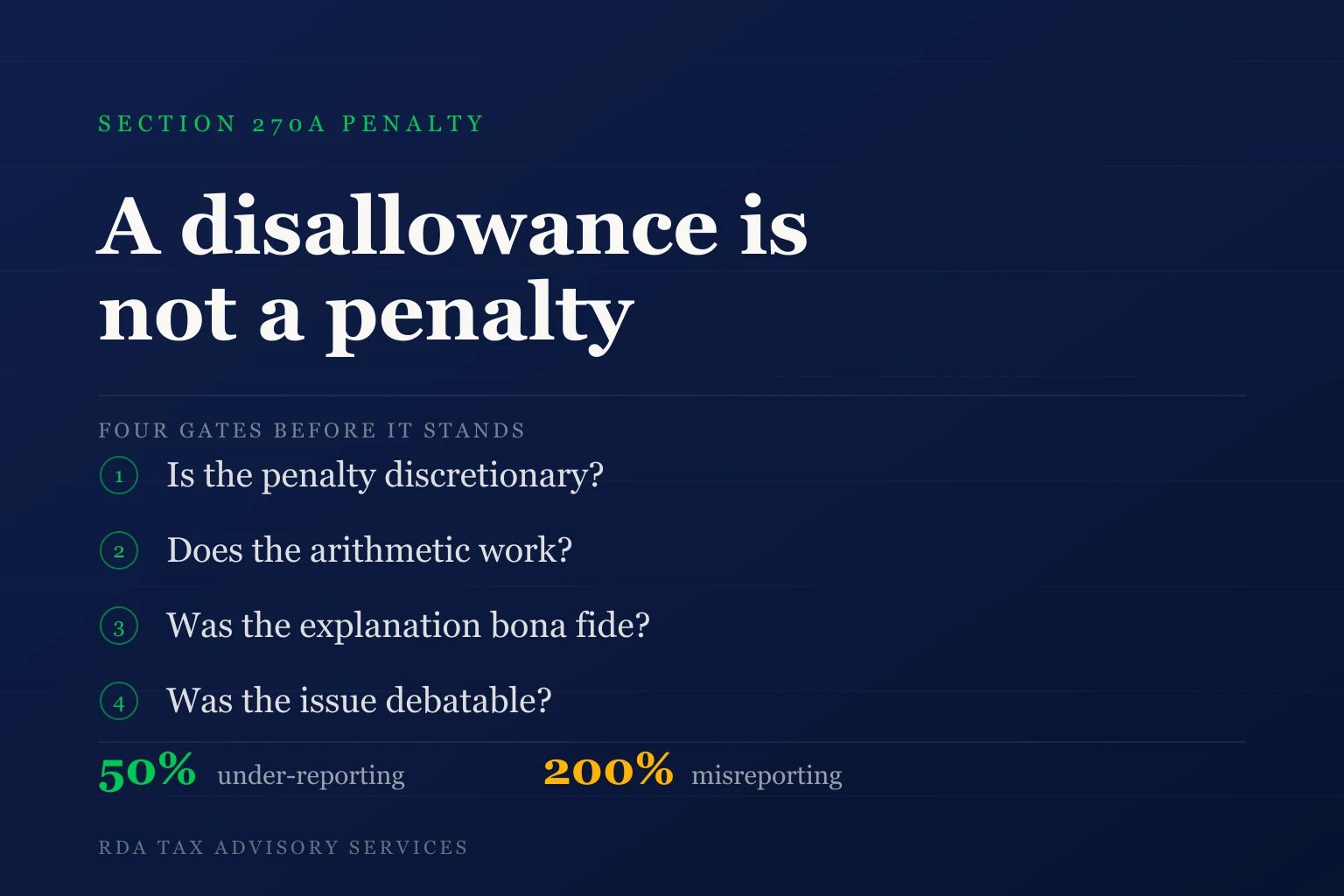
A deduction disallowed does not mean a penalty follows. Section 270A has four independent gates — and the Bombay High Court deleted a penalty in 2026 even though the taxpayer had lost the deduction outright. The statute, the four judgments, and the 2026 rewrite of the relief provision that turned an absolute bar into a price.
CA Rahul Dang
Founder & Practice Lead
An assessment order lands. A deduction you claimed has been disallowed, or an expense has been added back. At the foot of the order, one line: “Penalty proceedings u/s 270A of the Income Tax Act is initiated for under reporting of Income.”
The natural reading is that the penalty follows automatically from the addition. It does not. A disallowance and a penalty are two separate questions decided under two separate tests, and the second one has to be made out on its own.
This guide sets out the four independent gates the department has to clear before a penalty can stand on a disallowance — each one taken from the statute and from decisions of the Supreme Court and High Courts — and then the part most taxpayers get wrong: the relief provision was rewritten in 2026, and what used to be an absolute bar is now a price.
The short answer
No, a disallowance does not automatically mean a penalty. In the most instructive of the recent cases, the taxpayer lost the deduction entirely — the Supreme Court had settled the point against them — and the penalty was still deleted in full. Losing the quantum argument and owing a penalty are not the same thing.
First: which Act applies to your year
Section 536(2)(c) of the Income-tax Act, 2025 continues the repealed 1961 Act for proceedings in respect of any tax year beginning before 1 April 2026 — and penalty is named expressly in that provision, alongside assessment, reassessment and appeals.
FY 2025-26 and earlier — even where the penalty order is passed today — runs on section 270A of the 1961 Act, with relief under section 270AA.
Tax year 2026-27 onwards runs on section 439 of the 2025 Act, with relief under section 440.
Almost every penalty order in circulation right now is a section 270A order, because it relates to an earlier year. The 2025 Act provisions matter for planning, not yet for the order on your desk. We have set out the differences below, because they are not cosmetic.
Gate 1: the penalty is discretionary, not automatic
Section 270A(1) reads:
“The Assessing Officer or the Joint Commissioner (Appeals) or the Commissioner (Appeals) or the Principal Commissioner or Commissioner may, during the course of any proceedings under this Act, direct that any person who has under-reported his income shall be liable to pay a penalty in addition to tax, if any, on the under-reported income.”
The Bombay High Court in GM Modular took that word seriously. At paragraph 13: a plain reading of section 270A(1) shows the officer “may” direct a penalty, and “the use of the word ‘may’ clearly shows that the levy of penalty is discretionary and not mandatory. It is a well-settled principle of law that penalty is not an inevitable consequence in every case where an addition is made.”
That is not a new idea. The court traced it to the Supreme Court in Dilip N. Shroff, where at paragraph 37 the Court held that by reason of concealment or inaccurate particulars alone an assessee “does not ipso facto become liable for penalty. Imposition of penalty is not automatic.” And it noted the Supreme Court’s more recent statement in K. Krishnamurthy that while the officer has a discretion, “this discretionary power is not unfettered, unbridled and uncanalised. Discretion means sound discretion guided by law. It must be governed by rule, not by humour, it must not be arbitrary, vague and fanciful.”
The practical consequence: a penalty order that reasons only “an addition was made, therefore penalty” has not exercised a discretion at all. That is a ground of challenge in itself.
Gate 2: the arithmetic has to work
Before any question of bona fides arises, section 270A has a purely mechanical test. Section 270A(2)(a) provides that a person is considered to have under-reported income if:
“the income assessed is greater than the income determined in the return processed under clause (a) of sub-section (1) of section 143”
And section 270A(3)(i)(a) quantifies it as “the difference between the amount of income assessed and the amount of income determined under clause (a) of sub-section (1) of section 143”.
Note the comparator. It is not the income you returned. It is the income as determined in the section 143(1)(a) intimation — the automated processing that happens at the CPC before any officer looks at your file.
This matters more than it sounds, and GM Modular is the illustration. The facts, in order:
The company returned income of ₹70,11,00,620.
The CPC processed the return under section 143(1) and itself disallowed ₹26,72,885 for delayed payment of employees’ PF and ESI contributions under section 36(1)(va), by intimation dated 8 May 2020. Income determined: ₹70,37,73,510.
A search followed. The assessment order under section 143(3) read with section 153A merely repeated the same ₹26,72,885 disallowance.
The officer levied penalty of ₹4,67,006 on that disallowance for under-reporting.
The Court’s conclusion, at paragraph 20: because the assessment order only reiterated an addition already made in the section 143(1)(a) intimation, “the assessed income qua this specific addition does not exceed the processed income. Consequently, the mandatory ingredients for invoking a penalty for under-reporting of income under Section 270A(2) and (3) are not satisfied” — and on that ground alone, the penalty had to be deleted.
So the first thing to do with a penalty notice is arithmetic, not argument. Pull out the section 143(1) intimation. If the addition the penalty is based on was already reflected there, the trigger in section 270A(2)(a) may simply not be satisfied, whatever the merits of the disallowance.
The same comparator appears in the new Act: section 439(2)(a) of the 2025 Act measures against “the income determined in the return processed under section 270(1)(a)”, section 270(1)(a) being the successor to section 143(1)(a).
Gate 3: the bona fide explanation exception
This is the provision that decides most genuine cases. Section 270A(6)(a) takes certain amounts out of “under-reported income” altogether:
“The under-reported income, for the purposes of this section, shall not include … the amount of income in respect of which the assessee offers an explanation and the Assessing Officer … is satisfied that the explanation is bona fide and the assessee has disclosed all the material facts to substantiate the explanation offered”
Two conditions, both required: a bona fide explanation, and disclosure of all the material facts behind it. Neither on its own is enough.
In GM Modular the Court found the case “squarely covered” by this exception (paragraph 26). What satisfied it, at paragraph 27, was that the company had disclosed all material facts in its return of income and in the tax audit report, and had made the claim on a bona fide belief supported by precedent. Where that is so, the Court held, “it cannot be considered to be an under-reported income”.
The Court then applied the Supreme Court’s reasoning in Reliance Petroproducts, decided under the predecessor penalty provision, where the Court held that “a mere making of the claim, which is not sustainable in law, by itself, will not amount to furnishing inaccurate particulars”, and warned against the revenue’s logic in terms worth reading twice:
“If we accept the contention of the revenue then in case of every Return where the claim made is not accepted by Assessing Officer for any reason, the assessee will invite penalty … That is clearly not the intendment of the Legislature.”
The Bombay High Court held at paragraph 28 that although Reliance Petroproducts was decided under section 271(1)(c), “the underlying principle that a bonafide claim fully disclosed in the return does not warrant penal consequences applies with equal force to the exceptions carved out under Section 270A(6)(a)”.
What this means in practice. The disclosure point is the one you control, and you control it when you file, not when the penalty notice arrives. A deduction claimed openly, with the computation visible and the facts in the tax audit report, is in a fundamentally stronger position than the same deduction taken silently. The exception rewards having shown your working.
Gate 4: a debatable issue cannot carry a penalty
GM Modular gives this two forms, and both are useful.
A claim supported by binding precedent when you filed. The company’s PF/ESI claim was supported by a decision of its own jurisdictional High Court when the return was filed. The Supreme Court later reversed that view in Checkmate Services. The Court held at paragraph 21: “When a claim is made relying upon a binding judicial precedent, then certainly such an issue cannot invite any penal consequences, just because the view was subsequently reversed.”
This is the point to hold on to. The taxpayer in GM Modularlost the deduction — Checkmate Services is a Supreme Court decision and the disallowance stood. They still won on penalty, completely.
An issue on which courts genuinely differ. At paragraph 25 the Court held it “a settled position in law that when an issue is debatable, no penalty … can be imposed”, and found the issue debatable because different High Courts had taken different views — noting that as recently as 27 January 2026 the Supreme Court in Woodland (Aero Club) (P.) Ltd. had decided to revisit the question. The Court relied on the Punjab and Haryana High Court in Gurdaspur Co-operative Sugar Mills, where the Supreme Court dismissed the revenue’s petitions after the Additional Solicitor General “stated the correct position of law”, and on its own earlier decision in Nayan Builders & Developers.
The Karnataka High Court reached the same place by a different route in IBM Australia. The dispute was whether receipts for IT support and seconded-employee salary recoveries were taxable as fees for technical services. The Tribunal had tabulated seventeen decisions on the question; all but one favoured the taxpayer’s view. Upholding deletion of the penalty at paragraph 10, the Court held that “clearly, two views are possible”, the penalty could not be levied “as the question involved was a vexed one”, and the assessee “had laboured under the legitimate bona fide belief that the payments received were not taxable under the Act”.
Worth noting what that taxpayer had already done: they had settled the tax under the Vivad se Vishwas scheme and fought only the penalty — and won. Conceding the tax is not conceding the penalty.
Under-reporting at 50%, misreporting at 200%
The rate turns entirely on which of the two the department establishes.
Income-tax Act, 1961
Income-tax Act, 2025
Penalty provision
s.270A
s.439
Under-reporting
50% of tax on under-reported income — s.270A(7)
50% — s.439(9)
Misreporting
200% — s.270A(8)
200% — s.439(10)
Misreporting categories
Six — s.270A(9)(a) to (f)
Seven — s.439(11)(a) to (g)
Relief provision
s.270AA
s.440
The six misreporting categories under section 270A(9) are: misrepresentation or suppression of facts; failure to record investments in the books of account; claim of expenditure not substantiated by any evidence; recording of any false entry in the books of account; failure to record any receipt in the books having a bearing on total income; and failure to report an international transaction or specified domestic transaction under Chapter X.
The 2025 Act carries all six across as section 439(11)(a) to (f) and adds a seventh — clause (g), “income referred to in section 195(1)(b)”, inserted by the Finance Act, 2026 with effect from 1 April 2026.
Read the third category carefully, because it is the one that cuts. “Claim of expenditure not substantiated by any evidence” is a different thing from a claim the officer disagreed with. An expense you can document, explain and point to in your books is not in this category even if the deduction is refused. An expense with nothing at all behind it is — and then the position is genuinely serious, because section 270A(8) opens “notwithstanding anything contained in sub-section (6) or sub-section (7)”. Where misreporting is made out, the bona fide explanation exception in sub-section (6) is overridden. The same override appears in section 439(10) of the new Act.
That structure is why the label matters so much, and why the courts police it.
The order has to say which limb — and why
Two Delhi High Court decisions make the point. Both are from 2022 and both involve the same taxpayer problem: the department asserting “misreporting” without working for it.
In Schneider Electric South East Asia (HQ) Pte. Ltd. the Court held, at paragraphs 6, 7 and 10, that a penalty notice which does not specify whether the case is one of under-reporting or of misreporting is erroneous and arbitrary, and that a mere reference to “misreporting” in order to deny relief was manifestly arbitrary.
In Prem Brothers Infrastructure LLP the facts are the ones every adviser recognises. The only addition was a disallowance under section 14A. The assessee had itself disallowed ₹3.20 crore; the officer recomputed the disallowance at ₹6.82 crore — working from the very same details the assessee had furnished. At paragraphs 7 to 9 the Court held that where the assessee has furnished all the details and the two sides reach different conclusions on quantum from the same material, that is not misreporting; and that absent any indication of which limb of section 270A was attracted and how section 270A(9) was satisfied, the order was manifestly arbitrary. The penalty was quashed.
So: if the order or notice does not tell you which limb you are accused of and how it is made out, that silence is itself the point to take. It is also worth checking whether you are in fact in section 270A(6)(c) territory — the exception for a case where the assessee “has, on his own, estimated a lower amount of addition or disallowance on the same issue, has included such amount in the computation of his income and has disclosed all the facts material to the addition or disallowance”. That describes the Prem Brothers pattern precisely, and it is a statutory answer, not just a judicial one.
The 2026 change in the relief provision that most commentary has missed
Section 270AA lets an assessee apply for relief from the penalty and from prosecution. It was substituted in 2026, and the substitution reverses its most important feature.
The Department’s consolidated text records that sub-sections (1), (2), (3) and (3A) of section 270AA were substituted for the former sub-sections (1), (2) and (3) by Act No. 4 of 2026, with effect from 1 March 2026.
The position before the substitution. The old sub-section (3) directed the officer to grant immunity “where the proceedings for penalty under section 270A has not been initiated under the circumstances referred to in sub-section (9) of the said section 270A”. In other words, initiating penalty on a misreporting footing was an absolute bar to relief. That is the legal background against which Schneider Electric and Prem Brothers were decided in 2022 — and it explains why the courts were so firm. An unreasoned assertion of “misreporting” did not merely raise the rate; it shut the door on relief entirely.
The position now. Misreporting is no longer a bar. It is a price. Section 270AA(1) now requires:
(a) the tax and interest per the section 143(3) assessment or section 147 reassessment order paid within the period specified in the notice of demand;
(b) where penalty has been levied or is leviable under the misreporting circumstances in section 270A(9), additional income-tax of 100% of the tax payable on the under-reported income, paid within the demand period, “in lieu of such penalty”; and
(c) no appeal filed against the orders referred to in (a) and (b).
Put the numbers side by side. A misreporting penalty under section 270A(8) is 200% of the tax on under-reported income. The section 270AA route now costs 100%. For a taxpayer who has decided not to litigate, that is a halving of the exposure, plus immunity from prosecution under sections 276C and 276CC — and the route was simply unavailable before March 2026.
A new absolute bar replaces the old one, in sub-section (3A): no immunity or waiver where any proceeding has been initiated under Chapter XXII (the prosecution chapter).
The 2025 Act does the same thing in its section 440, substituted by the Finance Act, 2026 with effect from 1 April 2026 and now headed “Waiver of penalty and immunity from prosecution”. Its scheme is the same with one addition worth knowing: the additional income-tax is 100% for the misreporting categories in section 439(11)(a) to (f), but 120% for the new category in section 439(11)(g).
The timetable, and the trade
Your deadline is short. The application must be made within one month from the end of the month in which the order is received — section 270AA(2); section 440(2).
The officer’s clock. An order accepting or rejecting the application must be passed within three months from the end of the month of receipt — section 270AA(4); section 440(5). (That was “one month” until Act No. 7 of 2025 substituted “three months” with effect from 1 April 2025.)
You cannot be rejected unheard. No order rejecting the application may be passed without an opportunity of being heard — the proviso to section 270AA(4); section 440(6).
The decision is final — section 270AA(5); section 440(7).
And here is the trade. Once an application is accepted, no appeal under section 246 or 246A and no revision application under section 264 is admissible against the assessment or reassessment order itself — section 270AA(6); section 440(8) in the new Act. You are giving up the quantum fight, permanently, in exchange for closing out the penalty and the prosecution risk.
That is a real decision with a real cost, and it has to be made inside a month. It is not a free option, and it should not be taken on the assumption that the disallowance would have survived appeal — which, on the four cases above, is often exactly the wrong assumption.
A route most people do not know exists
There is a third path besides appeal and immunity, and GM Modular establishes it.
That taxpayer did not appeal the penalty order. It filed a revision application under section 264 before the Principal Commissioner, who rejected it summarily on the ground that the matter was not fit for revision — without giving reasons. The department argued before the High Court that section 264 cannot be invoked where the order is appealable.
The Court rejected that, at paragraphs 9 to 11. Section 264 is wide enough to cover “any order” passed by a subordinate authority, and a section 270A penalty order is an order under the Act. Section 264(4) sets out the only circumstances in which revision is barred — broadly, where an appeal is pending, or where the time to appeal has not expired and the assessee has not waived the right of appeal. Outside those, “an order, even it may be an appealable order, can be revised under Section 264”. There is “no statutory mandate compelling an Assessee to file an appeal”; the assessee has the right to choose its remedy. The Commissioner was “duty-bound to examine the merits of the penalty levied”.
The Court then went further and decided the penalty itself rather than remitting, to prevent further protraction of the litigation (paragraph 12).
The equivalent provision in the 2025 Act is section 378.
Which of these decisions actually binds your officer
This is not a technicality either. A decision that binds the assessing officer is a different instrument from one that merely persuades.
Decision
Court and date
Weight for a Pune assessee
Reliance Petroproducts, Dilip N. Shroff, K. Krishnamurthy
Supreme Court
Binding — Article 141
GM Modular (P.) Ltd.
Bombay High Court, 30 March 2026
Binding — jurisdictional High Court
Nayan Builders, Ghatge Patil Transports
Bombay High Court
Binding — jurisdictional High Court
Schneider Electric, Prem Brothers
Delhi High Court, 2022
Persuasive only
IBM Australia Ltd.
Karnataka High Court, 31 July 2025
Persuasive only
For a taxpayer assessed in Maharashtra, GM Modular is the important one — it is a decision of the jurisdictional High Court, it is recent, and it covers four separate grounds. The Delhi and Karnataka decisions are good authority and are worth citing, but an officer in Pune is not bound by them.
What these cases do not decide
Being straight about the limits is part of using them properly.
GM Modular’s “no under-reporting at all” ground depends on the addition having already been made in the section 143(1)(a) intimation. It does not help where the addition is made for the first time at assessment.
IBM Australia rests on a genuinely vexed cross-border question with a near-unanimous body of authority the taxpayer’s way, and on the tax having been settled separately. The reasoning — two possible views, so no penalty — travels. The facts do not.
Schneider Electric and Prem Brothers are writ decisions about the validity of the order and the denial of relief. They do not hold that penalty can never be levied, only that the authority must identify the limb and give reasons.
None of the four displaces section 270A(8) or section 439(10). Where misreporting is genuinely made out, 200% applies and the exceptions are expressly overridden.
In two of the four cases the taxpayer lost the underlying tax question — Checkmate Services in GM Modular, and the adverse Delhi decision in Centrica India Offshore looming over IBM Australia. That is not a weakness in the authorities. It is the whole point.
Two more provisions worth knowing
No penalty twice on the same addition. Section 270A(11) — no addition or disallowance may form the basis of a penalty if it has already formed the basis of a penalty for the same or any other assessment year. Section 439(13) of the new Act is to the same effect.
Updated returns. Section 270A(11A) provides that where additional income-tax is paid in accordance with section 140B(3A), the income on which it is paid shall not form the basis of a penalty under section 270A. The 2025 Act equivalent is section 439(13A), inserted by the Finance Act, 2026, referring to additional income-tax paid under section 267(5)(ii). If an updated return is on your mind, see our guide to belated, revised and updated returns.
What to do when a penalty notice arrives
Check the year. FY 2025-26 or earlier means section 270A and section 270AA, whatever today’s date is.
Do the arithmetic before anything else. Compare the assessed income against the income determined in the section 143(1) intimation, not against your return. If the addition was already in the intimation, the trigger may not be satisfied at all.
Find out which limb you are accused of. Under-reporting at 50%, or misreporting at 200% under a specified clause of section 270A(9)? If the notice does not say, that is a defect to raise, not a detail to overlook.
Assemble the disclosure trail. Return, computation, notes, tax audit report, correspondence. Section 270A(6)(a) turns on having disclosed all the material facts — so prove you did.
Test whether the issue was debatable when you filed. Was there a jurisdictional High Court decision, or conflicting decisions, supporting the claim at that time? A later reversal does not retrospectively make the claim penal.
Check section 270A(6)(c). If you had made your own lower estimate of the same disallowance, included it in your computation and disclosed the material facts, the statute itself may take the difference out of under-reported income.
Diarise the one-month relief deadline — one month from the end of the month of receipt — and decide deliberately between contesting and applying under section 270AA, remembering that acceptance closes off appeal and revision against the assessment itself.
Do not assume appeal is the only route. Revision under section 264 is available against a penalty order, subject only to the bars in section 264(4).
Steps 2, 3 and 7 are where most of the value is, and all three are time-sensitive. The relief window in particular is measured in weeks.
Need help with a penalty notice?
If you are holding a section 270A notice or order, the useful work is specific: establishing which Act and which limb apply, running the section 143(1) comparison, assembling the disclosure record, and deciding between contesting the penalty and applying for waiver before the one-month window closes. We do that work for taxpayers in Pune and across India.
Sources
Income-tax Act, 1961 — sections 270A and 270AA, read from the Income Tax Department’s consolidated text, pages 956 to 958, including the footnotes recording the substitution of section 270AA(1), (2), (3) and (3A) by Act No. 4 of 2026 with effect from 1 March 2026, and of “three months” for “one month” in sub-section (4) by Act No. 7 of 2025. Official text, section by section
Income-tax Act, 2025, as amended by the Finance Act, 2026 — sections 439 and 440 (Chapter XXI, Penalties), and section 536(2)(c). Official text, section by section
GM Modular (P.) Ltd. v. Principal Commissioner of Income-tax, High Court of Bombay, Writ Petition No. 378 of 2026, decided 30 March 2026, [2026] 185 taxmann.com 495 (Bombay).
Principal Commissioner of Income-tax (International Taxation) v. IBM Australia Ltd., High Court of Karnataka, IT Appeal No. 12 of 2025, decided 31 July 2025, [2025] 177 taxmann.com 543 (Karnataka).
Prem Brothers Infrastructure LLP v. National Faceless Assessment Centre, High Court of Delhi, W.P.(C) No. 7092 of 2022, decided 31 May 2022, [2022] 142 taxmann.com 38 (Delhi).
Schneider Electric South East Asia (HQ) Pte. Ltd. v. ACIT, High Court of Delhi, W.P.(C) No. 5111 of 2022, decided 28 March 2022, [2022] 145 taxmann.com 665 (Delhi).
CIT v. Reliance Petroproducts (P.) Ltd., Supreme Court, [2010] 189 Taxman 322 / 322 ITR 158 (SC); Dilip N. Shroff v. Jt. CIT, Supreme Court, [2007] 161 Taxman 218 / 291 ITR 519 (SC); K. Krishnamurthy v. Dy. CIT, Supreme Court, [2025] 171 taxmann.com 413 / 473 ITR 557 (SC) — each as quoted in the judgments above.
This guide explains the statutory tests for a penalty under section 270A and its successor, and how courts have applied them. It is not advice on any particular penalty notice. Whether a penalty can be sustained turns on the order, the year, the disclosure actually made and the material behind the addition — and the relief window is short. Take advice on the notice you actually hold.
Common questions
Frequently asked.
Does a disallowance automatically mean a penalty under section 270A?
No. Section 270A(1) says the officer "may" direct a penalty, and the Bombay High Court in GM Modular (P.) Ltd. v. PCIT (Writ Petition No. 378 of 2026, decided 30 March 2026) held at paragraph 13 that the word shows the levy is discretionary and not mandatory, and that penalty is not an inevitable consequence in every case where an addition is made. In that case the taxpayer had actually lost the deduction — the Supreme Court had settled the point against them — and the penalty was still deleted in full.
What is the difference between under-reporting and misreporting?
Under section 270A(7) the penalty for under-reporting is 50% of the tax payable on under-reported income. Under section 270A(8) it is 200% where the under-reporting is in consequence of misreporting. Section 270A(9) lists six exhaustive misreporting categories, including misrepresentation or suppression of facts and a claim of expenditure not substantiated by any evidence. The distinction matters enormously, because section 270A(8) overrides the bona fide explanation exception in sub-section (6).
What is the bona fide explanation exception in section 270A(6)(a)?
Section 270A(6)(a) excludes from under-reported income any amount where the assessee offers an explanation, the officer is satisfied the explanation is bona fide, and the assessee has disclosed all the material facts to substantiate it. Both limbs are required. In GM Modular the taxpayer satisfied it because all material facts were in the return and the tax audit report and the claim rested on a then-binding High Court decision.
Can a penalty be levied if the addition was already made in the section 143(1) intimation?
Section 270A(2)(a) measures the assessed income against the income determined in the return processed under section 143(1)(a) — not against the income you returned. In GM Modular the disallowance had already been made by the CPC in the section 143(1)(a) intimation and was only repeated at assessment, so at paragraphs 15 to 20 the Court held the assessed income did not exceed the processed income, the mandatory ingredients of section 270A(2) and (3) were not satisfied, and on that ground alone the penalty had to be deleted.
Can I get immunity from a section 270A penalty for misreporting?
Yes, and this changed in 2026. Section 270AA was substituted by Act No. 4 of 2026 with effect from 1 March 2026. Under the old sub-section (3), initiating penalty on a misreporting footing was an absolute bar to immunity. Under the current section 270AA(1)(b), a misreporting case is no longer barred — it requires additional income-tax of 100% of the tax on under-reported income, paid within the demand period, in lieu of the penalty that would otherwise be 200%. A new bar appears in sub-section (3A): no relief where any proceeding has been initiated under Chapter XXII.
How long do I have to apply for relief under section 270AA?
One month from the end of the month in which the assessment or reassessment order is received — section 270AA(2). The Assessing Officer must then pass an order accepting or rejecting the application within three months from the end of the month of receipt, and cannot reject it without giving an opportunity of being heard. Be deliberate about it: once an application is accepted, section 270AA(6) bars any appeal under section 246 or 246A and any revision under section 264 against the assessment order itself.
Which Act applies to my penalty — the 1961 Act or the 2025 Act?
Section 536(2)(c) of the Income-tax Act, 2025 continues the 1961 Act for proceedings, and penalty is named expressly, in respect of any tax year beginning before 1 April 2026. So FY 2025-26 and earlier run on sections 270A and 270AA even where the penalty order is passed today. Tax year 2026-27 onwards runs on sections 439 and 440 of the 2025 Act.
Does section 439 of the new Act differ from section 270A?
The structure carries across — 50% for under-reporting under section 439(9), 200% for misreporting under section 439(10), and the same exceptions in section 439(8). Two differences matter. Section 439(11) has seven misreporting categories rather than six: clause (g), income referred to in section 195(1)(b), was inserted by the Finance Act, 2026 with effect from 1 April 2026. And under section 440, the additional income-tax for waiver is 100% for categories (a) to (f) but 120% for the new clause (g).
Can I file a revision instead of an appeal against a penalty order?
Yes. In GM Modular the Bombay High Court held at paragraphs 9 to 11 that section 264 is wide enough to cover any order, including a section 270A penalty order, that section 264(4) sets out the only circumstances in which revision is barred, and that there is no statutory mandate compelling an assessee to file an appeal — the assessee may choose its remedy. The Commissioner was duty-bound to examine the merits of the penalty. The equivalent in the 2025 Act is section 378.