11 October 2026·7 min read·Filed under Income Tax·TDS / Section 201 / Section 234E / Section 271H / TDS Default / Compliance
TDS Defaults: Interest, Fee, Penalty and Disallowance — and the Escape Most Deductors Miss
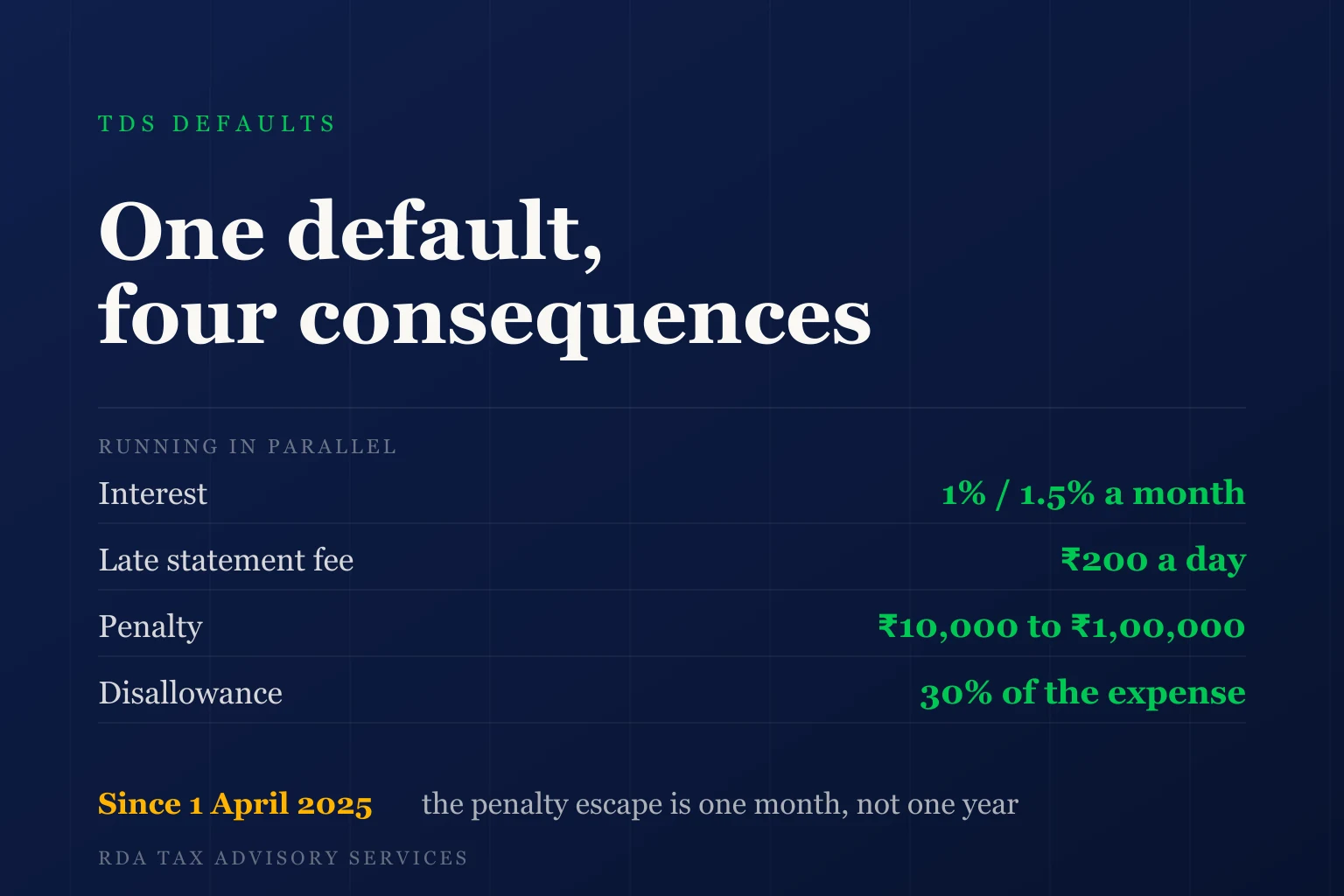
A TDS default is four consequences running in parallel, not one. Interest at 1% and 1.5%, a fee of ₹200 a day, a penalty up to ₹1,00,000 and disallowance of 30% of the expense — plus the payee-paid escape that closes off three of them, and the safe harbour that shrank from a year to a month in 2025.
CA Rahul Dang
Founder & Practice Lead
A TDS default is rarely one consequence. It is up to four, running in parallel, each under a different section and each on its own clock: interest, a late-filing fee, a penalty, and disallowance of the expense itself.
Most of them are avoidable even after the default has happened — but one of the exits was quietly narrowed from a year to a month in 2025, and that is the change worth knowing first.
The change most deductors have missed
Section 271H(3) of the 1961 Act provides a complete escape from the statement-filing penalty. If you pay the tax, the fee and the interest, and then deliver the statement within a window, no penalty is levied at all.
That window used to be one year. It is now one month. The word “year” was substituted by “month” by Act No. 15 of 2024, with effect from 1 April 2025.
So a deductor who files a quarterly statement three months late used to be comfortably inside the safe harbour and now is not. The penalty that becomes available in that situation is not less than ₹10,000 and may extend to ₹1,00,000.
The four consequences, separately
1. Interest — two different rates, and they are not the same thing
Section 201(1A) of the 1961 Act, and section 398(3)(a) of the 2025 Act, both charge simple interest at two rates:
Default
Rate
Running from → to
Failed to deduct
1% per month or part
date the tax was deductible → date it is actually deducted
Deducted but not paid
1.5% per month or part
date it was deducted → date it is actually paid
The higher rate attaches to holding on to money already deducted — money that was never yours. That is deliberate, and it is why the gap between deducting and depositing is the expensive one.
Note “or part of a month”. A single day into a new month is a whole month’s interest. Depositing on the 8th rather than the 7th can cost a full month.
Both Acts also require the interest to be paid before the statement is furnished — section 201(1A) and section 398(3)(b). Filing the statement without first paying the interest leaves the default open.
2. The late-filing fee — ₹200 a day, but capped
Section 234E of the 1961 Act, and section 427(1) of the 2025 Act, impose a fee of ₹200 for every day the failure to deliver the statement continues.
Two features matter, and both are in the taxpayer’s favour:
It is capped at the amount of tax deductible or collectible — section 234E(2), section 427(2)(a). The fee can never exceed the TDS in the statement. A statement carrying ₹9,000 of TDS cannot attract more than ₹9,000 of fee however late it is.
It must be paid before the statement is delivered — section 234E(3), section 427(2)(b). This is not optional sequencing; it is how the statement gets accepted.
Because it is a fee rather than a penalty, it is not discretionary and the reasonable-cause provisions do not reach it. The fee runs from day one.
3. The penalty — and the exit from it
Under the 1961 Act, section 271H allows the officer to direct a penalty where a person either fails to deliver the statement in time or furnishes incorrect information in it. The amount is not less than ₹10,000, extending to ₹1,00,000.
The exit, in section 271H(3), applies only to the late filing limb — not to incorrect information. No penalty is levied for late filing if the person proves that, after paying the tax along with the fee and interest, the statement was delivered before the expiry of one month from the prescribed time.
Read the conditions carefully, because they are cumulative. The tax, the fee and the interest must all be paid, and only then does delivering the statement inside the month close the penalty off.
And section 273B lists section 271H, so even outside that window reasonable cause remains a defence.
The position under the 2025 Act is differently shaped. Section 468(1) provides that a person who fails to comply with section 397 may be subject to a penalty of ₹10,000 — a flat figure, not a range running to a lakh. Section 468(2) adds the same ₹10,000 where a false TAN is quoted knowingly. Section 470 lists section 468, so reasonable cause is available. As drafted, section 468 does not carry a provision corresponding to the section 271H(3) safe harbour — which, given the much lower ceiling, matters considerably less.
4. Disallowance — the expensive one
This is the consequence that usually dwarfs the other three, and it is the one people forget.
Section 40(a)(ia) of the 1961 Act disallows 30% of any sum payable to a resident on which tax was deductible under Chapter XVII-B and which was either not deducted, or deducted but not paid on or before the due date under section 139(1).
On ₹20 lakh of contractor payments, that is ₹6 lakh added to taxable income — an order of magnitude beyond the fee and the penalty combined.
It is not permanent. The first proviso allows the 30% as a deduction in the year in which the tax is eventually paid. So the expense is deferred rather than lost — but it is deferred into a year where it may be worth less, and the cash cost of the extra tax lands now.
The escape most people do not use: the payee already paid
This one is worth knowing in detail, because it closes off the interest, the default status and the disallowance in a single move.
Under the first proviso to section 201(1) of the 1961 Act — and section 398(2) of the 2025 Act — a person who failed to deduct is not deemed to be an assessee in default if the payee:
has furnished a return of income;
has taken that sum into account in computing the income in that return; and
has paid the tax due on the income declared,
and the deductor furnishes a certificate to that effect from an accountant in the prescribed form.
All four limbs are required, including the accountant’s certificate. Many deductors satisfy the first three in substance and never obtain the certificate, which is the limb that actually delivers the protection.
What it achieves:
You are not an assessee in default, so the tax itself is not recovered from you again.
The 1% interest stops at the date the payee filed their return rather than running to the date you deduct — proviso to section 201(1A); section 398(3)(c).
The second proviso to section 40(a)(ia) engages, addressing the disallowance.
This is the first thing to test whenever a short-deduction notice arrives on payments to established, return-filing vendors. Very often the tax has already reached the government once.
How long the department has
An order treating you as an assessee in default for failure to deduct cannot be made after the later of:
six years from the end of the financial year in which the payment was made or credit given — or, under the 2025 Act, from the end of the tax year in which the tax was deductible or collectible; and
two years from the end of the year in which a correction statement is delivered.
Section 201(3) and section 398(5). Note the second limb: filing a correction statement restarts a two-year clock. That is worth weighing before filing corrections on old quarters.
Everything side by side
Consequence
Income-tax Act, 1961
Income-tax Act, 2025
Interest — not deducted
1% p.m. — s.201(1A)(i)
1% p.m. — s.398(3)(a)(i)
Interest — deducted, not paid
1.5% p.m. — s.201(1A)(ii)
1.5% p.m. — s.398(3)(a)(ii)
Late statement fee
₹200/day, capped — s.234E
₹200/day, capped — s.427(1),(2)
Statement penalty
₹10,000 to ₹1,00,000 — s.271H
₹10,000 — s.468(1)
Safe harbour
one month — s.271H(3)
no corresponding provision in s.468
Reasonable cause
Yes — s.273B
Yes — s.470 lists s.468
Payee-paid escape
first proviso to s.201(1)
s.398(2)
Outer limit for an order
6 years / 2 years — s.201(3)
6 years / 2 years — s.398(5)
Which Act applies turns on the year, not today’s date: section 536(2)(c) of the 2025 Act continues the 1961 Act for tax years beginning before 1 April 2026. Every default currently under examination is almost certainly a 1961 Act default.
What to do when a default surfaces
Separate the two interest periods. Work out what was never deducted (1%) and what was deducted but held (1.5%). They run on different clocks and the second is the one that compounds badly.
Test the payee-paid escape first, before paying anything. If the vendor filed and paid, the exposure changes completely — and get the accountant’s certificate, which is the limb that actually works.
Pay tax, fee and interest together, then file. Both the fee and the interest must be paid before the statement is delivered, and the penalty exit requires all three to have been paid.
If a statement is late, count the month. Under the 1961 Act that one-month window is the difference between no penalty and up to ₹1,00,000.
Check the disallowance exposure alongside everything else. On any material payment it will be the largest number on the page.
Think before filing a correction statement on an old quarter — it starts a fresh two-year window for a default order.
We handle TDS defaults, short-deduction notices and correction filings for businesses in Pune and across India. The useful work is usually quick and specific: computing the two interest periods correctly, testing whether the payee has already paid and obtaining the certificate if so, and sequencing the payment and filing so the penalty exit is actually available. If a notice has arrived, the month matters.
Sources
Income-tax Act, 1961 — sections 201 with its provisos, 234E, 271H with the amendment footnote recording the substitution of “month” for “year” by Act No. 15 of 2024 w.e.f. 1 April 2025, 273B, and 40(a)(ia) with its provisos. Official text, section by section
Income-tax Act, 2025, as amended by the Finance Act, 2026 — sections 398, 427, 468, 470 and 536(2)(c). Official text, section by section
This guide explains the statutory consequences of a TDS or TCS default. It is not advice on any particular default. Quarterly statement due dates and form numbers are prescribed by rules rather than by the Act and are deliberately not stated here — check the rules applicable to your year. Take advice on your own position.
Common questions
Frequently asked.
What is the interest on late TDS payment?
Two different rates. Simple interest at 1% for every month or part of a month where tax was not deducted, running from the date it was deductible to the date it is deducted; and 1.5% for every month or part where tax was deducted but not paid, running from the date of deduction to the date of actual payment — section 201(1A) of the 1961 Act and section 398(3)(a) of the 2025 Act. Because it is charged per month or part of a month, one day into a new month costs a full month.
What is the late fee for filing a TDS return late?
₹200 for every day the failure continues — section 234E of the 1961 Act, section 427(1) of the 2025 Act. It is capped at the amount of tax deductible or collectible, so the fee can never exceed the TDS in that statement, and it must be paid before the statement is delivered. Being a fee rather than a penalty, it is not discretionary and reasonable cause does not apply to it.
What is the penalty for not filing a TDS statement?
Under section 271H of the 1961 Act, not less than ₹10,000 and up to ₹1,00,000, for either failing to deliver the statement in time or furnishing incorrect information in it. Under section 468(1) of the 2025 Act the figure is a flat ₹10,000. Reasonable cause is a defence under both — section 273B lists section 271H, and section 470 lists section 468.
Is there a way to avoid the section 271H penalty?
Yes, for the late-filing limb only. Section 271H(3) provides that no penalty is levied if the person proves that, after paying the tax deducted or collected along with the fee and interest, the statement was delivered before the expiry of one month from the prescribed time. Note that this window was ONE YEAR until Act No. 15 of 2024 substituted month for year with effect from 1 April 2025. The conditions are cumulative: tax, fee and interest must all be paid.
Can an expense be disallowed for not deducting TDS?
Yes. Section 40(a)(ia) of the 1961 Act disallows 30% of any sum payable to a resident on which tax was deductible and was not deducted, or was deducted but not paid on or before the due date under section 139(1). On ₹20 lakh of payments that is ₹6 lakh added to taxable income. It is deferred rather than lost — the first proviso allows the 30% as a deduction in the year the tax is eventually paid.
What if the vendor has already paid tax on the income?
Then you may not be an assessee in default at all. The first proviso to section 201(1), and section 398(2) of the 2025 Act, provide that a person who failed to deduct is not deemed to be in default if the payee has furnished a return of income, taken the sum into account in computing income in that return and paid the tax due — AND the deductor furnishes a certificate to that effect from an accountant in the prescribed form. The certificate is the limb most people miss. It also stops the 1% interest at the date the payee filed, and engages the second proviso to section 40(a)(ia).
How long can the department raise a TDS default?
An order deeming a person to be an assessee in default for failure to deduct cannot be made after the later of six years from the end of the year in which the payment was made or credit given, and two years from the end of the year in which a correction statement is delivered — section 201(3) of the 1961 Act, section 398(5) of the 2025 Act. Note the second limb: filing a correction statement on an old quarter starts a fresh two-year window.
Which Act applies to my TDS default?
Section 536(2)(c) of the Income-tax Act, 2025 continues the 1961 Act for proceedings in respect of any tax year beginning before 1 April 2026. Any default currently under examination almost certainly runs on the 1961 Act — sections 201, 234E, 271H and 40(a)(ia) — whatever the date of the notice.