11 October 2026·7 min read·Filed under Income Tax·Books of Account / Section 44AA / Section 62 / Bookkeeping / Freelancers
Books of Account: Who Must Keep Them, and the 2026 Change That Catches IT Consultants
Specified professions must maintain books from the first rupee, with no turnover threshold at all — and from tax year 2026-27 the Income-tax Act, 2025 adds information technology and company secretary to that list. The thresholds for everyone else, the three-year look-back most people miss, and what it costs to have nothing on file.
CA Rahul Dang
Founder & Practice Lead
Most people assume that keeping books of account is something that kicks in once a business gets big enough. For a large group of professionals, that has never been true — the obligation applies from the first rupee, with no threshold at all.
And from 1 April 2026 that group gets larger. The Income-tax Act, 2025 adds information technology and company secretary to the list of professions that must maintain books regardless of turnover. For Pune’s very large population of independent IT consultants, that is a change worth knowing about before it applies rather than after.
Two different rules, depending on what you do
Both Acts split the obligation in two. There is a list of specified professions, which must keep books whatever they earn. And there is everyone else, who must keep books only once certain financial thresholds are crossed.
If you are in a specified profession: no threshold
Section 44AA(1) of the 1961 Act requires every person carrying on a listed profession to “keep and maintain such books of account and other documents as may enable the Assessing Officer to compute his total income”. There is no turnover figure and no income figure in that sub-section. The obligation is absolute.
Specified profession
s.44AA(1), 1961 Act
s.62(4), 2025 Act
Legal
Yes
Yes
Medical
Yes
Yes
Engineering
Yes
Yes
Architectural
Yes
Yes
Accountancy
Yes
Yes
Technical consultancy
Yes
Yes
Interior decoration
Yes
Yes
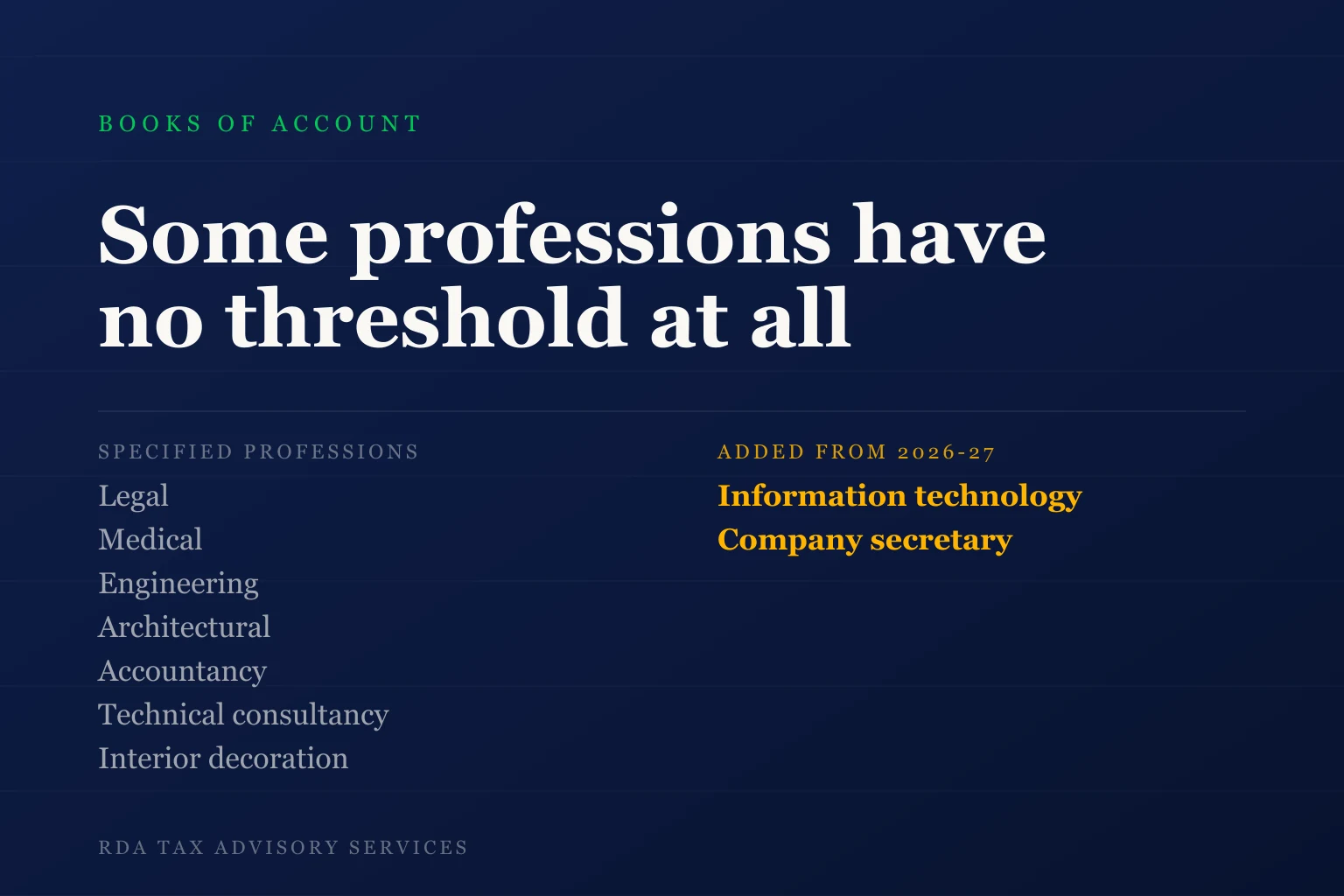
Information technology
—
Yes — new
Company secretary
—
Yes — new
Any other profession notified by the Board
Yes
Yes
Section 62(4) of the 2025 Act defines “specified profession” as “legal, medical, engineering, architectural, accountancy, technical consultancy, interior decoration, information technology or company secretary”, or any other profession notified by the Board.
The practical effect for an IT consultant. An independent software developer or IT consultant billing ₹18 lakh a year is, under the old Act, outside the specified-profession list and subject only to the general thresholds. From tax year 2026-27 they are inside the list, and the threshold question stops being relevant — books must be kept either way.
Two qualifications worth being honest about. First, “information technology” is not further defined in the section, so exactly which activities fall inside it is a question that will be worked out in practice. Second, many IT consultants were already arguably covered as “technical consultancy”; what the new entry removes is the argument, not necessarily the obligation. Either way, from 2026-27 the safe assumption for anyone selling IT services is that books are required.
If you are not: the thresholds
For everyone else carrying on a business or a non-specified profession, section 44AA(2) of the 1961 Act and section 62(2) of the 2025 Act impose the obligation where any of the following applies:
Income from business or profession
Sales, turnover or gross receipts
General
exceeds ₹1,20,000
exceeds ₹10 lakh
Individual or HUF
exceeds ₹2,50,000
exceeds ₹25 lakh
Under the 1961 Act the higher individual and HUF figures come from the two provisos to section 44AA(2); under the 2025 Act they are in section 62(2)(d). Either limb will do — income or turnover. You do not need to cross both.
The three-year look-back — the bit that surprises people
This is the detail most often missed. The test is not whether you crossed the threshold this year. Both Acts apply it where the threshold was crossed “in any one of the three years immediately preceding” the year in question.
So a consultant who had one strong year, then two quiet ones, is still required to maintain books in the quiet years. The obligation is sticky in a way a single-year test would not be. If you crossed the line in any of the last three years, you are in.
For a business or profession newly set up, the test is forward-looking instead: whether income or turnover is likely to exceed the thresholds during that year — section 44AA(2)(ii), section 62(2)(b).
Declaring below the presumptive rate
There is a third route in, unconnected to size. If you are within the presumptive scheme and declare profits lower than the deemed rate, books become mandatory.
Under the 1961 Act that appears in section 44AA(2)(iii), covering sections 44AE, 44BB and 44BBB, and in section 44AA(2)(iv) for cases where section 44AD(4) applies and income exceeds the maximum amount not chargeable to income-tax. Under the 2025 Act the equivalent is section 62(2)(c), by reference to sections 58(2) and 61(2).
This sits alongside the parallel rule for tax audit, which is triggered in much the same circumstances. If you are weighing whether to declare below the presumptive rate, both obligations arrive together — see our guides to section 44AD and section 44ADA, and to tax audit under section 44AB.
What “books of account” actually means
The statutory standard is functional rather than prescriptive. Both Acts require books and other documents “to enable the Assessing Officer to compute his total income”. That is the test: not whether the records look professional, but whether someone else could arrive at your taxable income from them.
Beyond that, the Board is empowered by rules to prescribe the books and documents to be kept, including inventories where necessary, the particulars they must contain, the form and manner and the place at which they are kept, and the period for which they must be retained — section 44AA(3) and (4), and section 62(3). Those specifics live in the rules rather than in the Act, so check the rules applicable to your year; this guide does not state them.
What it costs to not keep them
Under the 1961 Act, section 271A provides that where a person fails to keep and maintain books as required by section 44AA or the rules, or fails to retain them for the period specified in the rules, the officer may direct payment, by way of penalty, of ₹25,000. Note that it opens “without prejudice to the provisions of section 270A or section 271” — this penalty sits on top of any under-reporting penalty, it does not replace it.
The 2025 Act keeps the same figure. Section 441 provides that a penalty of ₹25,000 may be imposed where a person fails to keep and maintain the books and other documents as per section 62 or the rules, or to retain them for the period specified in the rules.
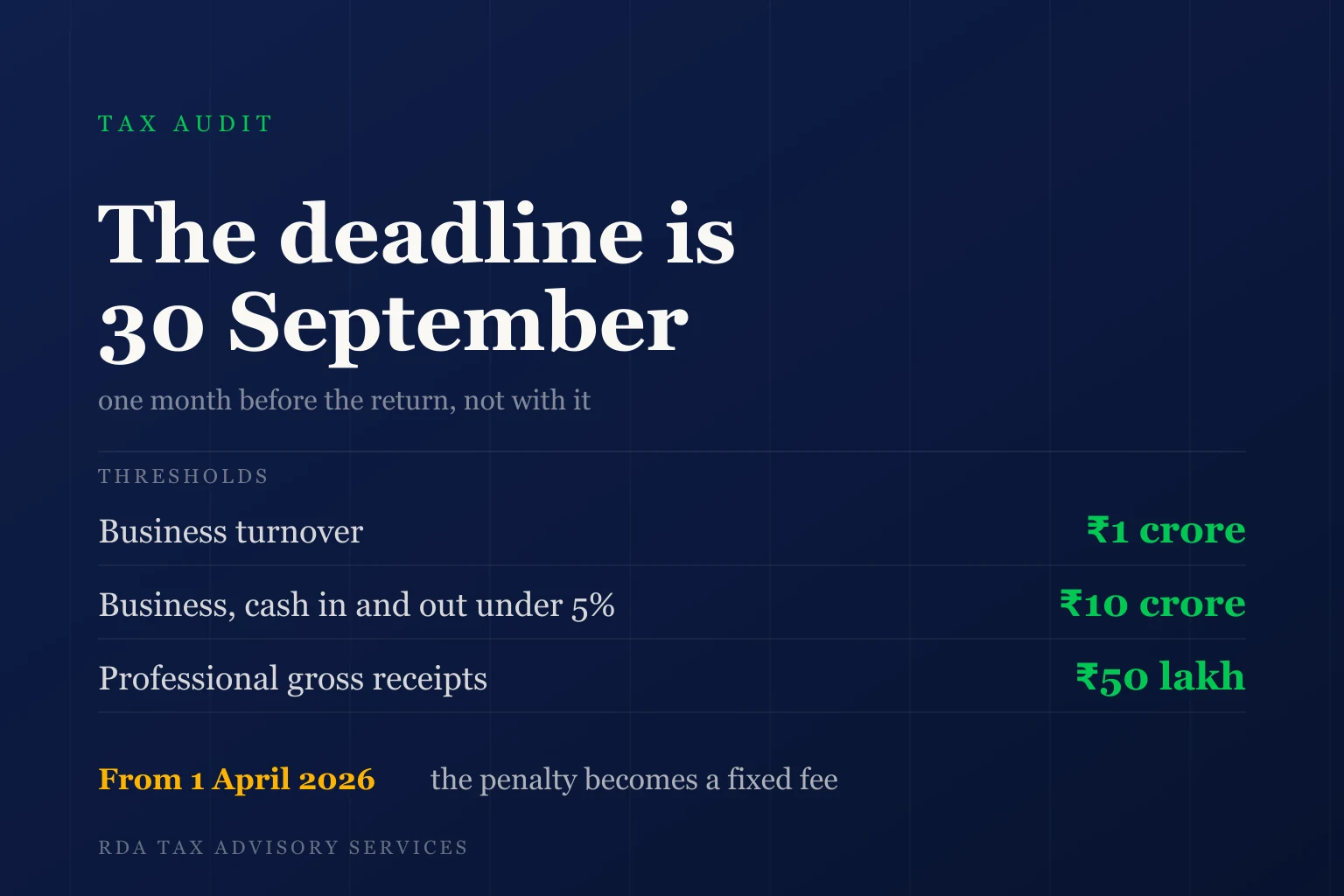
And here is a contrast worth drawing, because it is deliberate. The books penalty under section 441 remains a penalty, and section 470 expressly lists section 441 among the provisions under which no penalty is imposed if reasonable cause is proved. Compare the tax audit default, which the Finance Act, 2026 moved out of the penalty chapter entirely and turned into a fixed fee under section 428(c) — where the reasonable-cause provision does not reach. The drafters treated the two defaults differently on purpose.
Not keeping books
Not getting the tax audit done
1961 Act
s.271A — penalty ₹25,000
s.271B — penalty, lesser of 0.5% or ₹1,50,000
2025 Act
s.441 — penalty ₹25,000
s.428(c) — fee, ₹75,000 / ₹1,50,000
Reasonable cause?
Yes — s.273B / s.470
s.470 does not list s.428
The real cost of not keeping books, though, is rarely the ₹25,000. It is that without records you cannot substantiate a deduction — and an expense claimed with nothing behind it is not merely disallowed, it falls within the misreporting category of “claim of expenditure not substantiated by any evidence”, which carries a penalty at 200% rather than 50%. Books are what keep an ordinary disagreement about a deduction from becoming something much worse.
Which Act applies to your year
Section 536(2)(c) of the Income-tax Act, 2025 continues the 1961 Act for proceedings in respect of any tax year beginning before 1 April 2026. So FY 2025-26 and earlier run on section 44AA and section 271A; tax year 2026-27 onwards runs on section 62 and section 441 — including the expanded specified-profession list.
Practical checklist
Work out which side of the line you are on first. If you are in a specified profession, stop — you must keep books, and the thresholds are irrelevant.
If you sell IT services, plan for tax year 2026-27 now. From that year the threshold question falls away.
Apply the threshold test across three years, not one. Check each of the three preceding years, not just the last.
If you are newly set up, use the forward-looking test — what income or turnover is likely to be this year.
If you intend to declare below the presumptive rate, expect both books and audit obligations to follow.
Check the retention period in the rules for your year and keep the records that long. The penalty bites on failing to retain, not only on failing to create.
Keep records good enough that a stranger could compute your income from them. That is the statutory standard, and it is also the standard that protects a deduction when it is questioned.
Need help setting books up?
We do accounting and bookkeeping for professionals and businesses in Pune and across India — setting records up so they meet the statutory standard, so the tax audit can actually be completed by its deadline, and so that a deduction can be substantiated when someone asks. If you are moving into a specified profession from 2026-27, or you have crossed a threshold without noticing, it is worth looking at before the year ends rather than after.
Sources
Income-tax Act, 1961 — section 44AA with its two provisos, and section 271A, read from the Income Tax Department’s consolidated text, pages 174 and 962. Official text, section by section
Income-tax Act, 2025, as amended by the Finance Act, 2026 — section 62 including the definition of “specified profession” in sub-section (4), section 441, section 470 and section 428(c), pages 112–113, 541, 550 and 530–531. Official text, section by section
This guide explains who must maintain books of account and what the statute requires of them. It is not advice on any particular case, and it deliberately does not state the prescribed books or the retention period, both of which are fixed by rules rather than by the Act and should be checked for the year in question. Take advice on your own position.
Common questions
Frequently asked.
Who has to maintain books of account?
Two groups. Anyone carrying on a specified profession must keep books with no threshold at all — section 44AA(1) of the 1961 Act and section 62(1)(a) of the 2025 Act. Everyone else carrying on a business or a non-specified profession must do so once income exceeds ₹1,20,000 or turnover exceeds ₹10 lakh, those figures being ₹2,50,000 and ₹25 lakh for an individual or HUF.
Which professions have no threshold?
Under section 44AA(1) of the 1961 Act: legal, medical, engineering, architectural, accountancy, technical consultancy, interior decoration, and any profession notified by the Board. Section 62(4) of the 2025 Act carries all of those across and adds information technology and company secretary, with effect from tax year 2026-27.
Do IT consultants need to maintain books of account?
From tax year 2026-27, yes — section 62(4) of the Income-tax Act, 2025 includes information technology in the specified-profession list, so the turnover thresholds stop being relevant. Two caveats worth knowing: the section does not further define information technology, so the boundary of the term will be worked out in practice, and many IT consultants may already have been covered as technical consultancy under the old list.
Is the threshold tested on this year or earlier years?
Earlier years. Both Acts apply the test where income or turnover crossed the threshold in any one of the three years immediately preceding the year in question — section 44AA(2)(i) and section 62(2)(a). So one strong year followed by two quiet ones still leaves you obliged to keep books in the quiet years. For a newly set up business the test is forward-looking instead: whether income or turnover is likely to exceed the thresholds this year.
What counts as books of account?
The statutory standard is functional: books and other documents sufficient to enable the Assessing Officer to compute your total income. Beyond that the Board may prescribe by rules the actual books, the particulars they must contain, the form, manner and place of keeping them and the retention period — section 44AA(3) and (4), and section 62(3). Those specifics are in the rules rather than the Act, so check the rules applicable to your year.
What is the penalty for not keeping books of account?
₹25,000. Section 271A of the 1961 Act allows the officer to direct a penalty of ₹25,000 for failing to keep and maintain books as required by section 44AA or the rules, or for failing to retain them for the prescribed period, and it applies without prejudice to any penalty under section 270A or 271. Section 441 of the 2025 Act keeps the same figure. Reasonable cause remains a defence under section 273B and section 470 respectively.
Does declaring below the presumptive rate make books mandatory?
Yes. Section 44AA(2)(iii) covers sections 44AE, 44BB and 44BBB, and section 44AA(2)(iv) covers cases where section 44AD(4) applies and income exceeds the maximum amount not chargeable to tax. Under the 2025 Act the equivalent is section 62(2)(c), by reference to sections 58(2) and 61(2). The same decision generally triggers the tax audit obligation too, so the two arrive together.
Which Act applies to my year?
Section 536(2)(c) of the Income-tax Act, 2025 continues the 1961 Act for proceedings in respect of any tax year beginning before 1 April 2026. FY 2025-26 and earlier therefore run on section 44AA and section 271A; tax year 2026-27 onwards runs on section 62 and section 441, including the expanded specified-profession list.